In a landscape often dominated by immediate political noise, Jeffrey Kaplan offers a rare, clarifying lens on the very architecture of human certainty. By dissecting René Descartes' Meditation #1, Kaplan doesn't just summarize a 17th-century text; he exposes a radical methodology for clearing the mental slate that feels startlingly relevant to anyone navigating an era of information overload. The piece argues that true rationality requires not just filtering facts, but actively dismantling the foundational principles upon which our entire belief systems rest.
The Architecture of Doubt
Kaplan begins by establishing a crucial distinction that underpins the entire project: the difference between what is "probably true" and what is "100% guaranteed to be true." He uses the example of the speed of light to illustrate the former—a belief grounded in science and Wikipedia, yet still vulnerable to error. "Every claim that science makes seemingly goes in this category because it is possible for any scientifically based belief to be false although probably not," Kaplan notes. This framing is effective because it immediately grounds abstract philosophy in the daily reality of how we process information today. We live in a world of high-probability truths, but Kaplan suggests that for Descartes, probability is not enough for a stable foundation.
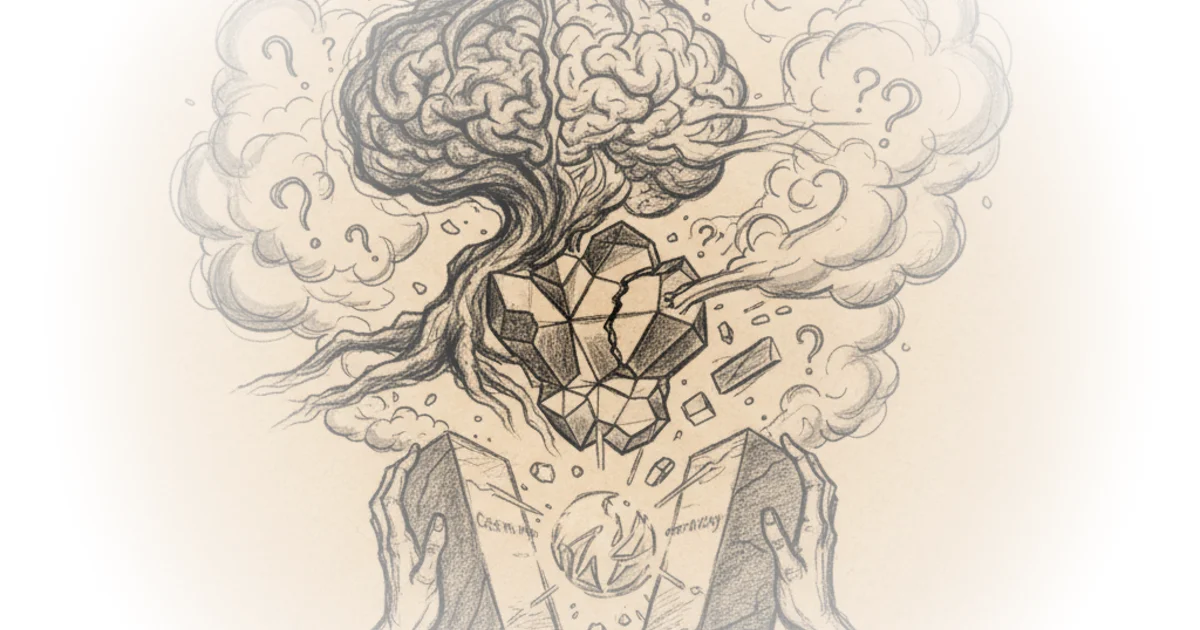
The core of the argument is Descartes' plan to "wipe out all of his beliefs" and rebuild them from scratch. Kaplan explains this not as a cynical exercise, but as a necessary demolition. "Reason now leads me to think that I should hold back my ascent from opinions which are not completely certain and indubitable just as carefully as I do from those which are patently false," Kaplan quotes from the text. This is the pivot point: treating uncertainty with the same skepticism as obvious falsehoods. The commentary highlights that this isn't about being skeptical for fun; it's about finding a bedrock that cannot be shaken.
"Once the foundations of a building are undermined, anything built on them collapses of its own accord."
Kaplan's use of the building metaphor is the piece's most vivid moment. He argues that Descartes realizes it would be an "endless task" to check every single belief individually. Instead, the philosopher targets the "basic principles" themselves. If you doubt the foundation, the entire structure falls without you having to pull out every brick. This reframes the act of doubt from a destructive force into a constructive one—a necessary step to build a "firmer house" with bricks instead of sticks.
The Senses as the First Casualty
The commentary then moves to the first target of this demolition: the senses. Kaplan identifies the first principle Descartes attacks: "Whatever I have up till now accepted as most true, I have acquired either from the senses or through the senses." It is a bold move to question the very mechanism by which we perceive reality. Kaplan writes, "But from time to time, I have found that the senses deceive, and it is prudent never to trust completely those who have deceived us even once." This logic is ruthless but compelling; if your eyes have tricked you once (mistaking a smudge for a spider), can they ever be fully trusted?
However, Kaplan also captures the nuance in Descartes' hesitation. The philosopher doesn't discard all sensory input immediately. He acknowledges that while distant or small objects are unreliable, some beliefs seem impossible to doubt, such as "that I am here sitting by the fire wearing a winter dressing gown holding this piece of paper in my hands." This moment of pushback is crucial. It shows that even the most radical skeptic must confront the immediacy of their own existence. Critics might note that this reliance on the "here and now" feels like a trap; if the senses can be deceived about a spider, why not about the fire, the gown, or the hands? Yet, Kaplan's explanation of this tension helps the reader understand why this first meditation is only the beginning of the journey, not the destination.
The Method of Doubt in Practice
What makes Kaplan's analysis particularly valuable for a busy reader is his clarity on the method. He strips away the academic jargon to reveal a simple, powerful algorithm: identify a group of beliefs, find the single principle holding them up, doubt that principle, and watch the group collapse. "Consider big groups of beliefs and doubt all the beliefs in that group at once," Kaplan summarizes. This transforms Descartes from a distant historical figure into a practical guide for critical thinking. The argument holds up well because it mirrors how we actually process information: we don't check every fact; we check the source or the underlying assumption.
The piece effectively argues that the goal of this intellectual demolition is not nihilism, but reconstruction. "He's going to slowly build back up all of his beliefs, believing new things only if he can support those new beliefs with, you know, guaranteed 100% foolproof arguments," Kaplan explains. This promise of a rebuilt, unshakeable system of knowledge is what drives the narrative forward. It suggests that the chaos of doubt is merely the construction site for a more robust truth.
Bottom Line
Jeffrey Kaplan's commentary succeeds by translating a dense philosophical text into a clear, actionable strategy for intellectual hygiene. Its strongest element is the "building" metaphor, which makes the abstract concept of foundational doubt tangible and urgent. The piece's vulnerability lies in its brevity; it sets up the demolition brilliantly but leaves the reader hanging on the reconstruction, which requires the subsequent meditations to resolve. For the busy reader, this is a perfect entry point: it proves that before you can know what is true, you must first have the courage to stop believing everything you think you know.