This piece reframes the climate crisis not as a technical problem of carbon metrics, but as a profound political failure of care. While mainstream discourse obsesses over emissions targets, Break-Down argues that our survival hinges on the often-invisible labor required to sustain life itself. The editors present a startling thesis: care is not a secondary social concern, but the central, urgent question of the climate endgame.
The Myth of Freedom and the Reality of Dependence
The commentary begins by dismantling the capitalist ideal of the autonomous individual. Drawing on political scientist Alyssa Battistoni's work, the piece interrogates the ideological pillar that equates capital with freedom. It notes that under market systems, "free" often means the absence of value assigned to essential things, from nature to the unpaid labor that sustains life. The editors highlight Marx's observation that workers are "free in the double sense": "free" to sell their labor, yet "free" or divorced from the means of production to sustain themselves. This framing is crucial because it exposes the illusion of independence that modern economies rely upon.
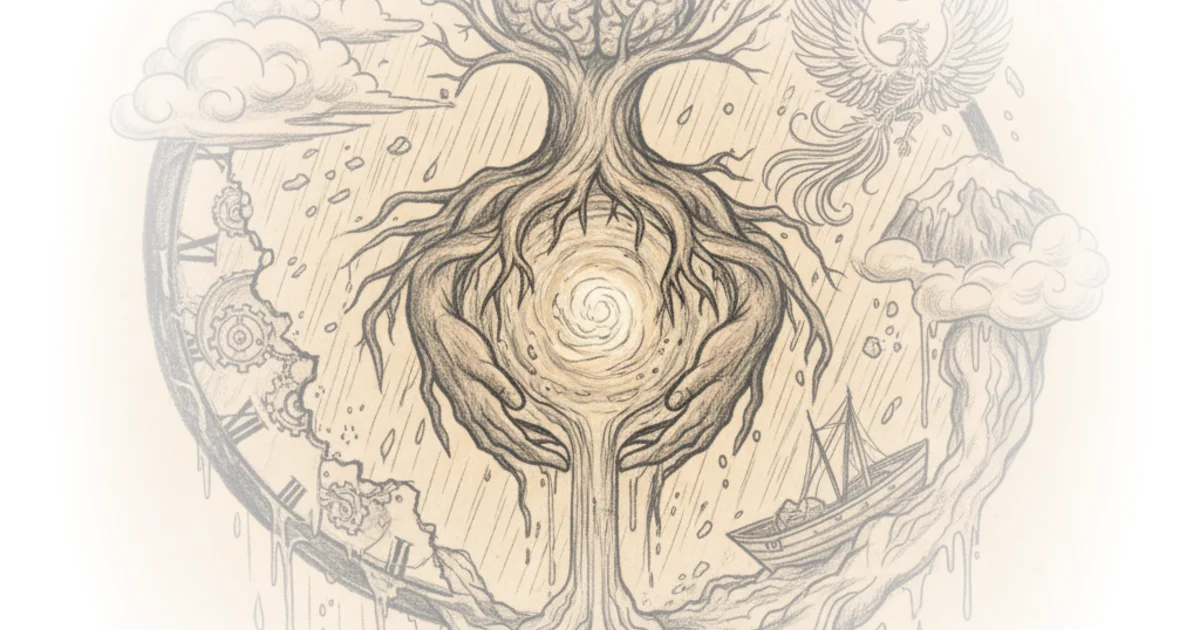
The argument shifts to the climate context, quoting Stephen Markley's novel The Deluge to describe the current era not as an apocalypse, but as a "beginning." Markley writes, "All the years of talk about the end of the world, but that's not what's happening. It's the beginning. And no one can wrap their minds around what it's the beginning of yet." Break-Down uses this to pivot away from the fantasy of a heroic, singular battle against climate change. Instead, they posit that the future will be a "chronic condition" of cascading crises. This is a sobering, necessary correction to the "Avengers style battle" narrative that often dominates climate fiction and policy.
"The concept of care is as central to the climate crisis as the concentration of carbon dioxide itself."
Care as Hard Labor, Not Soft Sentiment
The piece rigorously defines care, stripping away the romanticized notions often attached to the word. It argues that care is work—physical, manual, and mental labor that involves repetitive tasks like cooking, cleaning, and tending to the sick. The editors warn against the "fantasies and temptations" of care, such as essentializing it as a female trait or viewing it as something "soft" in opposition to the economy. Instead, they assert that "Care is not an unqualified good. It is not always about hot tea and hugs." This distinction is vital; it moves care from the realm of moral virtue to the realm of material necessity and political organization.
By connecting this to the tradition of eco-feminism and Marxist feminism, the article grounds its argument in a history of analyzing social reproduction. It points out that care work, whether paid or unpaid, is directed toward the "reproduction of life." This includes the biological maintenance of individuals and the social maintenance of communities. The piece notes that in the US, the "health care and social assistance" sector is now the largest employer, yet it exhibits a "strange resistance" to the productivity increases seen in other industries. You cannot "double the efficiency of tending to a dying patient without stripping out the very thing that makes it care." This paradox highlights a fundamental incompatibility between market logics and the needs of human life.
Critics might argue that prioritizing care in this way risks depoliticizing the structural causes of climate change, such as fossil fuel extraction. However, the piece counters that neglecting care is itself a political choice. It cites historian Gabriel Winant to show how deindustrialization has been matched by a massive, yet undervalued, growth in the care economy. The failure to recognize this labor is not an accident; it is a feature of a system that prioritizes surplus extraction over life maintenance.
Organized Abandonment and the Global Care Chain
The commentary then expands the scope to a global scale, describing the "care chains" that bind continents together. It illustrates how the crisis is not merely a local shortage of resources but a systemic displacement of responsibility. A Filipina nurse in Copenhagen or a Ghanaian elder-care worker in Berlin leaves someone behind who must find another caregiver, often unpaid. This creates a paradox where the need for care escalates even as the systems to provide it are eroded.
Break-Down introduces Ruth Wilson Gilmore's concept of "organized abandonment" to explain this dynamic. The editors argue that the deficit in care is not an unfortunate side effect but a "direct result of political and economic priorities." This resonates with the historical struggles seen in places like Lützerath, where activists fought against the expansion of lignite mines, highlighting how infrastructure decisions are often made without regard for the communities and ecosystems they displace. The piece suggests that what we are witnessing is a form of "structural carelessness," where care is centralized and controlled by the "unholy trinity of state, market and family," perpetuating inequality.
The argument is particularly sharp when it describes the "active organization of care neglect." It is not that care has disappeared; rather, it has been systematically distorted. This reframing challenges the reader to see the climate crisis not just as a failure of technology, but as a failure of social organization. The piece notes that in the UK, austerity and private equity have "hollowed out the care sector," while in Denmark, "efficiency measures" have exhausted care workers. These are not isolated incidents but symptoms of a global logic that treats life as a variable to be optimized rather than a condition to be sustained.
Bottom Line
The strongest element of this argument is its refusal to separate the climate crisis from the crisis of social reproduction; it forces the reader to confront the material reality that we cannot solve one without fixing the other. Its biggest vulnerability lies in the sheer scale of the transformation required, offering a diagnosis of the problem that is deeply compelling but leaves the specific mechanisms of political change somewhat abstract. Readers should watch for how this framework of "care" translates into concrete policy demands beyond the current discourse of carbon pricing and green technology.