Novara Media doesn't just warn that the middle class is crumbling; it argues that the very architecture of our current economic system is designed to build the scaffolding for fascism. The interview with economist Clara Mate cuts through the usual political noise to suggest that the extreme inequality we see today isn't a bug, but a feature of a system that relies on making people desperate enough to surrender their agency. For the busy listener, this is a stark reminder that the rise of the radical right isn't an anomaly, but a predictable outcome of specific economic policies that have been in motion for over a decade.
The Invisible Cage of the Capital Order
The conversation begins by dismantling the idea that the "free market" is a natural state of affairs. Mate introduces the concept of the "capital order," describing it as an invisible structure that forces most people into wage labor simply because they have no other option. "The free market is actually deeply rooted in the most unfree of all relations which is the wage labor relation," Mate explains. This framing is powerful because it shifts the blame from individual failure to systemic design. It suggests that the pressure to work for a profit-driven employer is maintained by political coercion rather than economic inevitability.
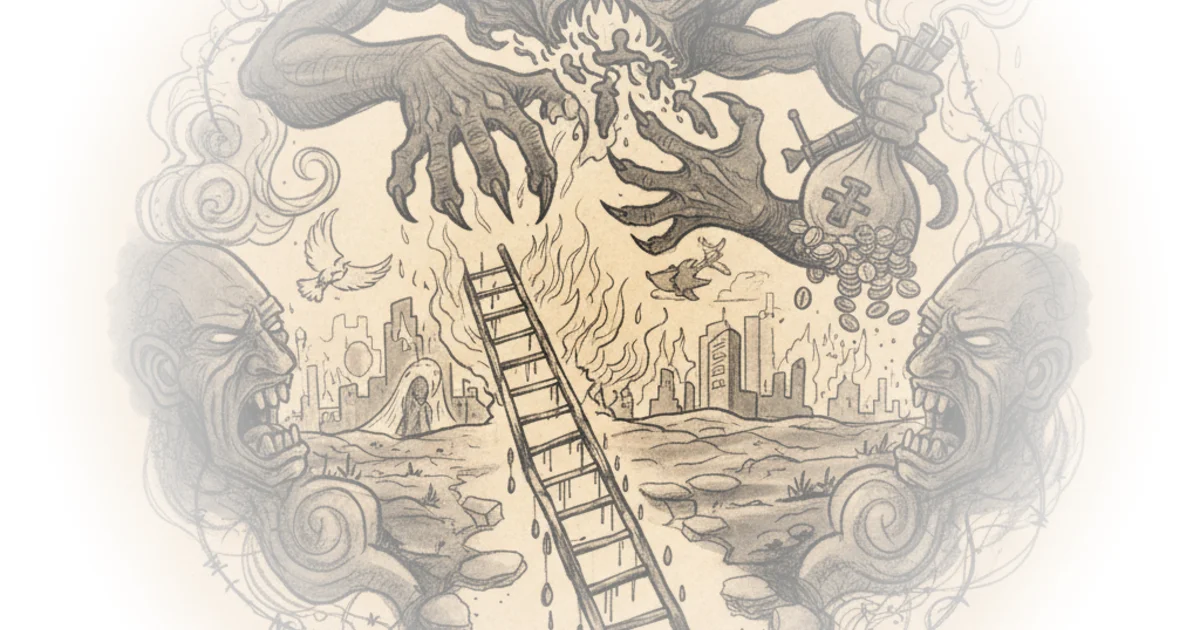
The author drives this point home by highlighting the sheer scale of current inequality, noting that "12 people own more than the bottom 50% of the global population." This statistic, drawn from Oxfam data, serves as a visceral anchor for the argument. It illustrates a world where accumulation at the top is decoupled from the well-being of the majority. Mate argues that this isn't just unfair; it is a deliberate strategy to preserve a system where "people go hungry while at the very top accumulation has never been so abundant." Critics might argue that such extreme wealth concentration is a result of innovation and risk-taking, but Mate counters that the system is constructed to ensure the majority never wins, regardless of their effort.
The system is constructed so the story we know is that if we don't do well it's probably our fault. That is a complete myth.
Austerity as the Precursor to Authoritarianism
The most compelling part of the interview connects modern economic policy to historical precedents. Mate draws a direct line from the austerity measures of the 1920s to the rise of Italian fascism. She notes that her PhD research focused on how "austerity programs and pushing down wages were the things that generated fascism." This historical parallel is crucial context. Just as Benito Mussolini rose to power in Italy after years of economic instability and social fragmentation following World War I, Mate suggests we are witnessing a similar rerun in Europe and the US.
The argument posits that austerity isn't merely about balancing budgets; it is a tool to increase market dependency. By cutting social expenditures and increasing unemployment through interest rate hikes, the state forces people into a position where they must accept any wage, no matter how low. "Austerity policies... are all meant to preserve those historical conditions that maintain capitalism in place," Mate asserts. This reframes the conversation about government spending. It's not just about efficiency; it's about power. The state uses these measures to ensure that the labor force remains desperate and compliant.
Critics might point out that modern democracies have stronger institutions and social safety nets than 1920s Italy, making a direct comparison to fascism seem alarmist. However, Mate's point is that the mechanisms of polarization and downward mobility are identical, even if the timeline is different. The danger lies in the normalization of these conditions until the political landscape shifts irrevocably.
The Military Economy and the Illusion of Choice
The interview concludes by addressing the role of the state in sustaining this order, specifically through militarism. Mate argues that the military sector is the preferred method for the state to stimulate the economy without empowering the working class. "Militarism is actually crucial to the functioning of capitalism because it is the best way for the state to stimulate an economy without risking the potential political empowerment that comes with social services," she states. This explains why billions flow to defense contractors while social services are starved. It is a choice to fund bombs rather than schools or healthcare because the latter might give people the agency to challenge the status quo.
The text also touches on the regressive nature of the tax system, noting that the wealthy often avoid taxation entirely through capital gains and inheritance loopholes. "The very rich are untaxed," Mate observes, pointing out that figures like Elon Musk accumulate wealth without ever selling shares, thus avoiding income tax. This reinforces the idea that the system is rigged to protect capital while extracting value from labor. The result is a "violent economic system" where the state of nature is not a philosophical abstraction but a daily reality for billions.
Capitalism and humanity just don't fit together.
Bottom Line
The strongest element of this piece is its refusal to treat the rise of the far right as a purely cultural phenomenon, instead rooting it firmly in the material conditions created by austerity and inequality. However, the argument's biggest vulnerability is its deterministic tone, which may leave listeners feeling that change is impossible without a total systemic overhaul. The piece succeeds in making the abstract concept of "capital order" feel immediate and dangerous, urging readers to see the connection between their paycheck and the political stability of their nation.