Karoly Zsolnai-Feher does not merely report on a scientific breakthrough; he captures the visceral, almost unsettling moment when artificial intelligence solved a biological puzzle that had stumped humanity for decades. The piece's true value lies not in the technical specs of AlphaFold, but in the candid admission from DeepMind's lead scientist, John Jumper, that the team's initial success felt "too easy," triggering a paranoia that they had accidentally leaked the test data rather than discovered a new law of nature.
The Illusion of Inevitability
Zsolnai-Feher structures the narrative around a fascinating paradox: the journey to AlphaFold was a chaotic rollercoaster of failure, yet the final result appears as a smooth, inevitable line of progress. He highlights how the team, led by Jumper, operated in cycles of "alternating elation and terror," where six-month review periods were often marked by the fear that no progress had been made until a sudden breakthrough occurred. "The ideas that you know we list maybe go like that, but the actual progress went flat flat flat," Zsolnai-Feher notes, quoting Jumper's description of the grueling reality behind the headlines.
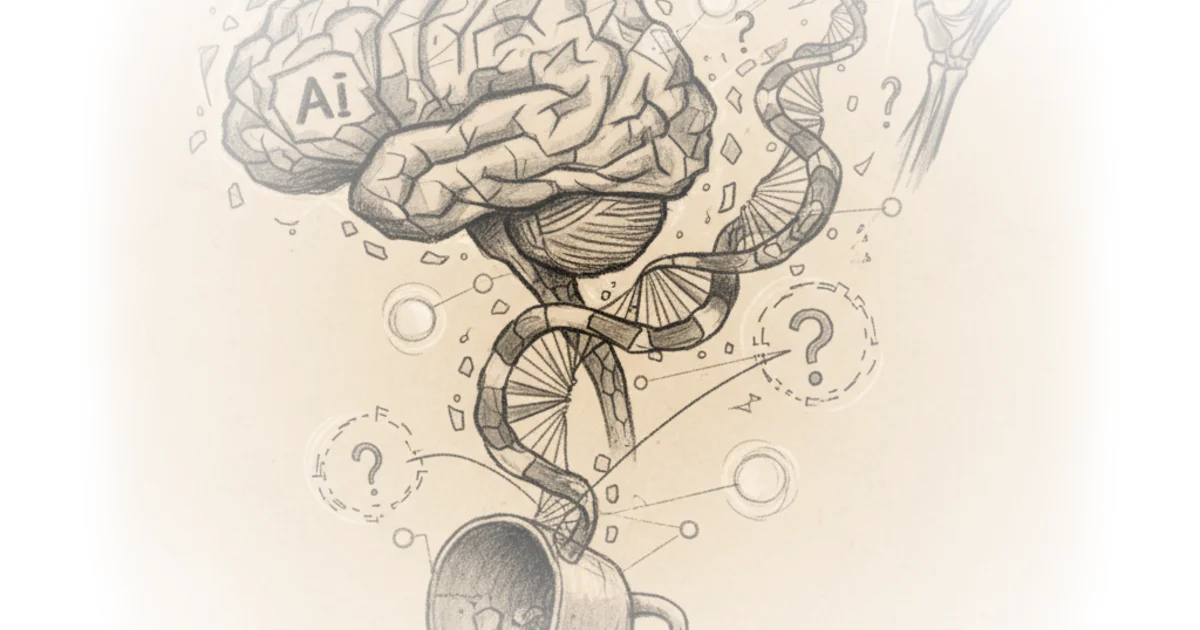
This framing is crucial because it demystifies the "overnight success" narrative that often plagues AI coverage. By emphasizing that AlphaFold was the sum of "30 or 40 different kind of individual ideas," Zsolnai-Feher argues that the system's power comes from the accumulation of small, iterative wins rather than a single magic trick. He effectively contrasts the linear appearance of the final graph with the jagged, uncertain reality of the research process. This is a vital correction to the public perception of AI development, which often assumes a steady, predictable march toward intelligence.
Critics might argue that focusing too heavily on the emotional toll of research distracts from the sheer technical elegance of the solution, but Zsolnai-Feher uses the human element to ground the abstract mathematics in relatable struggle.
"It felt like too many ideas were working. It felt it was going up... This problem can't be this easy. Are we leaking the test set?"
Beyond the Sequence
The commentary then pivots to the profound implications of the technology itself. Zsolnai-Feher explains the core biological challenge: while reading DNA sequences has become cheap and fast ("pennies to read"), determining the 3D structure of the resulting proteins has historically been a slow, expensive, and often failed experiment costing up to $100,000 per structure. AlphaFold changes the equation by predicting these structures in minutes with near-experimental accuracy.
What makes this coverage particularly compelling is how Zsolnai-Feher illustrates the system's ability to surprise even its creators. He recounts how the model initially produced "giant voided cavities" or floating spirals that looked wrong to human eyes, only for the team to realize the AI had correctly predicted that the protein existed as a multi-part complex (a trimer) or that the "ugly long arcing ribbons" were actually disordered regions with no fixed shape. "What AlphaFold was in fact telling us is this region doesn't have a structure," Zsolnai-Feher writes, paraphrasing Jumper's realization that the AI had implicitly learned to identify protein disorder, a feature previously missing from structural databases.
This section underscores a shift in scientific methodology. The AI is not just a faster calculator; it is a hypothesis generator that reveals patterns humans were blind to. The argument holds up well because it relies on specific, verifiable anecdotes from the lab rather than vague promises of future utility.
"We found out is that the lowest AlphaFold confidence protein was actually pretty much a state-of-the-art predictor of whether a protein was disordered."
The Scale of Transformation
Finally, Zsolnai-Feher zooms out to the macro impact, noting that the system has predicted the structure of 200 million proteins—essentially every known protein from organisms with sequenced genomes. He highlights the nuclear pore complex, a massive biological gatekeeper that was previously only partially understood, as a prime example of how AlphaFold allows scientists to combine low-resolution experimental data with high-precision AI predictions to solve "enormous" problems.
The author's claim that this is "the first problem really really transformed by AI" is bold, yet the evidence provided—three million scientists using the database, the acceleration of drug development, and the solving of previously intractable structures—lends it significant weight. The coverage effectively argues that we have moved past the era where AI mimics human capability to an era where it achieves "superhuman level" insight in specific domains.
"It's the promise that we're going to use AI not just to do things that humans can do or solve human problems, but to do kind of superhuman level."
Bottom Line
Zsolnai-Feher's piece succeeds by humanizing a technical marvel, revealing that the path to solving one of biology's grandest challenges was paved with doubt and iterative failure rather than linear genius. While the argument that this is the single most important AI breakthrough ever is ambitious, the concrete examples of how the tool has already unlocked the "nuclear pore" and identified disordered protein regions make the claim difficult to dismiss. The biggest takeaway is not just the speed of the prediction, but the new kind of scientific intuition the machine has introduced to the field.