"A miracle, it seems" is a rare editorial that refuses to let history rest on its own mythology, daring to ask whether divine intervention and ecological reality can coexist in the same narrative. Wayfare takes the foundational story of the Mormon pioneers—the gulls saving the crops from crickets—and peels back the layers of faith-promoting legend to reveal a messy, biological truth that is far more compelling than the myth alone.
The Weight of Survival
The piece opens by grounding the reader in the visceral struggle of 1847, stripping away the romanticism often attached to westward expansion. Wayfare reports, "Every bit of green from the white-tipped wild buckwheat to the rough bark of pinyon pine was a promise from the Earth of a bountiful future." This sets a high stakes scene: survival was not guaranteed, but earned through grueling labor and desperation. The editors note that the pioneers' diet included "crow and wolf meat, weeds like thistle tops and lily bulbs, and when they got desperate enough, tree bark," highlighting how thin the margin for error truly was.
This context is crucial because it explains why the subsequent cricket plague felt existential. When May arrived, the threat was immediate and total. Wayfare quotes Mrs. Lorenzo Dow Young: "Today to our utter astonishment, the crickets came by millions, sweeping everything before them... We went out with brush and undertook to drive them, but they were too strong for us." The article effectively argues that the psychological toll of this devastation nearly unraveled the entire colony, noting that some settlers began to murmur that perhaps Brigham Young had been wrong to lead them there.
"The threat of a mass exodus from this fledgling colony was existential to the whole Mormon experiment."
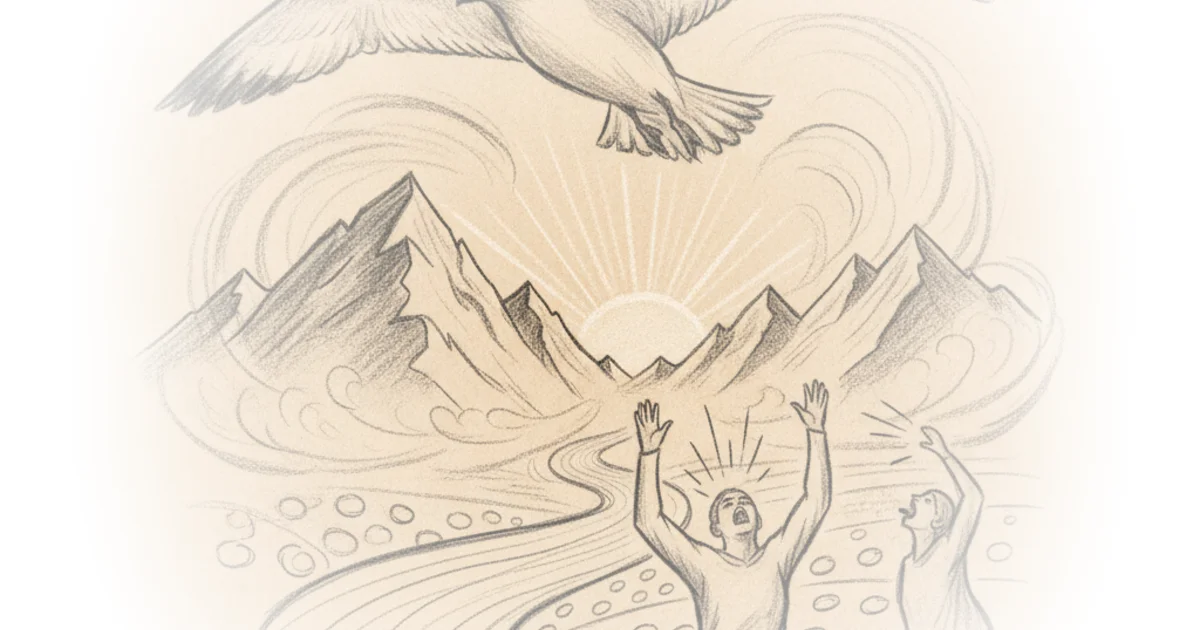
The narrative then pivots to the arrival of the California gulls. Wayfare describes the scene with cinematic gravity: "Their coming was like a great cloud; and when they passed between us and the sun, a shadow covered the field." The piece details the unique behavior of the birds—gorging on insects, washing them down, regurgitating pellets, and repeating—which the pioneers interpreted as a deliberate, divine act of salvation. This framing aligns with the broader Mormon cosmology described in the text, where history is a "bouncing from one miracle to the next," from Noah's ark to Joseph Smith's vision.
The Tension Between Faith and Fact
Here, Wayfare shifts from historical recounting to a sophisticated theological inquiry. The editors argue that modern believers face a unique challenge: how to reconcile grand scriptural miracles with an age of scientific explanation. "These modern-day miracles can fulfill a similar faith-promoting role as those recorded in scripture, but they diverge... in that they carry with them an implicit plausible deniability," the piece observes. The authors suggest that while a cancer survivor might feel a miracle occurred, an outsider might attribute it to medicine or luck, creating a tension between personal faith and empirical reality.
Critics of this approach might argue that dissecting the mechanics of a miracle risks diminishing its spiritual power for believers who view the event as proof of divine providence regardless of biological mechanisms. However, Wayfare pushes back by insisting that understanding the "how" does not necessarily negate the "why." The article points out that the gulls were not new to the area; written accounts predate the pioneers' arrival by years. Furthermore, the behavior of eating and regurgitating is a standard biological function for gulls unable to digest hard exoskeletons.
Wayfare notes that historical records credit human effort as well: "Brigham Young himself acknowledged this when he wrote that 'the crickets are still quite numerous and busy eating...'" The piece argues that the harvest was actually poor despite the birds' arrival, and the pioneers survived another year of hunger. This nuance is vital; it suggests the miracle wasn't a magical fix, but a partial reprieve that allowed for continued human effort.
A Modern Parallel in the Law School Valley
To bridge the gap between 1848 and today, the text draws a personal parallel to a modern "miracle" involving career advancement at Brigham Young University's law school. The author recounts how an upperclassman utilized an underused program called "International by Request" to land a job despite mediocre grades. Wayfare describes this as a "career hack," noting that the student had to guarantee acceptance of any offer, operating on a system of goodwill and risk.
The piece uses this anecdote to explore the nature of synchronicity in a secular world. Just as the gulls arrived when the crickets threatened total ruin, the career opportunity appeared at a moment of professional uncertainty. "I looked down at the valley below me—a wedding with the woman I loved, a path forward to financially care for the family I was building, and a foreign adventure that would help me get there," the author writes. The editors use this to ask: if we strip away the supernatural explanation from the gull story, do we lose the ability to find meaning in our own "miraculous" coincidences?
"When the gulls arrived in 1848, they did not bring the Saints total relief... The failure of the gulls to 'save' the crops, coupled with a modern understanding of local ecology, calls into question the miraculous nature of the birds' arrival."
This section is particularly effective because it refuses to let the reader off the hook with a simple "it was God" or "it was luck" binary. Instead, it suggests that the value lies in the narrative we build around the event. The piece argues that the story has been passed down for generations as a testament to faith, but the facts reveal a more complex interplay of ecology and human resilience.
Bottom Line
Wayfare delivers a masterful deconstruction of one of Utah's most cherished origin stories without dismantling its spiritual core; it invites readers to see the miracle not in the suspension of natural law, but in the convergence of timing, biology, and human perseverance that allowed a fragile colony to survive. The piece's greatest strength is its refusal to choose between faith and science, instead arguing that the "plausible deniability" of modern miracles might actually make them more resilient in a skeptical age. Readers should watch for how this nuanced approach to religious history influences broader conversations about faith in an era defined by empirical evidence.