Cory Doctorow does not merely predict an economic downturn; he maps a direct, causal pipeline from the collapse of a speculative AI bubble to the rise of authoritarianism. While most analysts focus on stock market volatility or job displacement, Doctorow argues that the true danger lies in the political vacuum created when public services crumble under austerity measures, leaving citizens vulnerable to fascist demagoguery.
The AI Bubble and the Austerity Trap
Doctorow begins by dismantling the current frenzy around artificial intelligence, describing it as "the money-losingest technology in the history of the human race." He warns that the real risk isn't the technology itself, but the catastrophic market correction that will inevitably follow. "My concern about a massive collapse in the capital markets isn't that workers will suffer directly," he writes, noting that the median American has only $955 in retirement savings. Instead, the terror lies in the political reaction to the crash.
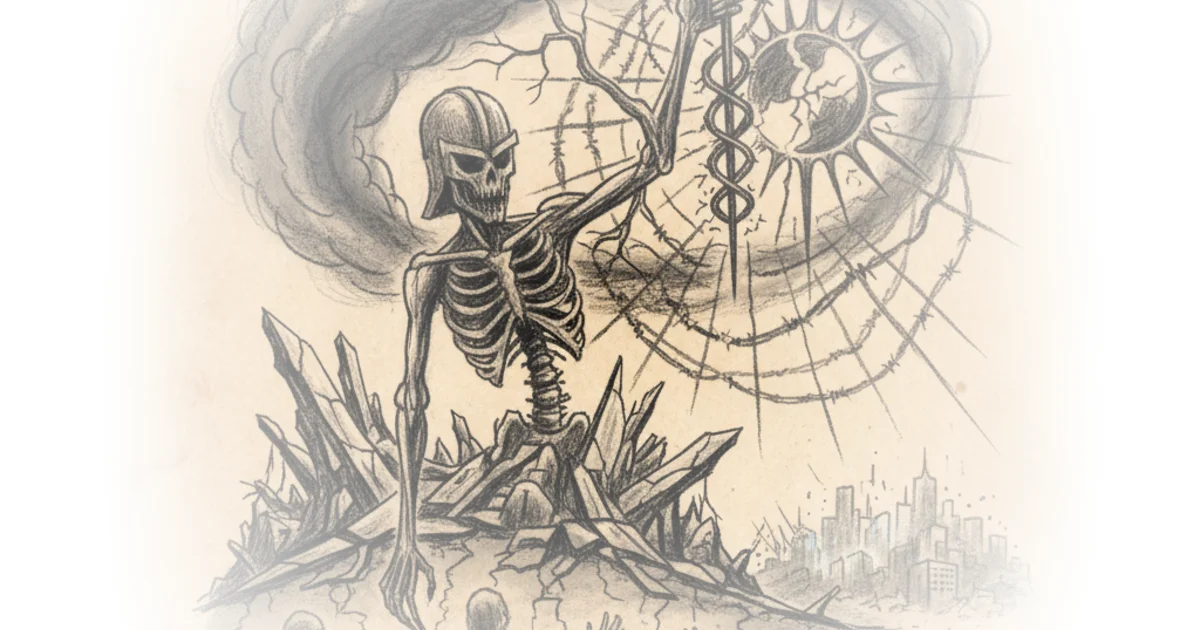
The author draws a sharp line between financial instability and the erosion of democracy. He posits that when the economy implodes, the inevitable response from the executive branch and financial regulators will be austerity. "Austerity begets fascism" is the piece's central thesis, supported by the observation that "there's a direct line from every K-shaped recovery to every strong-man who's currently sending masked gunmen into the streets." This framing is particularly potent because it shifts the blame from abstract market forces to specific policy choices made after a crisis.
Doctorow reinforces this by looking back at the 2008 financial crisis, where the administration chose to bail out banks while ordinary citizens faced foreclosure. He notes that Treasury Secretary Tim Geithner argued the banks could only be saved if the government "foamed the runways" with everyday Americans' mortgages. The result was a generation of disillusioned voters who watched their homes vanish while Wall Street was flushed with public cash. "Americans were understandably not entirely happy with this outcome," Doctorow observes, linking that specific policy failure to the subsequent political upheaval.
"When public services fail, people stop trusting the state, and that social contract starts to fray."
The Empirical Link Between Service Cuts and Fascism
Moving beyond historical anecdote, Doctorow anchors his argument in rigorous academic research, specifically a study by economists from the London School of Economics and Bocconi University. The study, titled "Public Service Decline and Support for the Populist Right," provides the empirical backbone for the claim that crumbling infrastructure breeds extremism. The researchers found that when people experience a degradation in essential services like healthcare, they don't just get angry at the system; they actively switch their political allegiance to fascist parties.
The article highlights the United Kingdom's National Health Service (NHS) as a prime example. With 1,700 general practitioner practices closing since 2013, the tangible loss of access to care has driven voters toward parties that have "called for ethnic cleansing in Britain." Doctorow explains the mechanism clearly: "Fascists come to power by mobilizing grievances. By choosing a scapegoat, fascists can create support from people who are justifiably furious that the services they rely on have collapsed." This is a crucial distinction; the argument suggests that fascism is not an ideological surprise, but a predictable reaction to the failure of the social contract.
Critics might argue that this view oversimplifies the complex drivers of populist movements, ignoring cultural anxieties or identity politics that exist independently of economic hardship. However, Doctorow's reliance on longitudinal data from the British Election Study and the GP Patient Survey suggests a robust correlation that cannot be easily dismissed. The evidence indicates that when the state fails to provide shelter, healthcare, or education, the population becomes a "mark for a fascist grifter."
The Choice Between Sewer Socialism and Barbarism
The commentary concludes by contrasting the path of austerity with an alternative model Doctorow calls "sewer socialism." He points to political leaders like Zohran Mamdani in New York, who are prioritizing visible, tangible improvements to public life—fixing potholes, maintaining community centers—as a way to rebuild trust in government. "We can see the looming economic crises in our near future," Doctorow writes, warning that whether we respond with cuts or investment is a deliberate choice.
He juxtaposes this constructive approach with the rhetoric of figures like Nigel Farage, who proposes creating a "paramilitary style" immigration enforcement apparatus and building camps for migrants. The stakes, according to Doctorow, are existential. "'Socialism or barbarism' isn't just a cliche — it's actually a choice on the ballot." This framing forces the reader to recognize that the debate is not about abstract economic theory, but about the immediate conditions of daily life and the future of civil society.
"Fascism — what Hannah Arendt called 'organized loneliness' — can only take root when people stop believing that their society will reward their lawfulness with an orderly and humane existence."
Bottom Line
Doctorow's most compelling contribution is the translation of abstract economic theory into a visceral warning about human suffering and political collapse. The argument's greatest strength is its reliance on empirical data linking service degradation to fascist voting patterns, moving the conversation beyond speculation. However, the piece's vulnerability lies in its deterministic view of the future, assuming that austerity is the only possible response to a market crash, when history shows that political will can sometimes pivot toward investment even in dire times. Readers should watch for how current administrations frame their responses to the next inevitable economic shock, as the choice between repairing public trust or retreating into authoritarianism will likely be made in the first 100 days of the crisis.