Slavoj Žižek turns the usual utopian narrative of the internet on its head, arguing that the digital realm does not liberate us but rather traps us in a suffocating paradox of infinite choice and radical closure. While popular discourse celebrates the web as a frontier of endless possibility, Žižek posits that the very removal of physical distance and the overload of information create a new, more terrifying form of confinement where the human subject loses the ability to truly want anything at all.
The Illusion of Choice
The piece opens with a provocative inversion of our daily digital experience. We are constantly bombarded by interfaces asking us to "press A" or "press B," treating us as subjects who know exactly what they desire. Yet, Žižek argues that this constant demand for choice actually erodes our capacity to know what we want. "The very evocation of a choice to be made performatively creates the need for the object of choice," he writes. This is a sharp critique of the algorithmic logic that drives modern platforms: by presenting us with a menu of options, the system does not serve our pre-existing desires but manufactures them in real-time.
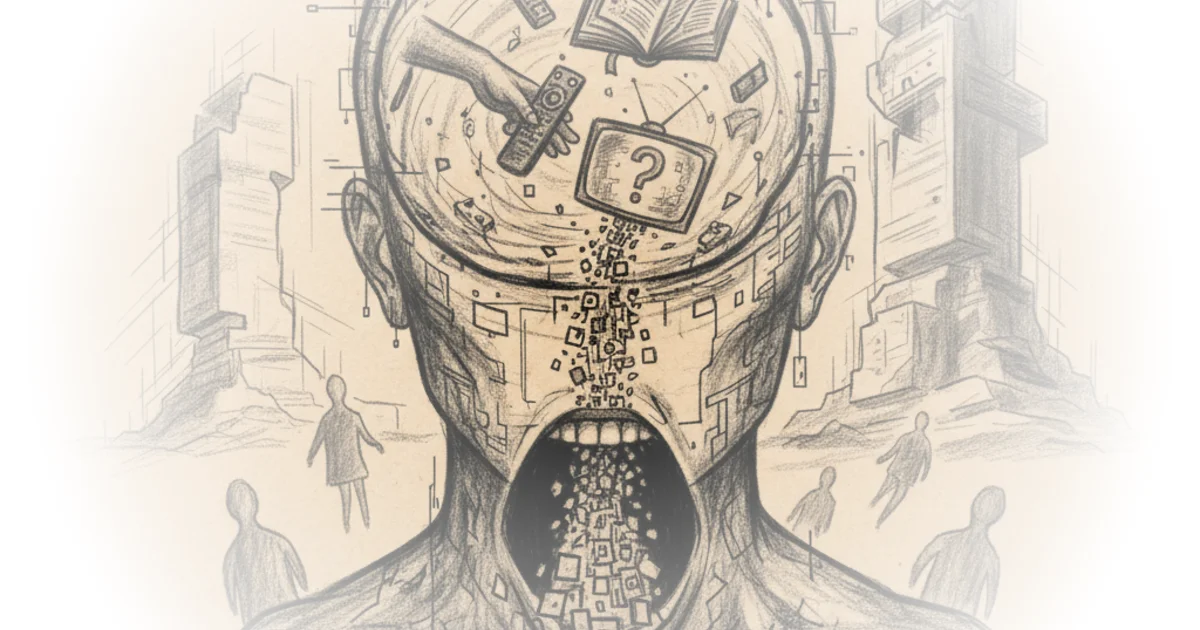
The core of the argument rests on the decline of the "Master" figure—the traditional authority that once told a subject what to desire. In the absence of this figure, one might expect total freedom. Instead, Žižek suggests the opposite occurs. "If no forced choice confines the field of free choice, the very freedom of choice disappears," he notes, paraphrasing a famous reversal of Dostoyevsky. This framing is effective because it explains the pervasive sense of paralysis many feel when scrolling through endless feeds; the lack of a guiding hand leaves us adrift in a sea of options that feel meaningless. Critics might argue that this view is overly pessimistic, ignoring the genuine agency users exercise in curating their own digital lives, but Žižek's point is that the structure of the interface itself dictates the terms of that agency.
The obverse of this suspension of the distance which separates me from a far-away foreigner is that, due to the gradual disappearance of contact with "real" bodily others, a neighbour will no longer be a neighbour, since he or she will be progressively replaced by a screen spectre.
The Spectre of the Neighbor
Žižek moves from the psychology of choice to the sociology of connection, challenging the idea that the internet brings us closer together. He argues that by removing the physical friction of proximity, cyberspace creates an "unbearable claustrophobia." The digital neighbor is not a flesh-and-blood person with a distinct, sometimes annoying, mode of being (what psychoanalysts call jouissance), but a sanitized, over-present image. "Our point is rather that cyberspace is not spectral enough," he asserts, flipping the common complaint that the internet is too fake. The problem, he suggests, is that it is too smooth, too frictionless, and therefore too devoid of the "real" obstacles that define human relationships.
This analysis draws a fascinating, if controversial, parallel to the Christian injunction to "love thy neighbour." Žižek explains that the difficulty in loving one's neighbor stems from their intrusive, unpredictable presence. In the digital realm, this intrusion is removed, leaving only a "torrential flow of images." This is where the argument risks becoming too abstract, potentially overlooking how digital spaces can indeed foster genuine, messy, and transformative connections for marginalized communities. However, the insight that the absence of physical risk creates a new kind of emotional suffocation remains a powerful lens for understanding online toxicity and the desire to retreat into isolation.
The Myth of the Natural Organism
A significant portion of the commentary is dedicated to dismantling the "spontaneous ideology of cyberspace," which treats the internet as a self-evolving natural organism, akin to the Gaia hypothesis. Žižek warns against blurring the line between culture and nature, noting that "the Earth (as Gaia) as well as global market, they both appear as gigantic self-regulated living systems whose basic structure is defined in the terms of the process of coding and decoding." This naturalization of the market and the web serves to obscure the political decisions and power structures that actually govern them.
He connects this to a broader historical shift in how we understand science and meaning. Referencing the difference between traditional meteorology, which saw weather as meaningful signs from a mysterious "Beyond," and modern satellite meteorology, which views the atmosphere as a closed, meaningless mechanism, Žižek argues that the digital age replicates this "closed" universe. "The universe of modern science, in its very 'meaninglessness,' involves the gesture of 'going through fantasy,' of abolishing the dark spot," he writes. The internet, paradoxically, becomes the new "dark spot" where we project our fantasies of a limit-less future, all while ignoring the rigid, coded reality of the infrastructure beneath.
The vision of cyberspace opening up a future of unending possibilities of limitless change, of new multiple sex organs, etc., conceals its exact opposite: an unheard-of imposition of radical closure.
The Fantasy of the White Master
In a striking turn, Žižek invokes the colonial literature of the 19th century, specifically the works of Edgar Allan Poe and Rider Haggard, to illustrate the psychological function of the "Beyond." He references the motif of the "dark continent" or the Antarctic in Poe's The Narrative of Arthur Gordon Pym, where explorers seek a mysterious realm of pure Otherness. "What they encounter there, in this purely fantasmatic Beyond, is again the rule of a mysterious White Man, the pre-Oedipal father, the absolute Master," he observes. This is a crucial intervention: the fantasy of a free, uncolonized digital space inevitably collapses into a re-enactment of existing hierarchies.
The argument suggests that the desire for a "Shangri-La" in cyberspace is a defense mechanism against the meaninglessness of the modern world. We imagine a digital frontier where we can escape the constraints of the body and the state, only to find that the "Master" (the algorithm, the platform owner, the market logic) is still in charge, perhaps even more effectively than before. While the heavy reliance on literary tropes and colonial metaphors might feel dense to some, it serves to ground the abstract theory of the internet in a tangible history of human domination and the failure of escape fantasies.
Bottom Line
Žižek's most compelling contribution is his diagnosis of the internet not as a tool of liberation, but as a mechanism that amplifies our anxiety by removing the very boundaries that make choice meaningful. The argument's greatest vulnerability lies in its tendency to generalize the digital experience, potentially underestimating the diverse ways people actually navigate and resist these structures. However, the warning against treating the digital ecosystem as a "natural" force that operates beyond politics remains an essential corrective for anyone navigating the modern information landscape.