The Wall That Moves
Jordan Schneider's latest ChinaTalk episode centers a book that arrived exactly when the global internet lost its innocence. Yi-Ling Liu's The Wall Dancers traces five figures who navigated China's censored digital landscape—not as victims, but as performers who learned to move within shifting constraints. The metaphor cuts deeper than resistance or compliance. It captures something more human: the agility required when the rules change faster than you can memorize them.
Dancing in Shackles
Schneider frames Liu's work as a corrective to Western assumptions about Chinese technology. The familiar narrative painted China's internet as an aberration—a prison contrasting with the free, luminous web promised to the West. By 2026, that story aged poorly.
Jordan Schneider writes, "The internet and tech world we now inhabit increasingly resembles China's in its inner logic and ultimate purpose, not the other way around."
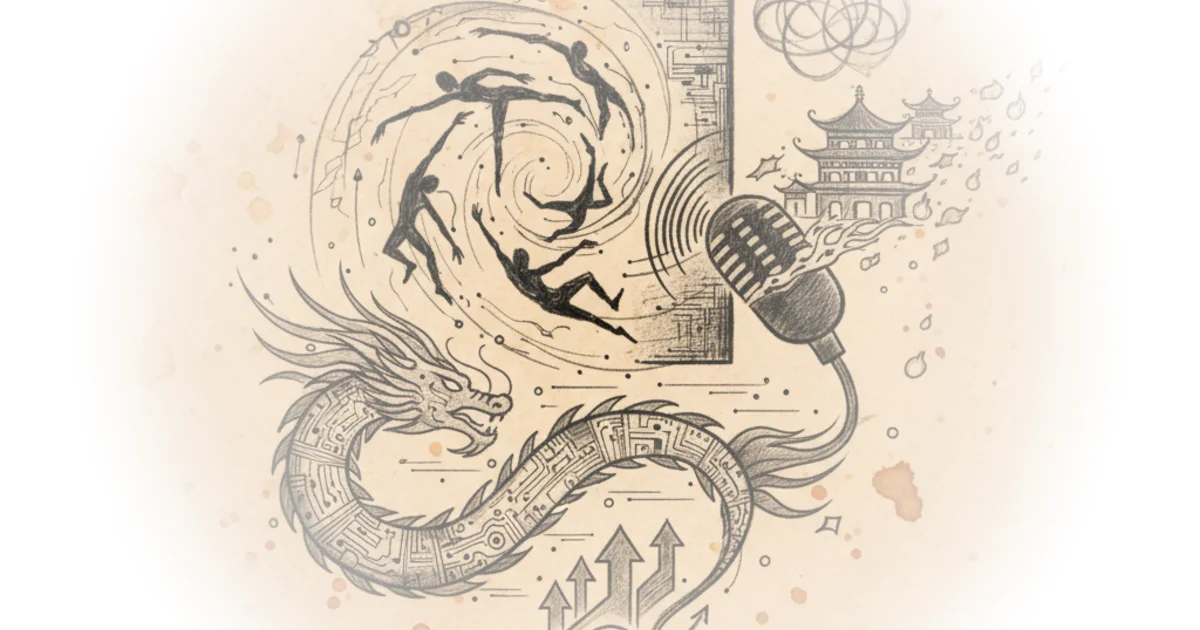
The phrase "dancing in shackles" originated with Chinese journalists in the early 2000s, describing reporting under state constraints. It migrated outward—musicians adopted it, science fiction writers invoked it, software engineers embraced it. Liu chose "wall dancers" for her protagonists because the wall itself moves.
Jordan Schneider writes, "A dance requires agility, nimbleness. The people I profile had to navigate constantly shifting terrain, which is why I call them 'wall dancers'—people skilled at pushing for dignity and connection on the Chinese internet, and in Chinese public life more broadly, within a system whose boundaries are always moving."
The five dancers Liu profiles represent different facets: Ma Baoli, founder of Blued (China's largest gay dating app); Lü Pin, feminist activist; Kafe Hu, underground rapper; Chen Qiufan, science fiction writer and former Google employee; and Eric Liu, a Weibo censor who embodies the Firewall apparatus itself.
"Anyone living inside the Great Firewall is constantly asking themselves, How should I move?"
Between Inside and Outside
What united Liu's dancers was their ability to code-switch between mainstream and margin. Ma Baoli was a former police officer. Lü Pin worked as a state journalist. Chen Qiufan held a position at one of the world's largest tech companies. Even Kafe Hu, the rapper, operated a standard business.
Jordan Schneider writes, "This ability to move between inside and outside made them both idealistic and pragmatic. They could code-switch and wear different masks."
Liu's craft involved reconstructing scenes from fragments. Ma Baoli had told the story of discovering the queer novel Beijing Comrade hundreds of times in two sentences. Liu asked him to walk through it repeatedly—where was the internet café, who sat beside him, when did he walk out. She interviewed dozens across each realm, tracking everyone in massive spreadsheets.
Jordan Schneider writes, "I wasn't doing investigative journalism, uncovering hidden scoops. I was taking dispersed pieces and breathing life and color into them."
One moment haunts the narrative: Ma Baoli's recurring dream of returning to the police bureau but unable to find his office. The feeling of being rooted in a role, then uprooted, not knowing who you are anymore.
Fàng and Shōu
Liu's book traces China's cyclical pattern of fàng and shōu—opening and tightening. The mid-2010s were vibrant: ByteDance founded, venture capital flooding the ecosystem, the Party emboldening founders to build boldly. Then 2020-2021: Jack Ma's Ant IPO pulled, the big tech crackdown, Common Prosperity campaigns.
Jordan Schneider writes, "We're still in that closing cycle, though there are micro-openings around AI. But this sits within a global authoritarian shift."
The convergence between Chinese and Western internet logic accelerated after 2016. Trump's election and Brexit proved social media could be manipulated to influence opinion even in democracies. Snowden's 2013 revelations shattered illusions about technology and freedom. The Arab Spring's failure showed regimes that digital tools could serve repression, not just revolution.
Jordan Schneider writes, "The so-called 'free' internet and the one behind the Great Firewall have started to resemble each other, converging."
Counterpoints
Critics might note that Liu's dancer metaphor risks aestheticizing survival under censorship. Not everyone can dance—some are crushed when the wall moves. The five profiles lean heavily toward figures who succeeded in navigating constraints, potentially obscuring those who couldn't code-switch or wear masks effectively.
Critics might also argue that the convergence narrative—Western internet becoming Chinese—overstates similarity. US-owned TikTok censors content, but the mechanisms differ from state-mandated firewalls. Platform capitalism and state authoritarianism share outcomes but diverge in accountability structures.
Bottom Line
The Wall Dancers arrives as a mirror held up to the global internet's lost innocence. Liu's work suggests the West must learn from Chinese netizens: how to seek freedom and connection within tech plutocracy, in an algorithmic age. The dance continues, but the shackles have spread.