This piece reframes the recent Independence Day spectacle not as a political failure, but as the inevitable culmination of decades-long legal and economic engineering designed to dismantle public accountability. Matt Stoller argues that the chaotic scenes in Washington, D.C., from heat-stricken crowds to private oligarchic parties, are merely the physical manifestation of a system where corruption has been legally codified rather than merely tolerated.
The Spectacle of Enclosure
Stoller opens by contrasting the traditional 19th-century Fourth of July oration—a time for public moral reckoning—with today's privatized celebrations. He notes that while the National Mall is usually open to families, this year it was "peppered with high fences and corporate sponsored obnoxious exhibits." The author suggests this physical enclosure mirrors a broader political one, where the public sphere has been ceded to private interests.
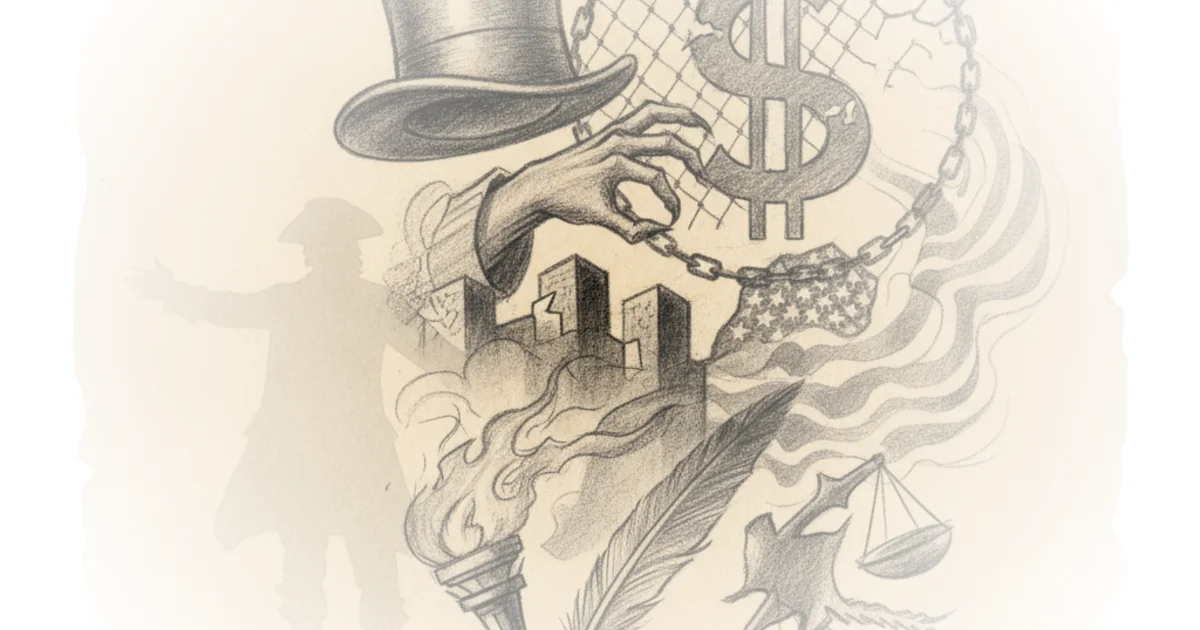
The commentary draws a sharp line between the administration's public display and its private reality. Stoller points out that while the President oversees fireworks that "will cause dangerous air pollution," the true festivities are happening behind closed doors. According to the author, these events are part of a "baroque scheme to simply steal money appropriated for the public festivities," sponsored by defense contractors and Silicon Valley figures.
The metaphor here is too on the nose. Last year, according to the financial disclosures he released this week, Trump made $2.2 billion, mostly through pyramid schemes and bribery through the veil of cryptocurrency.
Stoller's analysis of the financial disclosures is aggressive, framing the administration's wealth accumulation not as luck but as a structural feature of the current regime. He details how billions were generated through crypto ventures that saw supporters lose nearly $4 billion, describing these moves as "theft from his supporters." The argument here is that the fusion of government and finance has reached a point where self-enrichment is no longer hidden; it is the primary function of office.
Critics might argue that focusing on personal financial disclosures distracts from broader policy achievements or that market volatility affects all asset classes, not just those held by political figures. However, Stoller's specific data points regarding insider trading and the timing of tariff pauses suggest a pattern of behavior that transcends normal market fluctuations.
The Architects of Nihilism
The piece shifts from current events to historical genealogy, identifying two "patron saints" of this era: Roy Cohn and Aaron Director. Stoller traces the modern political culture back to Cohn's cynical tactics during the McCarthy era, noting that Cohn "created America's modern political culture." He highlights Cohn's background, including his family's wealth derived from a bank failure where "his wealthy Jewish uncle stole from hundreds of thousands of Jewish immigrants," to illustrate a long-standing belief that rules should not apply to insiders.
Parallel to Cohn's political maneuvering is the intellectual framework provided by Aaron Director. Stoller explains that Director founded the law and economics movement in the late 1940s with funding from the Volcker Fund, aiming to "restore the framework of pre-New Deal America." This was not just an academic exercise; it was a deliberate strategy to dismantle antitrust enforcement.
The ambition of Director, wrote Director's ally George Priest years later, was essentially to ridicule the Supreme Court's treatment of antitrust as well as of other forms of government interference with the market.
Stoller connects these historical figures directly to current judicial outcomes, arguing that their combined legacy has created a system where "monopolization doesn't matter." He cites a white-collar defense attorney who claimed, "It is general knowledge in our practice that for $2 million, you can have a pardon," illustrating the transactional nature of justice under this framework. The author suggests that viewing these issues solely through the lens of one politician's morality is an error; rather, it is the result of an elite consensus that views corruption as "the currency of the realm."
The Judicial Shield
The commentary culminates in a critique of recent Supreme Court decisions that Stoller argues have effectively elevated Wall Street to a fourth branch of government while stripping protections from public regulators. He points to the inconsistency in rulings where independent agencies can be fired at will, yet the Federal Reserve remains insulated as a "special arrangement sanctioned by history."
Stoller highlights how the Court has narrowed the definition of corruption to only include explicit quid pro quos, rendering influence peddling legal unless a direct bribe for a favor is proven. He notes that in recent cases, the Court ruled that federal anti-bribery laws do not bar "gratuities" if the money changes hands after the act is performed.
The court hasn't stopped with Citizens United. A few years ago, six conservative justices decreed that a federal anti-bribery law doesn't bar 'gratuities,' only bribes. What is the difference? If you get the money after you do the favors, it's a gratuity, if you get it before the acts, it's a bribe. I'm not kidding.
The author argues that this legal gymnastics has created a paradox where the Court defines bribery laws out of existence and then uses the lack of prosecutions as evidence that corruption is low. Stoller concludes that this "nihilism" allows for open price-fixing, citing an egg industry CEO who openly rigged prices while lying to reporters about avian flu. The piece suggests that the public's realization of this systemic rot is growing, making it no longer scandalous but routine to criticize the judiciary.
There is a nihilism now, a straight-up robbery of every nook and cranny of a nation.
Critics might contend that the Court's decisions are rooted in constitutional originalism rather than political bias, arguing that expanding definitions of corruption could infringe on executive power. Stoller counters this by showing how these interpretations consistently favor financial elites over public regulators, suggesting the outcome is less about legal theory and more about power preservation.
Bottom Line
Stoller's most powerful contribution is linking the chaotic spectacle of the holiday to a deliberate, decades-long project of institutional capture driven by Cohn's political cynicism and Director's economic theories. The argument's greatest strength lies in its refusal to treat current corruption as an anomaly, instead presenting it as the logical endpoint of legal changes that have redefined graft as a legitimate business practice. Readers should watch for how these newly expanded definitions of "official acts" and "gratuities" will be tested in future investigations into executive branch dealings.