Rick Rubin doesn't just trace the lineage of heavy metal; he dismantles the myth that it arrived fully formed with Black Sabbath. In this conversation with Daron Malakian, the legendary producer argues that the genre was not a sudden invention but a slow-burning evolution from psychedelic rock, blues, and even folk, where the "spark" of a single riff often mattered more than the band's entire discography. For the busy listener trying to understand why metal sounds the way it does, Rubin's insistence that the "feeling of doom" existed in The Beatles and Cream long before the term "heavy metal" was coined offers a necessary correction to the standard rock history narrative.
The Psychedelic Roots of Doom
Rubin and Malakian begin by challenging the timeline, suggesting that the seeds of metal were sown in the late 1960s psychedelic era. Rubin points out that bands like The Who and even The Beatles were experimenting with darkness before the genre had a name. "It's it's metal. It it it's it gives you the feeling of what Black Sabbath gives you without necessarily the same guitar tones or whatever, but the sound, the music, the darkness," Rubin asserts regarding the end of The Beatles' "I Want You." This observation is crucial because it shifts the definition of metal from a specific guitar tone to an atmospheric quality.
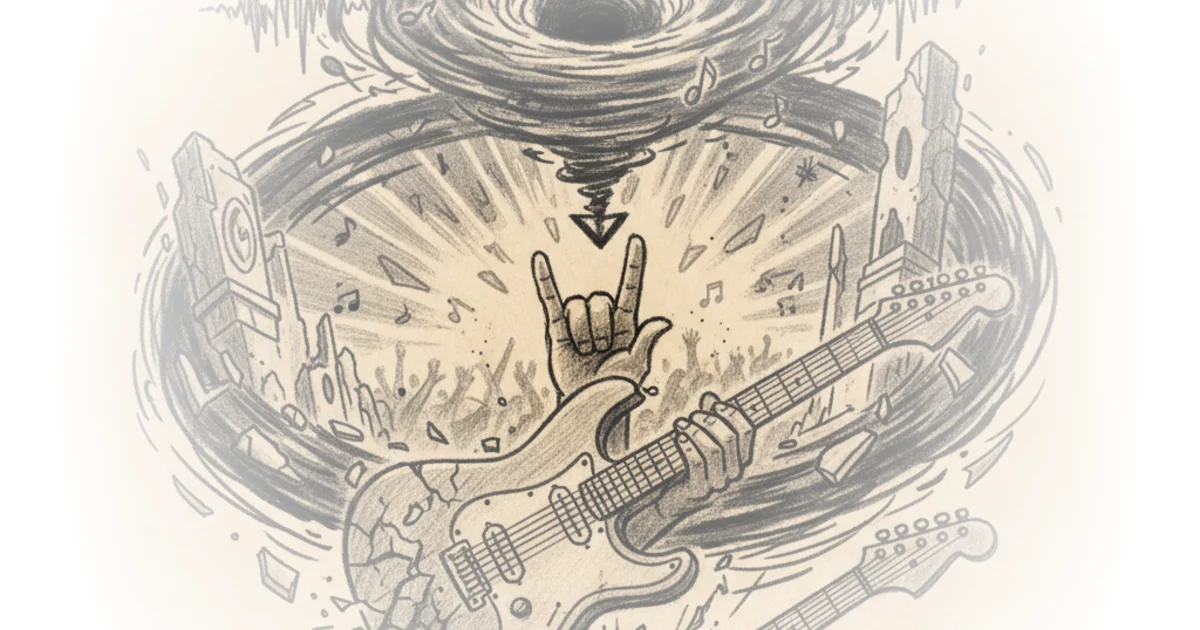
The conversation highlights how the transition from psychedelia to metal was organic. Rubin notes that while bands like High Tide were playing "heavy" music, they were still categorized as psychedelic. He argues that "psychedelic music was moving into this direction," blending folk flavors with heavy riffs in a way that felt natural rather than forced. This reframing helps explain why early metal bands often had a "folky" side; they were inheriting a dualistic approach from their predecessors. Critics might note that this broadens the definition of metal so much that it risks including almost any loud rock song from the 60s, but Rubin's specific focus on the "doom" and "darkness" of the vibe keeps the argument grounded.
The blues and the jazz was still there, but that came in between the heavy riffs. And the riffs with Sabbath weren't like for example we mentioned the band High Tide but probably if you listen to the rest of their songs that was probably the only song that was heavy.
The Sabbath Spark
While Rubin acknowledges the precursors, he draws a hard line at Black Sabbath, identifying them as the true architects of the genre's identity. The distinction lies in consistency. Where bands like Cream or The Kinks had heavy moments, Rubin argues that Sabbath made heaviness their entire character. "Sabbath brought the doom," he states, contrasting them with Led Zeppelin, whose heaviness was often punctuated by lighter, bluesy tracks. Rubin emphasizes that for Sabbath, the heavy sound was "the rule," not the exception.
This consistency created a new archetype. Rubin suggests that a single riff can spark a whole genre, citing Cream's "I Feel Free" and The Kinks' "You Really Got Me" as early sparks, but Sabbath was the fire. "One song or one riff can take a band and someone who is listening to that would be like, I want to write more songs that are like this," Rubin explains. This insight into the creative process of metal is compelling; it suggests the genre was built on imitation and escalation of specific, isolated moments of intensity rather than a grand design.
The discussion also touches on the vocal style, with Rubin identifying Ozzy Osbourne as the "archetype heavy metal voice." He notes that while others brought aggression, Ozzy's unique delivery was inimitable. "Nobody else sounded like him. It's just the aggression," Rubin observes. This focus on the human element—the voice and the lyrics—adds depth to the musical analysis, reminding listeners that metal is as much about the performance as the instrumentation.
Theater and the Birth of a Label
As the conversation moves into the 1970s, Rubin and Malakian explore how the genre solidified through both sound and spectacle. Rubin brings up KISS, noting that their "theatrics is a part of a lot of metal as well." He recalls being terrified as a child by their image, a reaction that underscores the genre's power to provoke visceral responses. "The image of the demon, the fire breathing, the blood that was huge to the kids that grew up with that and then started bands was huge for me," Rubin reflects. This highlights a critical, often overlooked component of metal: the visual and performative aspect that turned fans into practitioners.
Rubin also addresses the naming of the genre, pointing out that "heavy metal" was a label applied by the press after the fact, much like "rock and roll" or "grunge." He notes that bands like Sir Lord Baltimore were playing heavy music in the US without a specific genre tag. "I don't think any of the bands that we've listened to yet when they formed formed as heavy metal bands. There was no word," Rubin says. This historical context is vital for understanding the genre's evolution; it was a movement defined by its sound before it was defined by its name.
It's the press starts has has to put a label on it in some way. So when did heavy metal start? I don't know.
Bottom Line
Rubin's greatest strength in this piece is his ability to connect the dots between disparate musical eras, showing that heavy metal was an inevitable evolution of rock's darker impulses rather than a sudden anomaly. His argument holds up well because it relies on specific sonic examples rather than vague generalizations. However, the piece's biggest vulnerability is its reliance on memory and subjective feeling, which can sometimes blur the historical record. For the listener, the takeaway is clear: metal didn't just appear; it was forged in the fires of psychedelic experimentation and refined by the relentless consistency of Black Sabbath.