In a field often dominated by abstract skepticism, Kenny Easwaran presents a rigorous defense of a concept many modern thinkers have discarded: the existence of knowledge independent of sensory experience. This piece cuts through the noise of contemporary epistemology to argue that pure reason still offers a unique, indispensable foundation for truth, distinct from the fallible data of our five senses. For busy professionals navigating a world of data overload, understanding where reason ends and observation begins is not just academic—it is essential for distinguishing between what we know because we see it and what we know because it must be so.
Redefining the Rationalist Project
Easwaran begins by clarifying the stakes, shifting the debate from the existence of "a priori knowledge" to the existence of "a priori justification." He writes, "the main focus of my discussion will in fact not be a priori knowledge but a priori justification or rather more specifically a priori reasons for believing something to be true." This is a crucial pivot. By focusing on the reasons we hold for our beliefs rather than the absolute certainty of the beliefs themselves, Easwaran sidesteps the trap of infallibility that has doomed many rationalist arguments in the past. He acknowledges that justification is the bridge between belief and truth, and it is here that the distinction between experience-based and reason-based arguments matters most.
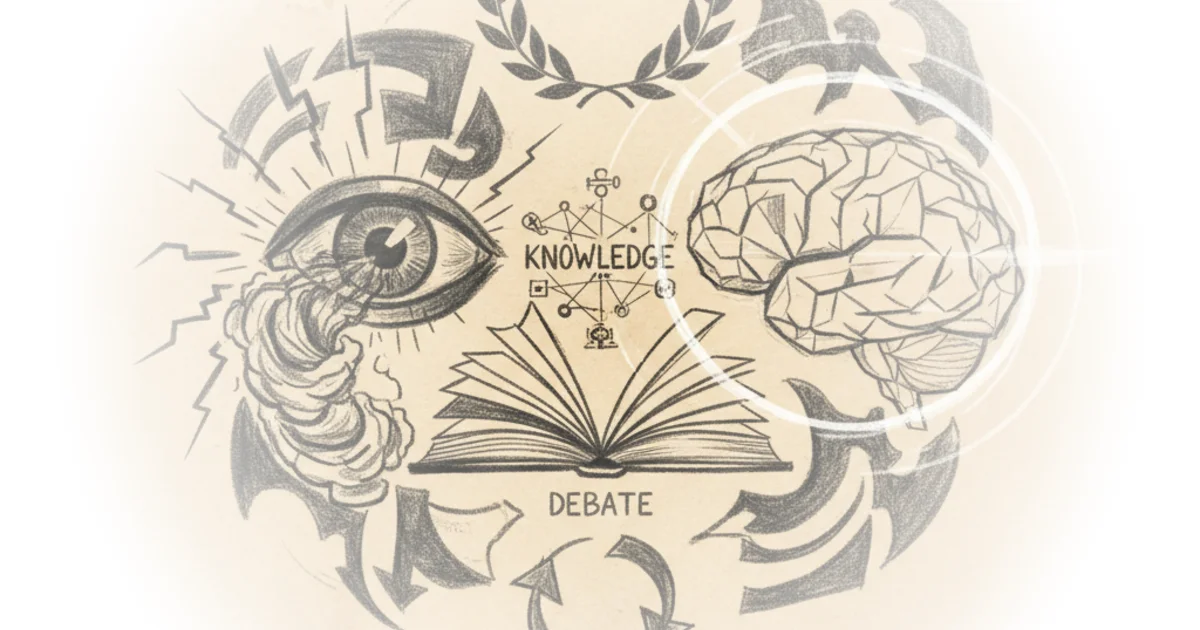
The author then defines the core concept with precision, noting that an a priori reason is one "whose rational force or cogency does not derive from experience either directly as in sense perception or indirectly as by inference of any sort." This negative definition is powerful because it isolates the source of the justification. Easwaran is careful to note that this does not mean a person needs zero experience to have the concept; one must learn language and logic through experience to even formulate the thought. However, once the concept is formed, the justification for the claim stands on its own, independent of further sensory input. This distinction is vital for anyone trying to understand how mathematics or logic can be universally true regardless of local conditions.
The possession of an a priori reason requires understanding the claim for which it is a reason and experience even experience of some fairly specific sort might be required for that.
Critics might argue that if experience is required to understand the premises, the entire structure is tainted by empiricism. Easwaran anticipates this, arguing that the weight of the reason is what matters, not the biological prerequisites for having the thought. He effectively separates the psychology of learning from the logic of justification.
The Limits of Experience and the Cartesian Trap
One of the most compelling moves in the commentary is Easwaran's treatment of introspection. While many philosophers treat internal mental states as a special, non-empirical category, Easwaran insists they are still a form of experience. He argues that "introspective awareness of one's thoughts sensations and other mental states should also count as a variety of experience." This is a bold claim that dismantles the idea that looking inward provides a purely rational foundation.
This has profound implications for the famous Cartesian argument, "I think therefore I am." Easwaran contends that even this foundational claim relies on "introspective awareness of the occurrence of specific thoughts and sensations," and therefore, it is a posteriori, not a priori. By classifying the awareness of one's own existence as an empirical observation of a mental state, he forces a re-evaluation of what counts as the bedrock of rationalism. If even the certainty of one's own existence is rooted in an experience of thinking, then the realm of the purely a priori is smaller, but perhaps more robust, than traditionally thought.
The idea of an a priori reason when understood in this way imply either one that experiences of some sort could not also count for or against the claim in question or two that such experiences could not override perhaps even more or less conclusively the a priori reason in question.
Easwaran also addresses the fear that a priori reasons must be infallible. He clarifies that an a priori reason does not render a claim "certain or infallible." It is possible for experience to override a rational insight, such as when a new mathematical discovery corrects an old error. This flexibility makes the argument more defensible in a modern context, where absolute certainty is rarely claimed. It suggests that rationalism is not about having unshakeable dogmas, but about having reasons that are valid regardless of sensory input, even if those reasons can be superseded by new evidence.
Insight Over Intuition
The piece concludes by defining the positive nature of a priori reasons: they are insights into the necessary truth of a claim. Easwaran deliberately avoids the word "intuition," which he notes is "slippery," preferring instead "a priori insights." He writes, "a priori insights at least purport to reveal not just that the claim is or must be true but also at some level why this is and indeed must be so." This distinction is critical. It elevates the concept from a mere "hunch" to a deep understanding of the essential nature of reality.
a priori insights at least purport to reveal not just that the claim is or must be true but also at some level why this is and indeed must be so.
He further refines this by suggesting these insights are often not propositional in form but are the basis for deductive inference, referencing the logical problem posed by Lewis Carroll. This moves the discussion away from static statements and toward the dynamic process of reasoning itself. The argument implies that the power of pure reason lies in its ability to reveal the structural necessities of the world, a capability that sensory experience alone cannot replicate.
Bottom Line
Kenny Easwaran's commentary succeeds by stripping away the mysticism often associated with rationalism and replacing it with a clear, functional definition of a priori justification. The strongest part of the argument is its refusal to demand infallibility, allowing reason to coexist with the possibility of empirical correction. The biggest vulnerability remains the practical difficulty of distinguishing between a genuine insight into necessity and a deeply held, yet mistaken, conviction. For the busy reader, the takeaway is clear: while our senses tell us what is, only pure reason can tell us what must be, and that distinction remains the bedrock of logical and mathematical certainty.
The possession of an a priori reason requires understanding the claim for which it is a reason and experience even experience of some fairly specific sort might be required for that.