The electric vehicle revolution is hitting a hard ceiling: weight. While governments and manufacturers race to ban fossil fuel engines, Dave Borlace argues that the biggest bottleneck isn't the motor or the software, but the battery itself, which can account for a third of a vehicle's total mass. Borlace introduces a radical shift in thinking: what if the car's body didn't just hold the battery, but was the battery? This structural battery concept promises to turn the heaviest part of an electric vehicle into its most efficient component, potentially unlocking the viability of electric flight and ultra-thin electronics.
The Weight Problem
Borlace sets the stage by highlighting the sheer inefficiency of current battery integration. He notes that while internal combustion engines only need fuel that makes up about three percent of a car's mass, "batteries in a typical EV can account for as much as a third of the total mass of the vehicle." This disparity is the central obstacle to scaling green transport. The author points out that even with Tesla's advances in manufacturing and chemistry, "a whole bunch of every battery packs attached to your vehicle represents a very large proportion of the overall weight and a significant drain on energy efficiency."
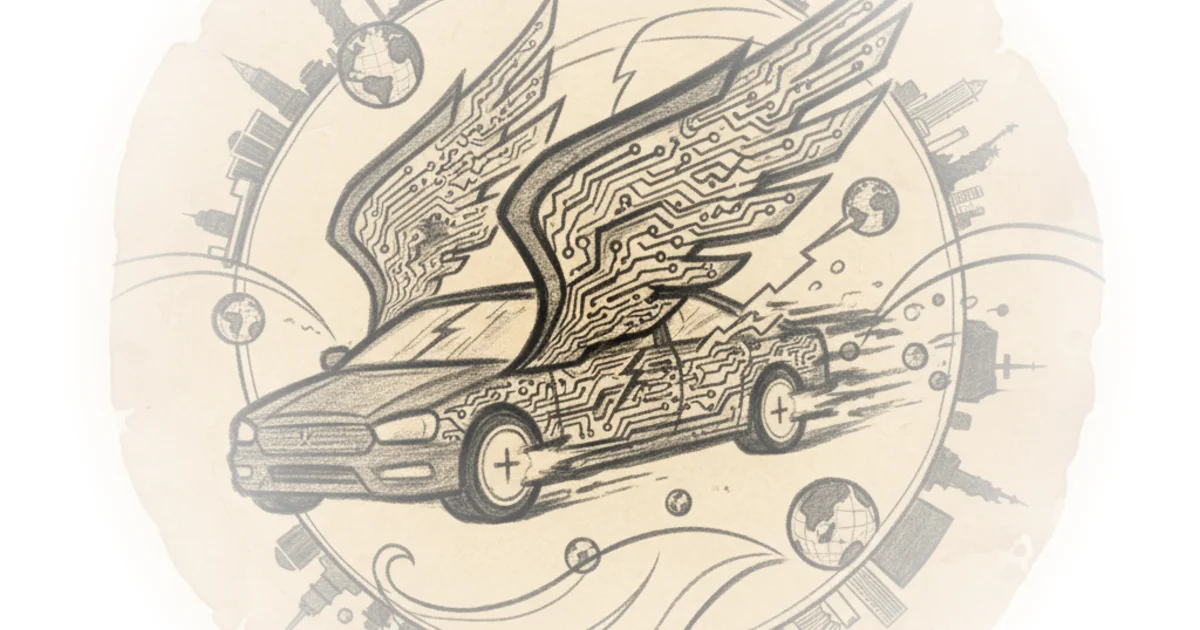
The commentary here is sharp because it moves beyond the usual cheerleading for electric cars to address the physics that currently limits them. Borlace correctly identifies that simply making better batteries isn't enough; the architecture of the vehicle itself must change. The solution proposed is "structural batteries," where the bodywork provides the energy.
"What if you didn't need to bolt the batteries to any part of the bodywork at all? What if the bodywork itself provided all the energy the car needed?"
This reframing is the piece's most compelling hook. It suggests that the future of transport isn't just about swapping an engine for a motor, but about reimagining the entire chassis as a power source.
Engineering the Impossible
The path to structural batteries is fraught with engineering hurdles. Borlace explains that conventional lithium-ion batteries rely on precise alignment between the anode and cathode. If you bend or stretch the material, you lose that alignment and the circuit breaks. Xi Xiao, a scientist at the Pacific Northwest National Laboratory, is quoted explaining the constraint: "From a design point of view, it's very important that your positive and negative electrodes face each other... if those electrodes are unaligned, they're not participating in the chemical reaction."
To overcome this, Borlace details the work of Emil Greenhouse at Imperial College London and Leif Asp at Chalmers University of Technology. Their team utilized carbon fiber, a material already prized for its strength in aerospace, and infused it with iron phosphate to act as the cathode. They then encased this in a conductive polymer resin to maintain alignment under stress. The result is a material that is both a structural panel and a power cell. Borlace notes that this technology has matured significantly since early EU-funded projects, stating that "now we can make materials that have at least 20 to 30 percent of both energy storage capacity and the mechanical capacity of the systems we want to replace."
Critics might note that achieving 30 percent of the required capacity is still a long way from a full replacement, and the cost of manufacturing such complex composites could be prohibitive for mass-market vehicles. However, Borlace's framing suggests that even a partial integration offers a massive net gain in efficiency.
Beyond the Road: Flight and Micro-Electronics
The implications of this technology extend far beyond cars. In aviation, weight is the enemy of flight. Borlace highlights the Kitty Hawk Cora air taxi, where batteries currently make up 17 percent of the weight. To make electric air taxis commercially viable, batteries need to reach 400 watt-hours per kilogram, a target currently out of reach. MIT's approach, as described by Borlace, is to flip the equation: "Rather than striving to increase battery energy to that new level, their goal is to bring that threshold back down to where it is today by making their structural batteries become components of the plane's body."
This logic applies to consumer electronics and medical devices as well. Borlace points out that modern smartphones are essentially "a big battery surrounded by some tiny components." By turning the phone's housing into a structural battery, the device could be reduced from over seven millimeters to under five. In the medical field, Xi Xiao's team is working on injectable tracking tags and electronic skin for prosthetics, where a structural battery "doesn't take up any more space than the device itself."
"One of the best ways to save energy and reduce greenhouse gas emissions is simply not to use the energy in the first place, and these new structural [batteries] could play a major role in achieving that goal."
This conclusion ties the technical details back to the broader climate imperative. By eliminating the need for separate, heavy battery packs, the energy required to move the vehicle or device is drastically reduced, creating a compounding efficiency gain.
Bottom Line
Dave Borlace's analysis effectively pivots the conversation from battery chemistry to structural engineering, identifying a critical bottleneck that the industry has largely ignored. While the technology is still in its infancy and faces significant scaling challenges, the argument that integrating power storage into the vehicle's skeleton is the key to unlocking electric flight and ultra-efficient transport is both sound and urgent. The strongest part of this argument is its focus on system-level efficiency rather than incremental component improvements, suggesting that the next leap in green technology will come from how we build, not just what we power.