What if the most honest path to faith isn't a sudden revelation, but a calculated investment? Jimmy Alfonso Licon, a philosophy professor at Arizona State University, dismantles the assumption that belief is a binary switch we cannot flip, proposing instead that we might be able to cultivate sincerity through indirect means—even if the initial spark is a bribe. This is not a theological sermon, but a rigorous stress test on the nature of human conviction and the conditions under which a deity might accept a relationship born of transaction.
The Myth of the Belief Switch
Licon begins by confronting the most obvious objection to his thought experiment: the idea that we can simply decide to believe something we currently reject. He writes, "We cannot, like the flip of a switch, decide we believe that '2+2=5', no matter how much money someone offers us to sincerely believe it." This framing is crucial because it immediately grounds the discussion in the psychological reality of doxastic involuntarism—the philosophical view that we lack direct control over our beliefs. Citing William Alston, Licon notes that just as one cannot choose to believe a tree has no leaves while staring at one in broad daylight, one cannot willfully toggle faith on or off.
"We have just as little voluntary control over ordinary beliefs formed by introspection, memory, and simple uncontroversial inferences."
This is a strong, necessary constraint. It prevents the argument from devolving into a cartoonish "flip a switch" scenario. However, Licon quickly pivots to the more nuanced reality: while we lack direct control, we possess indirect control. He argues that the bribe doesn't need to change the belief instantly; it can fund the journey that leads there. If an atheist accepts ten thousand dollars to investigate theism, they might end up reading arguments, attending services, and eventually finding genuine conviction. The money didn't buy the belief; it bought the time and exposure that allowed the belief to form naturally.
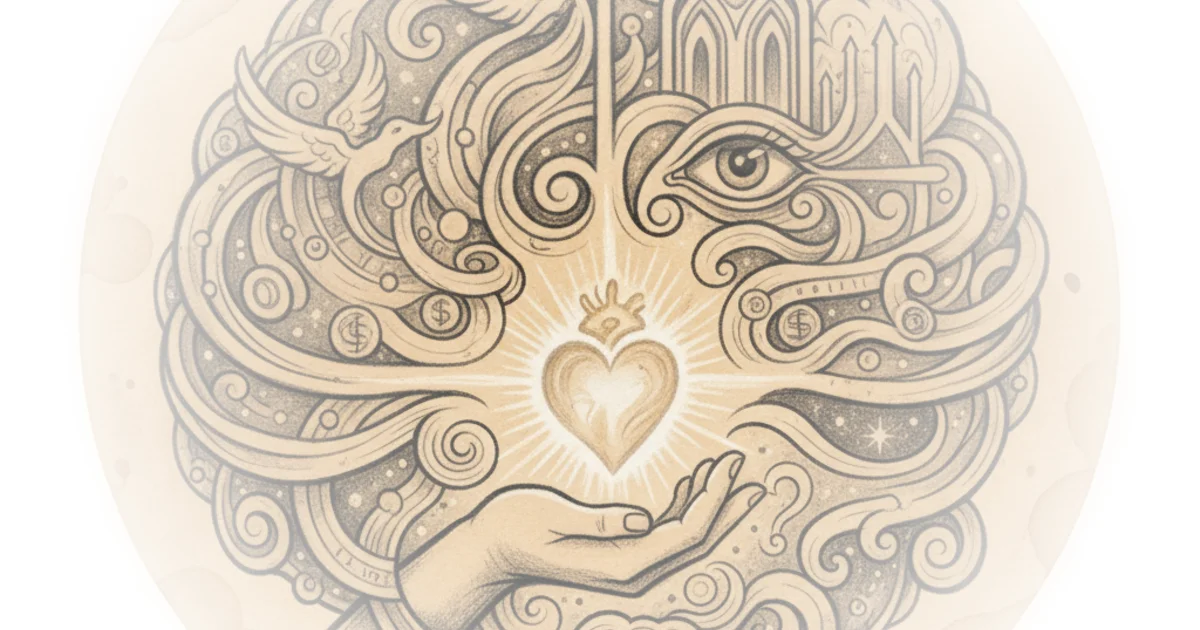
The Pragmatic Path to Faith
Here, Licon leans heavily on historical precedent, weaving in the legacy of Blaise Pascal. He points out that the 17th-century mathematician faced the exact same criticism: that faith cannot be forced. Pascal's response, detailed in The Pensées, was to suggest that one should act as if they believe until the belief takes root. Licon paraphrases this historical insight effectively: "Follow the way by which they began; by acting as if they believed, taking the holy water, having masses said, etc." The author draws a parallel between religious cultivation and other forms of belief formation, noting that people can be "politically radicalized, slowly over time, by hanging out with likeminded people, consuming political propaganda, and so on."
This comparison is provocative. It suggests that the mechanism of belief is less about divine intervention and more about environmental conditioning. Critics might note that equating religious conversion with political radicalization or cult indoctrination risks trivializing the spiritual dimension of faith, reducing it to a form of psychological manipulation. Yet, Licon's point stands: the process of coming to believe is often indirect, regardless of the starting motivation.
The Problem of Wrong Reasons
The most contentious part of Licon's argument addresses the second half of the thought experiment: even if the belief becomes sincere, would God object to the bribe as the catalyst? Licon acknowledges the intuition that a relationship founded on money feels "disingenuous." He asks, "Would we want someone to fall in love with us, even sincerely, if they were paid to?" The answer, he suggests, is likely negative, as it implies the relationship lacks authenticity.
"It would be like, say, to sincerely falling in love with someone because one was bribed. Would we want someone to fall in love with us, even sincerely, if they were paid to? Likely the answer is negative."
However, Licon pushes back against this intuition by introducing a counter-scenario. If the bribe leads to a profound religious experience, or if the person goes on to live a virtuous life, does the origin story matter? He draws a powerful analogy to those born into religious families: "It isn't a good reason to believe in God simply because one's parents believe." Yet, we rarely question the validity of a believer who grew up in a church home, even though their initial reason for belief was circumstantial rather than evidential. If a childhood upbringing is an acceptable "wrong reason" that leads to a "robust and deep relationship," Licon argues, why not a bribe?
This is the piece's most daring move. It challenges the notion that the motive for seeking truth invalidates the truth itself. A counterargument worth considering is that a bribe introduces a transactional element that fundamentally alters the nature of the relationship, whereas family upbringing is a passive context, not an active purchase. Licon admits this tension remains unresolved, leaving the reader to decide if the destination justifies the transactional start.
Bottom Line
Licon's strongest contribution is reframing belief not as a static state to be toggled, but as a dynamic process that can be cultivated through indirect means. His argument is vulnerable to the charge that it reduces faith to a psychological trick, yet it effectively exposes the hypocrisy of accepting belief born of upbringing while rejecting belief born of inquiry. The reader is left with a provocative question: if the end result is a sincere, life-changing relationship with the divine, does the currency of the journey truly matter?
"Even if a bribe started off her spiritual journey, it doesn't mean that she couldn't end up, at the end of the journey, with a proper and robust relationship with God."
The ultimate verdict is that the piece successfully dismantles the idea that belief must be purely spontaneous to be valid, forcing a re-evaluation of how we judge the authenticity of faith in a world where every choice has a cost.