This piece cuts through the usual hype to ask a brutal question: Is China's AI momentum hitting a structural ceiling? Paul Triolo, drawing on recent on-the-ground tours and a sharp critique from Peking University scholar Hou Hong, argues that the real gap isn't about who writes the best code, but who can build a commercial ecosystem where AI actually gets used. The data is stark and the implications are immediate for global investors and policymakers watching the next decade of tech dominance.
The Ecosystem Trap
Hou Hong's central thesis challenges the narrative that China is simply waiting for better chips. Instead, he posits that a "vicious low-growth cycle" is already locking the country into a lower trajectory. He writes, "The interaction of the factor side, the demand side and the competitive landscape has created a vicious cycle that traps its AI industry on a lower growth trajectory." This framing is crucial because it shifts the blame from external sanctions to internal market dynamics. The author points out that while China dominates in hardware manufacturing, its business-to-business sector is struggling to monetize AI. With only 8% of Chinese businesses adopting generative AI compared to a global average of 21%, the commercial engine is sputtering.
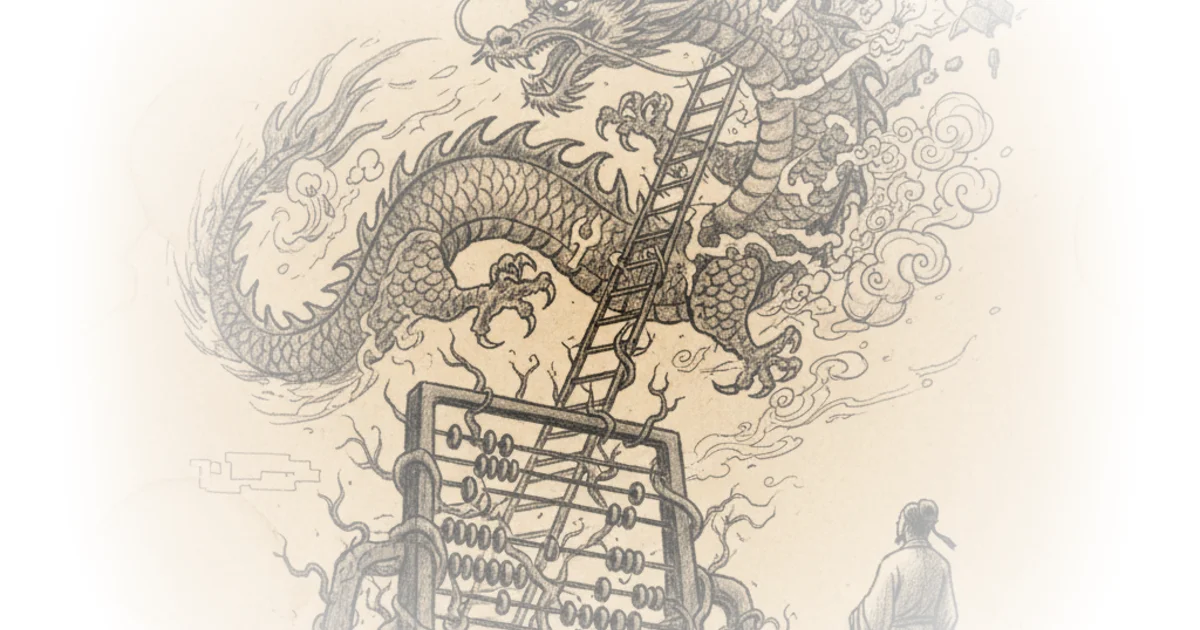
The argument gains weight when Hou contrasts the US and Chinese markets. He notes that in the US, "firms will pay a clear premium for the best model because productivity gains map directly to economic value." By contrast, he observes that "business to business in China is hard," forcing many innovative coding agents to seek revenue overseas while domestic users treat AI merely as a search upgrade. This distinction is vital; it suggests that without a mature enterprise culture willing to pay for efficiency, the most advanced models become expensive toys rather than economic drivers. Critics might argue that this overlooks the speed of state-mandated digital transformation, but the current data on adoption rates supports Hou's caution.
"Competition in the AI industry is unfolding along three trajectories... The Internet of Agents, meanwhile, enables the large-scale application of intelligence by establishing network effects and innovation ecosystems on a broader level."
The Agentic Divide
The commentary identifies the "Internet of Agents"—a network where AI systems interact with each other—as the new "commanding heights" of the competition. This is where the divergence becomes most dangerous for Beijing. Hou argues that while China is competitive in building large foundational models, it is falling behind in the application layer. He writes, "The recent surge in American agentic AI unicorn start-ups points to a flourishing application ecosystem underpinned by strong infrastructure, whereas China has only a handful of such start-ups." This isn't just a numbers game; it reflects a deeper structural issue where closed, walled-garden platforms like WeChat stifle the open interoperability required for an agent-based economy.
Triolo adds a layer of nuance here, suggesting that China's closed ecosystem might actually accelerate a specific type of deployment. He notes that "Chinese consumers and companies appear to be much more likely to embrace an agentic AI future than US companies and consumers," citing the recent launch of an agentic AI smartphone by ByteDance and ZTE. However, this speed comes at a cost. The author warns that this model "will require new regulatory structures that protect data and privacy, and anti-trust frameworks that will allow agents from various platforms to interact with applications that are controlled by big tech firms." Without breaking up these digital silos, the "Internet of Agents" remains a theoretical concept rather than a functioning market.
The Compute Illusion
A significant portion of the debate focuses on hardware. The pessimistic view holds that without access to advanced lithography, China cannot catch up. Hou acknowledges this, stating, "Upstream, China has limitations in advanced lithography/capacity and in the broader software ecosystem if compute becomes the binding constraint." Yet, the commentary offers a counter-perspective that the hardware gap may be less fatal than assumed. Triolo suggests that "major breakthroughs within the domestic semiconductor industry over the next two to three years" could narrow the divide, particularly as the industry shifts from training massive models to running inference.
The argument that "the compute gap is likely to become much narrower and much less of a factor over time" is compelling but relies on optimistic assumptions about domestic innovation. It also assumes that the US will not tighten export controls further. Triolo admits that "if both sides are able to approve and commence shipments of H200-class AI hardware to Chinese firms, in the short to medium term the compute capacity issue will be much more tractable." This highlights a critical vulnerability: China's AI future is currently tethered to geopolitical negotiations as much as technological breakthroughs. The reliance on a "manufacturing-dominated economy" and "limited consumer power" means that even if the chips arrive, the market demand to justify their use may still be missing.
"China must curb platform monopolies, expand risk capital and develop a domestic Internet of Agents ecosystem leveraging its strengths in telecoms infrastructure and manufacturing-embedded edge devices."
Bottom Line
The strongest part of this analysis is its refusal to treat AI as a simple race of model benchmarks; it correctly identifies the "Internet of Agents" and commercial adoption as the true battlegrounds where China currently lags. The biggest vulnerability in the argument is its assumption that domestic hardware breakthroughs will inevitably close the compute gap, a gamble that ignores the accelerating pace of US technological iteration. The reader should watch for whether Chinese regulators can actually dismantle the very platform monopolies that Hou Hong identifies as the primary barrier to the next phase of AI growth.