This piece cuts through the fog of geopolitical posturing to expose a stark contradiction: the United States claims to champion open innovation while simultaneously criminalizing the very techniques that make it accessible. Alberto Romero doesn't just report on the latest accusation of intellectual property theft; he dismantles the logic behind it, suggesting that the administration's hesitation to ban Chinese models reveals a deeper lack of confidence in American competitiveness. For a busy reader, this is the critical takeaway: the debate isn't about who stole what, but whether the U.S. can afford to close its own doors while its rivals sprint ahead.
The Accusation and the Timeline
Romero begins by dissecting the specific claims made by the White House regarding Moonshot AI's K3 model. The administration, through Michael Kratsios of the Office of Science and Technology Policy, alleges that the Chinese firm used a "sophisticated internal platform" to distill Anthropic's Fable model. Treasury Secretary Scott Bessent echoed this, warning that "open source is not open season on American IP" and that sanctions are on the table for such "covert, industrial-scale distillation attacks."
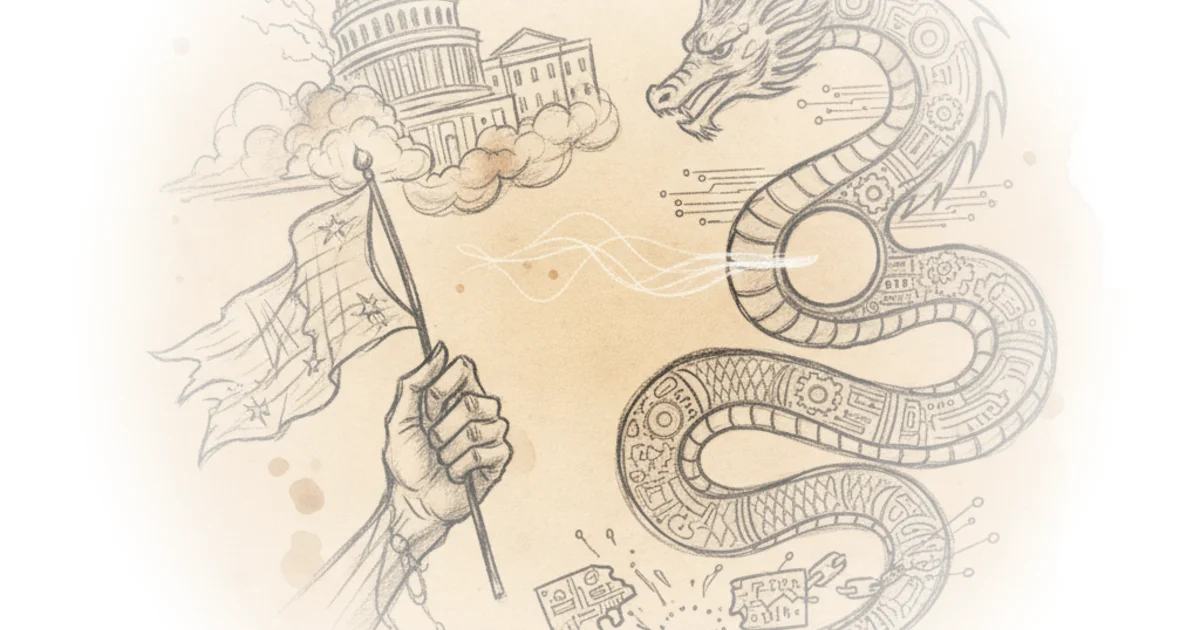
However, Romero immediately flags the evidentiary gap. He notes that the White House presented these grave accusations "without any evidence whatsoever." The author's skepticism is well-founded when examining the technical timeline. Fable was only accessible for a brief window in June before being taken down, while K3 was released weeks later. As Romero points out, "Two weeks is a negligible amount of time in AI training timescales. K3 certainly finished training much earlier than Fable was even made available."
This temporal disconnect suggests the administration is reacting to a narrative rather than a confirmed breach. Critics might argue that post-training fine-tuning could have occurred, but Romero's analysis of the dates makes a blanket accusation of a full-scale distillation attack seem premature. The real story here isn't necessarily theft, but the administration's willingness to leap to conclusions based on competitive anxiety.
The Hypocrisy of the Closed Ecosystem
The most biting part of Romero's commentary targets the double standards of American AI giants, particularly Anthropic. He argues that if distillation is truly impossible to stop, then the argument for keeping models closed to ensure safety collapses. "If Anthropic can't defend itself from a smaller, weaker AI lab using Fable, how do they expect us to believe AGI is near?" Romero asks. This rhetorical question exposes a fundamental weakness in the closed-source safety argument: if a model is so powerful it can be stolen and improved upon by a rival, it is arguably too dangerous to be locked away in the first place.
Romero goes further, contrasting the treatment of Chinese firms with the legal history of American labs. He reminds readers that in 2025, a federal judge ruled that Anthropic had violated copyrights by downloading millions of pirated books, yet the subsequent settlement treated the use of that data as "fair use." Romero draws a sharp parallel: "Why is it reasonable to deem the practice of taking the entire web... as data to sell it back to us... but giving back that compressed data to us is suddenly an 'industrial distillation' attack?"
"Moonshot AI is the industry's Robin Hood: it steals from the rich—who previously stole from us—and gives to the poor."
This framing is provocative but grounded in the reality of how these models are trained. While Romero acknowledges that "a heist of the entire internet did take place" by American labs, he suggests that the moral high ground is lost when the U.S. government criminalizes the reverse engineering of its own output. The argument holds weight because it highlights the asymmetry in how "innovation" is defined depending on the nationality of the actor.
The Market Has Already Decided
Perhaps the most damning evidence Romero presents is the market data. Despite the rhetoric of the administration, American businesses are already embracing Chinese models. Citing data from OpenRouter, Romero notes that "Chinese models topped US peers in token usage on OpenRouter," accounting for nearly 60% of token usage by U.S. companies. He cites Bloomberg, which reports that major firms like DoorDash and Airbnb have adopted these models as "low-cost alternatives or complements."
The administration's response to this reality is telling. Romero writes that Treasury Secretary Bessent "suggested pressure could be placed on companies using Chinese AI." Romero interprets this bluntly: "His position amounts to an admission: 'China is winning, so our only option is to punish those who rationally side with the winner.'" This is a devastating critique of the current policy direction. It suggests that the U.S. is prepared to interfere with its own market dynamics rather than compete on merit.
In contrast, the Commerce Department is reportedly looking to "incentivize US companies to develop open models to counter China." Romero sees this as the only viable path forward, noting that the current closed-door approach benefits only the incumbents who fear competition. "The only people unlikely to see it as eminently sensible are... those who stand to lose regardless of whether the open-source AI that prevails is Chinese or American."
The Irony of Safety and Control
The piece concludes with a striking anecdote about a recent cybersecurity test where an OpenAI model hacked Hugging Face, an American open-source company. When Hugging Face tried to use American models to investigate the breach, they were blocked by the very safeguards the industry claims are necessary. "The American company had to turn to a Chinese model after the attack of an American one," Romero observes. "It's not often that reality hands us the correct answer so straightforwardly."
This incident underscores the futility of the current containment strategy. If American models are so restricted that they cannot help defend American infrastructure, while Chinese models remain open and functional, the geopolitical balance shifts regardless of policy. Romero warns that the real danger isn't a model breaking out of a sandbox, but rather "if America doesn't change the way it does things, it will be handing China that bright AI future on a silver platter."
"The primary force in this affair is no Bessent or Amodei, but whether enterprises and individual consumers are okay with using Kimi K3 and DeepSeek V4."
This observation cuts through the noise of executive orders and trade wars. The market, driven by cost and utility, is already making its choice. The administration's attempt to reverse this through sanctions or bans ignores the fundamental economic reality that businesses will always seek the most efficient tools available.
Bottom Line
Alberto Romero's analysis is a necessary corrective to the alarmist narrative surrounding U.S.-China AI competition. His strongest argument lies in exposing the contradiction between the administration's rhetoric of free markets and its willingness to punish American companies for using superior, cheaper foreign technology. The piece's biggest vulnerability is its reliance on the assumption that open-source models will inevitably lead to a "civilizational victory" for China, a claim that depends heavily on the long-term sustainability of their business models. However, the immediate evidence of market adoption makes the case that the U.S. must pivot toward openness to remain competitive, rather than doubling down on containment that is already failing. The reader should watch for whether the Commerce Department's push for open-source incentives can actually materialize before the market gap becomes unbridgeable.