Then & Now makes a startling claim: that understanding the 19th-century German philosopher G.W.F. Hegel is not an academic exercise, but the key to decoding the very architecture of modern freedom, from Cold War communism to liberal interventionism. This piece distinguishes itself by refusing to treat Hegel as a dusty relic, instead framing his dense work as a "world spanning Soul penetrating painful joyous and fulfilling Journey" that explains why we feel alienated today and how we might find our way back to a sense of belonging.
The Kantian Wall and the Hegelian Bridge
The coverage begins by dismantling the dominant philosophical framework of the late 18th century, specifically the work of Immanuel Kant. Then & Now writes, "Kant puts up a wall we know what we see we know what we smell and hear and perceive and we could think logically about things like mathematics but we cannot go beyond that." The author argues that Kant created a hard boundary between our subjective experience and the "thing in itself" (the reality of the world independent of our perception). This is a crucial setup because it isolates the human mind, suggesting we can never truly know the universe, only our representation of it.
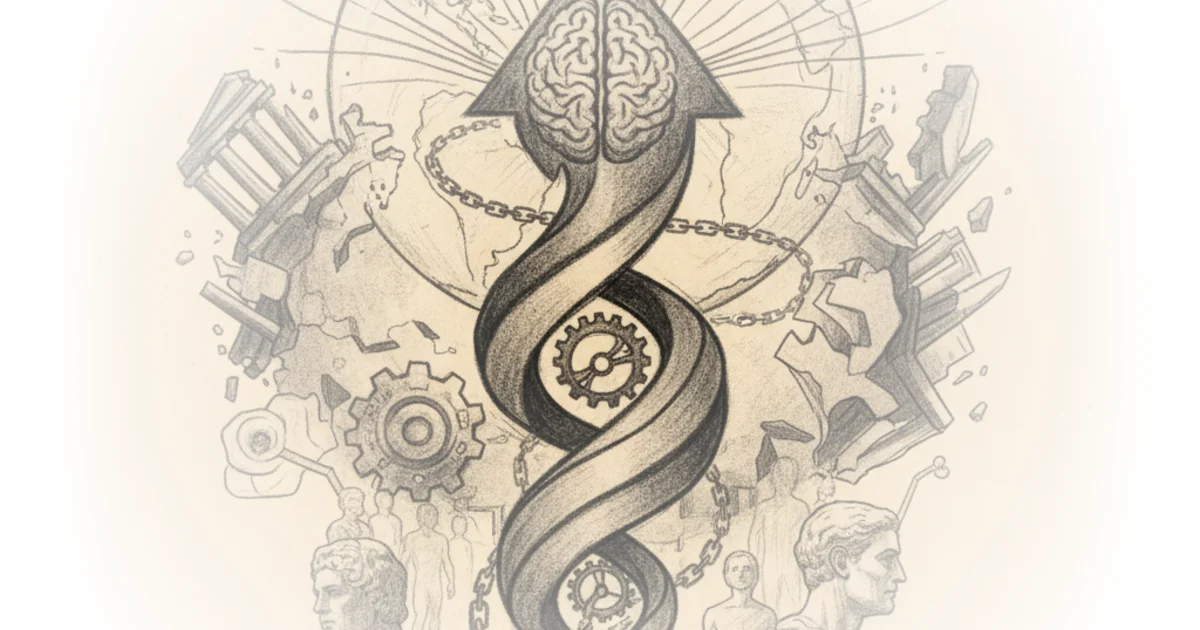
Hegel's entire project, as described by Then & Now, is an attempt to knock down that wall. The author notes that Hegel found Kant's limitation "counter-intuitive," arguing instead that "we're part of it all." This reframing is powerful because it shifts the reader's perspective from being an observer of the world to being an active participant in a single, unified substance. Then & Now writes, "Hegel affirms what Kant denies that it's possible to have a knowledge through pure reason of the absolute or the unconditioned." This is the core of the piece's argument: that the separation between the thinker and the world is an illusion that creates modern alienation.
Critics might note that Hegel's rejection of Kant's limits is highly controversial and has been debated for two centuries; many philosophers argue that Kant was right to be humble about what we can know. However, Then & Now effectively sidesteps this technical debate to focus on the consequence of Hegel's view: the desire for a total, unified understanding of reality.
The Firework Metaphor and the Search for Home
To make these abstract concepts accessible, the author employs a striking visual metaphor. Then & Now asks the reader to "imagine the absolute as bathing in the totality of the universe all is one but this also seems like a beginning." They describe the human experience as a single spark from a firework, spiraling away from the center, "grasping looking towards the center at all of the other Sparks knowing that we were are can be part of something bigger." This imagery transforms Hegel's complex dialectic into a relatable story of longing and return.
The commentary highlights that modern life often fails to satisfy this longing, leaving us feeling "alienated from nature from ourselves from different parts of ourselves and from each other." Then & Now writes, "Hegel sees the world as an organic unity and that includes us ideas others animals history and everything else in that history." This framing suggests that the solution to modern existential dread isn't to retreat into individualism, but to recognize our embeddedness in a larger historical and natural process.
We do this with everything and I mean everything it goes on behind the scenes but count said we only have limited senses a limited ability to perceive certain spectrums of light and sound certain smells certain sensitivities to the touch other animals have other limited senses but we are all subjective finite limited creatures we cannot really know what can't called the thing in itself.
From Abstract Analysis to Living History
The piece argues that previous philosophers, while rigorous, were too static in their approach. Then & Now writes, "none of that explains what it's like to be at a fireworks display what that means what philosophers seem to have left out is life process history and connecting that analytical piece of knowledge to the totality as a movement." This is a vital distinction: Hegel is presented not as a system-builder who files ideas away, but as a thinker of movement and process. The author suggests that true knowledge comes from understanding how ideas evolve and interact over time, rather than analyzing them in isolation.
The commentary posits that Hegel's method is a "picture gallery of shapes of Consciousness as they move through that process." Each shape represents a stage in human understanding that asserts itself as absolute truth, only to be challenged and expanded by the next. Then & Now writes, "one entry point into Hegel is to ask what it means to reflect on the world reflection like a mirror suggests a doubling in thinking about what I think about the world." This recursive process of reflection is presented as the engine of progress, driving us from simple awareness to "Absolute knowing."
A counterargument worth considering is that this view of history as a rational, unfolding process can be dangerous if it implies that current political realities are the inevitable and "correct" endpoint of history. Then & Now touches on this by mentioning how Hegel's ideas have influenced both "Cold War communist regimes" and "liberal interventionism," hinting at the double-edged nature of believing in a singular historical trajectory.
Bottom Line
Then & Now succeeds in demystifying Hegel by focusing on the emotional and existential stakes of his philosophy rather than getting bogged down in technical jargon. The strongest part of this argument is the reframing of alienation not as a personal failure, but as a structural disconnect between the individual and the universal. The piece's biggest vulnerability is its optimistic assumption that a total, unified knowledge is actually attainable, a claim that many modern thinkers would dispute. For the busy reader, the takeaway is clear: understanding the logic of history and our place within it is the only way to stop feeling like a lost spark and start feeling like part of the fire.
The beginning is an end that we want to get back to and this points to another part of hegel's Beginnings that people like Kant and Spinoza had got a lot right they were analytical rational meticulous but they were very abstract as if to know what a firework spark is is to analyze its trajectory its brightness its chemistry and combustion none of that explains what it's like to be at a fireworks display.