Andy Masley delivers a rare, forensic takedown of a best-selling narrative, exposing how a single mathematical error in Karen Hao's Empire of AI has distorted the global conversation on technology and water. While the book frames data centers as colonial plunderers draining the world's rivers, Masley demonstrates that the core statistics are off by a factor of 4,500, turning a legitimate concern into a "wildly misleading" alarmist fantasy. For busy readers trying to separate signal from noise in the AI boom, this is a crucial correction that demands attention before the next policy cycle begins.
The Illusion of Consumption
The piece opens by dismantling the book's most cited statistic: the claim that AI will consume 1.1 to 1.7 trillion gallons of fresh water by 2027. Masley writes, "The study mentioned is 'Making AI Less Thirsty.' The study does not say that AI demand will consume 1.1-1.7 trillion gallons of water annually." He points out that the author of the book confused "withdrawal"—water taken from a source and often returned—with "consumption," which is water permanently removed via evaporation.
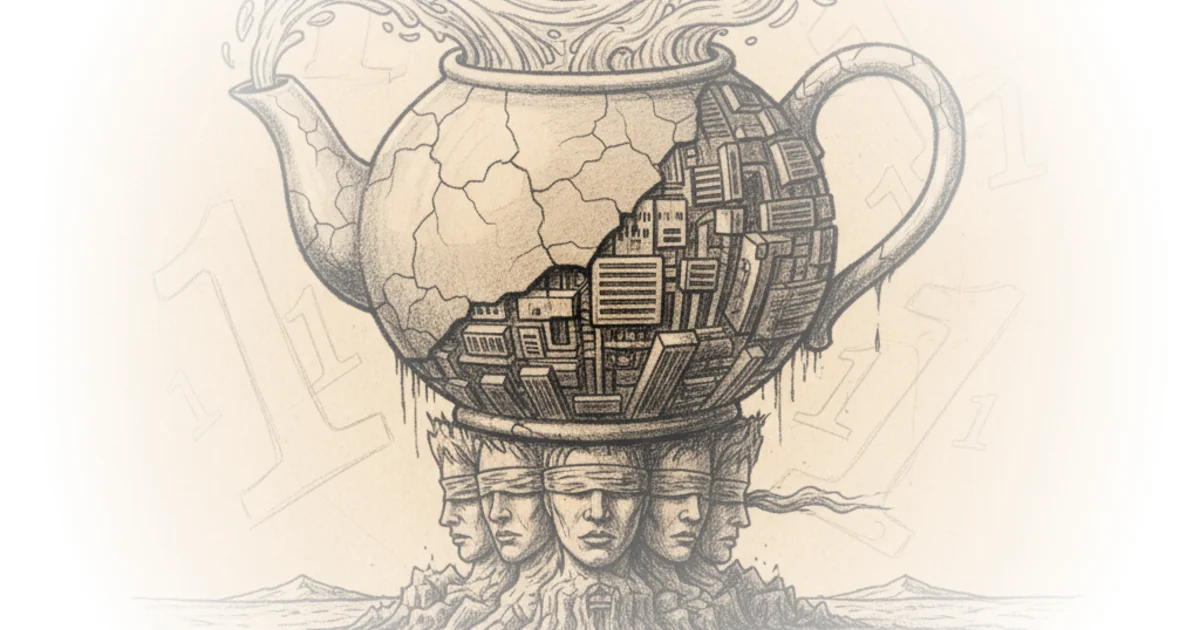
This distinction is not merely semantic; it is the difference between a temporary disruption and a permanent drain. As Masley notes, "Withdrawal is very different from consumption. Withdrawal means the amount of water taken from a local source. Consumption is the amount of water taken and not returned to the local source." He illustrates this with a simple analogy: diverting a river to run a mill and returning it is not the same as sucking the river dry. The book's narrative relies on the reader assuming the worst-case scenario, yet the data suggests 90% of the water cited is returned to the source unaffected.
"Every single time water's mentioned in this book, the reader is left with a worse understanding than they came in with."
The error compounds when looking at the type of water used. The book implies a massive drain on potable (drinking) water, but Masley clarifies that the vast majority of the water involved is used by offsite power plants, not the data centers themselves. "Basically none of the water power plants use is potable," he argues. "The only potable water used for AI is in data centers themselves." When corrected for this, the actual volume of drinking water at risk is a mere fraction of the book's claim—roughly 3% of the number Hao presents. Critics might argue that even small amounts of potable water are precious, but Masley's point stands: framing the issue as a "drinking water crisis" when it is largely a matter of industrial cooling water creates a false sense of urgency that distracts from real resource management.
A Factual Catastrophe in Chile
The most damning section of Masley's analysis focuses on a specific case study in Chile, where the book claims a Google data center uses 1,000 times more water than a city of 88,000 people. Masley identifies this as "the single largest error in any popular book that I've found on my own." He breaks down the math: the author of the book divided the data center's usage by a municipal total that was itself off by a factor of 900.
"The average citizen of Chile buys 180 liters per day from their municipal water systems," Masley writes, contrasting this with the book's implication that residents were using a fraction of a liter. "This implies that a city of 88,000 people is using as much water per day in total as a single shower head left running." The result is a narrative where a single building is portrayed as a resource vampire consuming the equivalent of a city of 88 million people.
This error is particularly damaging because it is woven into a broader argument about colonialism. The book frames the data center as a continuation of historical plunder, yet Masley notes that the facility would actually use only ~0.3% of the municipal water system. "If instead you see data centers using water in other countries as part of a simple trade the countries are making to get more taxable industry in the area, and that doesn't seem to harm water access, the central narrative thrust of the chapter becomes false." The stakes here are high: by misrepresenting the data, the book undermines the credibility of legitimate environmental activism.
"She implied that a single building is using as much water as a city of 88 million people. That's over 4x the entire population of Chile!"
Masley also contextualizes this within the broader history of water infrastructure, noting that while the book cites a "megadrought" in Chile, the data center's actual impact is negligible compared to agricultural and industrial usage in the region. He references the historical context of cooling towers and data center water footprints to show that modern facilities are often more efficient than the public imagines, yet the book's "wildly misleading" claims prevent a nuanced discussion.
The Cost of Bad Data
The piece concludes by addressing the broader implication: why does this matter? Masley argues that the book has become a primary reference for the AI/environment conversation, meaning its errors are now being cited in policy debates and media coverage. "One of the most common replies I've received to my water arguments is that I should read it," he writes. "So I did, and I came away kind of shocked at how badly it covered the issue."
The danger is that by painting a picture of "brutal acts of torture and plunder" where none exists, the book alienates potential allies and obscures the actual challenges. As Masley puts it, "My only ask for people writing about AI and the environment is that at the end, readers are left with a more accurate picture of how energy and water is being used overall in the regions covered." The alternative is a public discourse driven by "contextless impression of AI as a huge environmental offender in places where it's not."
Critics might suggest that highlighting the potential for future strain is a valid precautionary principle, even if current numbers are low. However, Masley's evidence suggests that the book isn't just being cautious; it is actively misrepresenting the present reality, which makes it harder to address genuine future risks when they arise.
Bottom Line
Andy Masley's critique is a masterclass in fact-checking, exposing how a single unit conversion error can derail a book's entire thesis and mislead a generation of readers. While the book's intent to scrutinize the environmental cost of AI is noble, its reliance on flawed data renders its central narrative about "plunder" not just exaggerated, but factually inverted. The strongest takeaway is that accurate environmental stewardship requires precision, not panic, and the AI industry's water footprint is far more complex—and far less catastrophic—than popular literature suggests.