This piece does not merely recount the history of meteorology; it resurrects a forgotten vision of science as a radically democratic, participatory act. Justin E. H. Smith reveals how Jean-Baptiste Lamarck, often dismissed as a failed evolutionist, was actually a pioneer who sought to turn every French citizen into an observer of the sky, long before the term "biology" existed. In an era where scientific expertise is increasingly siloed and elite, Smith's excavation of Lamarck's 1802 yearbook offers a startlingly modern argument for the value of public engagement with data.
The Democratization of the Sky
Smith frames Lamarck not just as a scientist, but as a revolutionary democratizer of knowledge. While his English contemporary Luke Howard sought to standardize cloud names in Latin for the exclusive use of the "learned of different nations," Lamarck made a deliberate, political choice to use French. Smith writes, "Lamarck, on the other hand, used French terms... because he hoped to create a participatory community of meteorologists that would include the non-learned." This distinction is crucial: it was not a linguistic accident, but a rejection of the idea that understanding nature should be the province of the aristocracy.
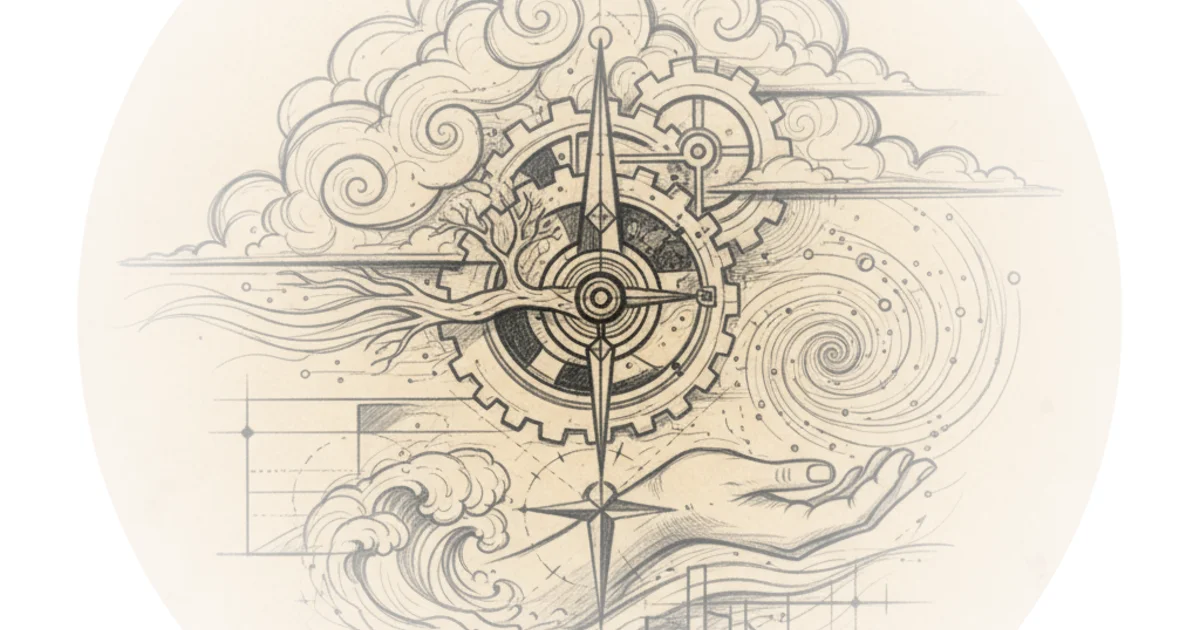
The author highlights how Lamarck's 1777 classification of clouds—dividing them into types like "veiled," "gathered," and "dappled"—was initially shelved for twenty-five years until he could publish it in a format accessible to the public. Smith notes that while Howard's Latin terminology eventually won out internationally, Lamarck's approach was rooted in a specific moment of revolutionary fervor. He argues that "embarking on an entirely new science, Lamarck was free to define its terms as he liked," choosing accessibility over tradition.
"Only an educated minority would have understood Latin terms; and Latin names would have indicated that meteorology was an elite, scholarly pursuit, which was exactly the opposite of what Lamarck intended."
This framing is powerful because it challenges the modern assumption that scientific rigor requires specialized jargon. Smith suggests that Lamarck's failure to gain lasting traction in the Anglosphere may be due to this very commitment to inclusivity, which clashed with the emerging professionalization of science. A counterargument worth considering is whether this accessibility came at the cost of precision, yet Smith implies that the loss of Lamarck's voice was a cultural tragedy, not a scientific necessity.
The Moon, The Metric, and The Amateur
The piece takes a fascinating turn when detailing Lamarck's specific methodology, which blended rigorous observation with what modern science might deem superstitious. Lamarck's central principle was that the moon's gravitational pull created "atmospheric tides," influencing weather patterns based on its position in the zodiac. Smith explains that Lamarck divided the year into "boreal" and "austral" constitutions, believing the moon's north-south movement dictated wind and rain.
While the lunar influence on weather is a fringe theory today, Smith points out that "Lamarck's essential idea remains present in current meteorological science," albeit in a much more refined form. The real innovation, however, was the mechanism of data collection. Lamarck didn't just publish forecasts; he invited readers to annotate their copies of his yearbook, creating a distributed network of observers. Smith writes, "He issued a special 'invitation to amateurs of meteorology' encouraging readers to annotate their copies of the book by recording their own observations in them."
This participatory model extended to the metric system. Even though the new system of weights and measures was causing public resentment, Lamarck included thorough explanations in his yearbooks. Smith argues this was a strategic move to spread scientific literacy: "Here was a further expression of his purpose to spread scientific literacy and a participatory feeling among his readers." The author effectively uses this detail to show that for Lamarck, science was not just about discovering facts, but about reshaping the citizenry's relationship with the world.
"The emotional, the lyrical and the scientific were all one sky, one weather system, one world. And the observer — Lamarck himself and each of his readers — was right there in the thick of it, not outside looking in."
Smith's analysis here is particularly strong because it refuses to separate the "mistakes" of Lamarck's science from the brilliance of his methodology. The lunar theory was wrong, but the call for public observation was visionary. This mirrors the historical context of the Bureau des Longitudes, where similar tensions between elite calculation and public utility played out, though Lamarck took the radical step of handing the pen to the public.
The Beauty of the Storm
Perhaps the most evocative section of the piece is Smith's description of Lamarck's aesthetic engagement with weather. Far from the detached observer, Lamarck is portrayed as a man who found "the most imposing and the most beautiful" phenomena in storms. Smith recounts Lamarck's rapturous description of a hurricane in 1808, where he witnessed a "large rotating cloud" that resembled "an enormous pyramid" with its summit pointing downward.
Smith writes, "The storm's great diversity of cloud shapes and colors had fascinated him, their rapid dance across the sky so 'magnificent' that 'I couldn't tire of admiring the beautiful spectacle before my eyes.'" This passage underscores Smith's central thesis: that for Lamarck, the appreciation of beauty was inseparable from the practice of science. It was while standing in the midst of the storm that Lamarck made his discovery of the funnel cloud, noting that the "misty parts of the waterspout" turned "as if around an axis but rising and forming a spiral."
The author suggests that this emotional connection is what made Lamarck's science so compelling to his contemporaries. He didn't just want people to measure the barometer; he wanted them to feel the "intimate relations that each particular state of the sky exercises on us." Smith concludes that this holistic view—where the observer is part of the system—offers a corrective to the cold, detached objectivity that often characterizes modern scientific communication.
"Science and the appreciation of beauty were inseparable, since it was while he stood rapt in the midst of the storm, watching the drama unfold, that Lamarck made a surprising observation."
Critics might argue that this romanticization of science risks obscuring the need for empirical rigor, but Smith's evidence suggests that Lamarck's rigor was simply different, rooted in a deep, personal engagement with the natural world rather than a desire to dominate it.
Bottom Line
Justin E. H. Smith's commentary on Lamarck is a masterful re-evaluation of what science can be when it is stripped of its elitist armor. The strongest part of the argument is the demonstration that public engagement is not a modern invention but a lost tradition of the Enlightenment, one that prioritized participation over prestige. The piece's biggest vulnerability is its reliance on a historical figure whose specific scientific theories were largely discredited, yet Smith successfully argues that the method of inquiry remains more relevant than ever. Readers should watch for how this model of "citizen science" is being revived today, proving that the sky is still an immense laboratory for everyone.