A Political Prisoner's Prayer Life
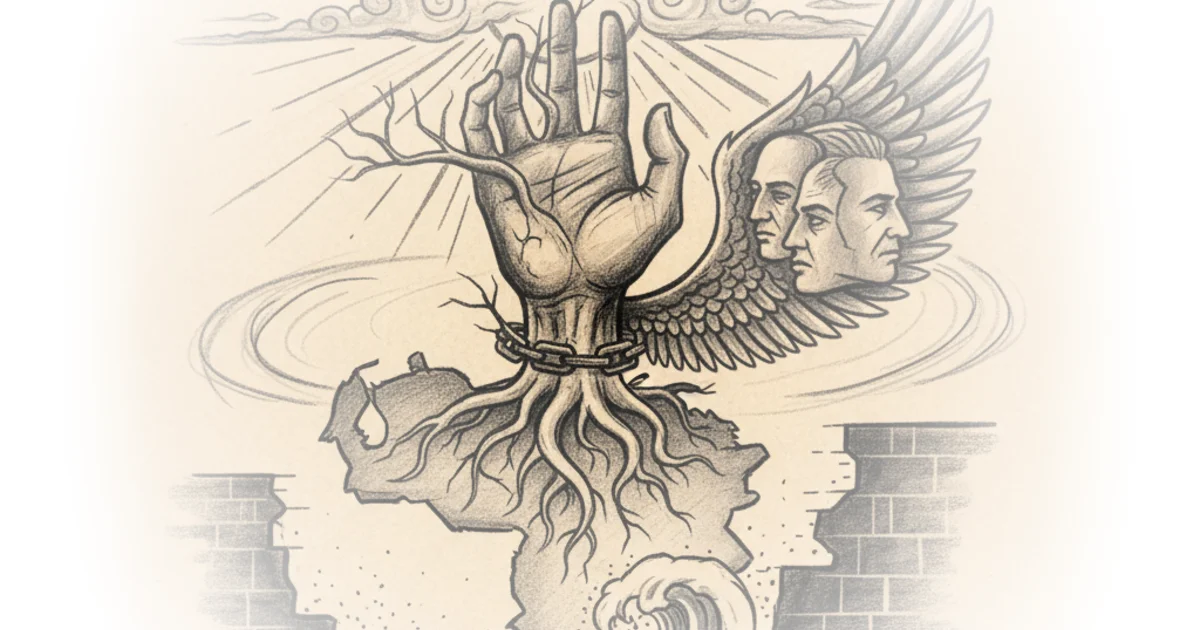
Juan Pablo Guanipa, a veteran Venezuelan opposition politician and self-described right hand of Nobel Peace Prize laureate Maria Corina Machado, spent nine months in solitary confinement after being arrested on May 23, 2025, on charges of conspiracy and terrorism. In an interview with The Pillar, a Catholic news outlet, Guanipa describes how he transformed his cell into something resembling a monk's quarters, building a daily routine around prayer, exercise, and gratitude that he credits with sustaining him through conditions that included no bathroom, no mirror, and a one-inch mattress.
The interview, conducted in Spanish after Guanipa's release in February 2026, covers his prison spirituality, the Catholic Church's role in Venezuelan politics, and his own pro-life convictions. It is a striking document of faith under duress, though one that raises questions about how neatly personal piety maps onto political struggle.
Building a Chapel from Nothing
Guanipa's account of his daily routine is remarkably specific. He describes waking each morning and commending himself to the Holy Trinity, the Virgin Mary, and Saint Joseph, followed by what he calls a battery of saints including Saint Josemaria Escriva, founder of Opus Dei, and two Venezuelan saints. He took up the Rosary for the first time while imprisoned, fashioning a makeshift counting tool from the one religious object he had on him at the time of arrest:
Cuando me arrestaron en mayo, me piden que me vista y en el pantalón que me puse, tenía un escapulario en el bolsillo. Cuando me meten en mi celda, yo convertí ese escapulario en un decenario, le hice 10 nudos para rezar cada misterio del Rosario.
That detail, converting a scapular into a ten-bead rosary by tying knots, carries the specificity of lived experience. It is hard to fabricate.
His nighttime practice was equally intense. Guanipa says he recited the Glory Be, a short Trinitarian doxology, one hundred times before sleeping each night. He explains why with a theological observation that is surprisingly thoughtful for a politician:
No sé por qué pero se me vino a la cabeza durante mi tiempo en prisión que el Gloria era una oración muy olvidada. Pero es muy importante, porque es alabar a las tres divinas personas.
The phrase that Guanipa says he coined in prison, a kind of personal creed of gratitude, is worth noting for its simplicity:
Gracias, Dios mío, por todo lo que me has dado, por todo lo que me has ayudado, por todo lo que me has perdonado y por todo lo que me has amado.
"Thank you, my God, for all you have given me, for all you have helped me, for all you have forgiven me, and for all you have loved me." The four-part structure, moving from provision to assistance to forgiveness to love, has an almost liturgical cadence.
Gratitude Even for the Cell
The interviewer presses Guanipa on whether his gratitude extended to the imprisonment itself. His answer is unequivocal:
Totalmente. Yo creo que de todo se aprende. Yo no puedo decir que yo quería ir preso. Jamás en la vida. Yo me escondí durante 10 meses. Estuve en 12 sitios distintos. Hice todo para que no me detuvieran, pero al final me detuvieron.
He is quick to clarify he did not seek martyrdom. He hid for ten months in twelve different locations. But once captured, he chose to interpret the experience as providential. He describes being shackled, hands chained to waist to feet, and responding by praying and shouting "Viva Venezuela libre."
Critics might note that this framing, where suffering becomes a gift from God, can serve a dual purpose: it sustains the prisoner, but it also makes excellent political narrative. The line between genuine spiritual experience and the construction of a political identity around persecution is not always clear, and Guanipa, a career politician, is surely aware of the power of the story he is telling.
The Sacraments Denied and Reclaimed
One of the most revealing passages concerns Guanipa's repeated requests to see a priest, all denied without explanation. Unable to receive the sacraments, he confessed directly to God with what he describes as a commitment to confess properly to a priest upon release. When he was finally moved to house arrest, a priest friend visited, but even then Guanipa could not confess:
No pude confesarme porque tenía la duda de que hubiesen micrófonos en mi casa.
The fear of surveillance extending even into the sacrament of confession is a chilling detail. The priest gave him general absolution and communion instead. Twelve days later, upon full release, Guanipa says he went almost immediately to the priest's home for a proper confession lasting about an hour. His summary is characteristically direct:
Es muy sabroso estar en gracia de Dios.
"It is very delicious to be in God's grace." The colloquial phrasing, "sabroso" meaning tasty or delightful, carries a warmth that more formal theological language would miss.
Between the denied sacraments and the surveillance anxiety, Guanipa's account paints a picture of a regime that controls not just political activity but attempts to reach into the most intimate corners of spiritual life.
The Church, the Pope, and Political Liberation
When the conversation turns to the Church's role in Venezuela, Guanipa reaches for his most significant historical comparison: Pope John Paul II and the fall of communism in Poland. He argues the Church should actively work for Venezuela's liberation, not merely call for nonviolence:
Yo le pediría que escuche bien al pueblo venezolano. He leído algunas de sus declaraciones sobre Venezuela y lo he visto preocupado por el país, lo he visto tratando de ver cómo se involucra. Pero la solución no solo es decir que no debe haber violencia.
This is a polite but pointed critique of Pope Francis. Guanipa wants active ecclesial engagement in regime change, not just pastoral concern. He acknowledges the January 3 capture of former dictator Nicolas Maduro by the United States was problematic, saying it should not have happened, but places the blame squarely on Maduro for creating the conditions that led to it.
A counterargument is that the Church's institutional credibility depends precisely on not being instrumentalized by any political faction, however sympathetic. Guanipa is asking the Pope to take sides in a political conflict, which is a different thing from the Church's social teaching on human rights and dignity. The John Paul II comparison, while flattering to Guanipa's cause, elides the considerable differences between 1980s Poland and 2020s Venezuela.
Catholicism Without a Buffet
The interview's most direct theological moment comes when Guanipa is asked how he reconciles working with opposition figures who support abortion rights. His response is blunt:
El catolicismo no es un mapa que puedes recortar y quedarte con lo que te gusta. No es un buffet en el que te sirves los platos que te gustan y dejas fuera lo que no. Eres católico y no lo eres y punto.
"Catholicism is not a map you can cut up and keep what you like. It is not a buffet where you serve yourself the dishes you like and leave out what you do not. You are Catholic or you are not. Period." The metaphor is vivid and the position is uncompromising.
He says he would never vote for legislation undermining the right to life, even if his own party instructed him to, though he adds that his party, which he describes as center-humanist and grounded in Catholic social doctrine, would likely never ask. He sidesteps the specific question about Machado's views by saying he does not know her position on these issues, a diplomatic non-answer from a man who is described as her closest political ally.
Bottom Line
Guanipa's interview is a compelling account of faith practiced under extreme conditions. The granular detail of his prayer routine, the improvised rosary, the hundred nightly Glory Be recitations, the fear of microphones during confession, these carry the texture of authentic experience. His theological instincts are sound if uncomplicated: gratitude as a discipline, the sacraments as essential rather than optional, Catholic teaching as indivisible.
The weakest points emerge when private faith meets public strategy. Guanipa deploys his imprisonment and his piety as political credentials, which is understandable but worth noting. His call for the Church to champion Venezuelan liberation risks reducing the institution to a tool of one political movement. And his careful non-answer about Machado's views on abortion suggests the "no buffet" principle may be more flexible in coalition politics than in theology. Still, as a portrait of how religious conviction can sustain a person through solitary confinement and state persecution, the interview is powerful and specific in ways that demand respect.