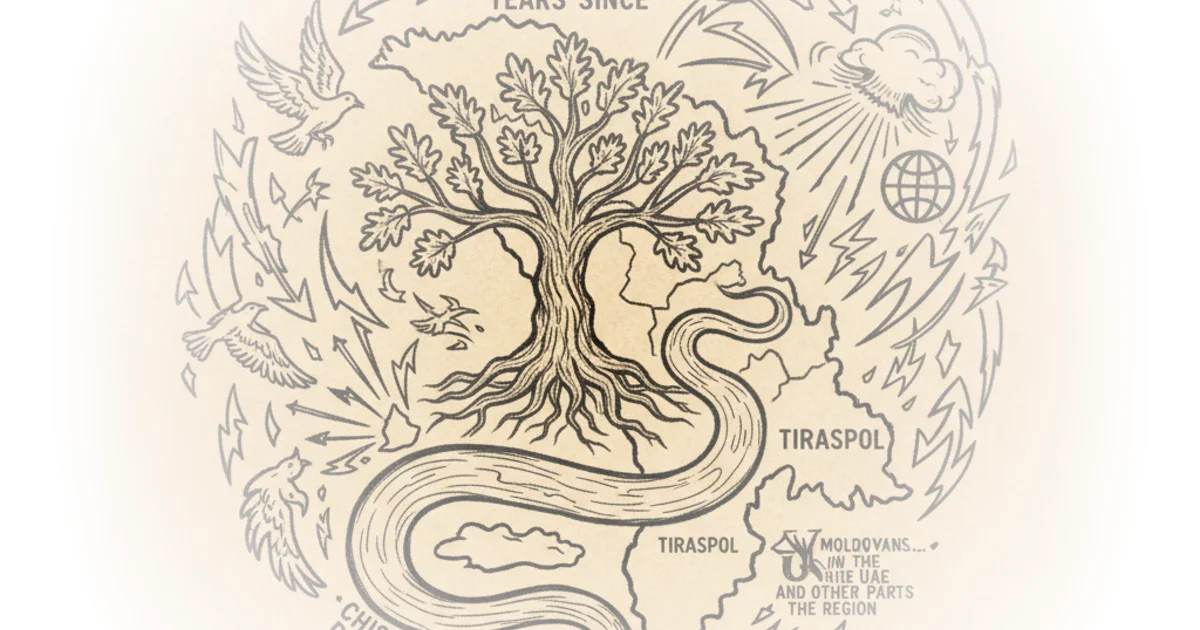
On March 2nd, 2026, Moldova marked 34 years since the Transnistrian war, a four-month conflict in 1992 that killed an estimated 1,500 people across both banks of the Dniester River. David Smith, writing for Moldova Matters, uses the anniversary as a frame for what amounts to a catalogue of mounting pressure from Chisinau on the breakaway region, and it is a packed week by any measure.
Smith opens with a brief nod to the Iran crisis before pivoting to domestic affairs. President Maia Sandu led the March of Remembrance through central Chisinau, laying flowers at the "Mourning Mother" statue and delivering a speech that left little room for ambiguity about who she considers the aggressor, then and now.
"In 1992, the aggressor was Russia. Today, in Ukraine, the aggressor is Russia. To say that 'both sides are guilty' is to falsify the truth. Moral neutrality in the face of aggression is not only cowardice, but also a lie."
Sandu went further, framing cognitive warfare as the modern successor to the tanks of 1992. Smith quotes her at length, and the speech builds to a memorable line connecting memory to national security.
"Without memory, there is no identity. Without identity, there is no resilience. Without resilience, there is no security."
The rhetoric is forceful. Whether it resonates beyond Chisinau's already pro-European electorate is another question entirely.
Citizenship Revocations and Economic Leverage
The week's concrete actions mattered more than the speeches. On February 25th, Sandu signed a decree stripping citizenship from nine individuals holding senior roles in Transnistria's unrecognized governing structures. The Security and Intelligence Service, known by its Romanian acronym SIS, provided the referral. Smith reports that at least two of the nine fought for the separatists during the 1992 war, while others served in the region's "Supreme Soviet," its "Central Election Commission," or its security services.
"The withdrawal of citizenship of the Republic of Moldova is a form of sanction for exercising functions within unconstitutional structures on the left bank of the Nistru River, for continuous actions to undermine the sovereignty and territorial integrity of the state, as well as for serious violations of the rights of citizens of the Republic of Moldova."
Smith notes that a December 2025 amendment to Moldova's citizenship law created a carveout allowing citizenship revocation even when it would leave someone stateless, provided the acts were sufficiently grave. It remains unclear whether any of the nine hold Russian citizenship or are left only with Transnistria's universally unrecognized documents.
The following day, members of the ruling Party of Action and Solidarity, abbreviated PAS, introduced legislation to gradually eliminate tax exemptions enjoyed by Transnistrian companies. The initial targets would be "socially non-essential" goods like alcohol, with broader categories to follow. Radu Marian, chairman of the Economy, Budget and Finance Committee, estimated the equalization would generate 3.3 billion lei, roughly 164 million euros, in additional state revenue. Starting August 2026, that money would flow into a new "Convergence Fund" earmarked for expanding public services to Moldovan citizens living in the Transnistria region.
Critics might note that revoking citizenship and tightening economic screws simultaneously could harden Transnistrian resistance rather than encourage reintegration. Stripping nine officials of their citizenship is symbolically potent, but it risks deepening the identity divide at a moment when Chisinau says it wants convergence.
A Foiled Assassination Plot with Transnistrian Threads
Smith devotes significant space to a Russian-orchestrated assassination plot targeting Ukrainian public figures, foiled jointly by Moldovan and Ukrainian security services. Twelve people were detained across Chisinau, Kyiv, and Odesa. The alleged organizer, a 34-year-old Moldovan citizen named Nicolae Sepeli, was recruited by Russian intelligence while serving time in a Russian prison for drug trafficking.
"After returning to Moldova, he supported pro-Russian groups whose activities were aimed at destabilizing the country and organizing mass protests in 2022-2023."
The network planned to kill at least five Ukrainian officials, including high-ranking military personnel, leaders of state enterprises, and at least one journalist reported to be Dmitry Gordon. Contract killers were to receive up to $100,000 per target. Ukraine's SBU, the country's Security Service, released photos showing that one detainee carried an identification card from Transnistria's PGTRK television channel.
The Sepeli case also created a political headache for Sandu. She had pardoned him in April 2022 after a process that began under a previous government. The pardon was supported by human rights and anti-trafficking nongovernmental organizations on the grounds that Sepeli had been fraudulently lured to Russia as a courier and did not realize he would be forced into drug trafficking. Smith carefully traces the multi-year pardon process, noting that investigative journalists at ZdG have mapped the entire chain.
"As of the time of writing, no wrongdoing has been found or alleged at any stage of this process which involved officials appointed by all Moldova's major political parties at one stage or another."
Smith handles this delicately. The pardon looks bad in hindsight, but his reporting shows the process followed standard procedures. A counterargument is that even a clean process can reveal systemic vulnerability: if Russian intelligence can recruit assets in foreign prisons and then exploit routine pardon mechanisms, the vetting system itself needs strengthening regardless of who signed off.
Corruption, Courts, and the Plahotniuc Trial
The newsletter's crime section is dense with developments. The Plahotniuc "bank fraud" case, tied to Moldova's infamous 2014 "Theft of the Billion" scandal, completed its judicial investigation phase on February 26th. A secret witness described how the oligarch used a Romanian consultant named Bogdan-Andrei Gheorghiu to build a web of shell companies collectively called UNIASIA HOLDINGS, through which approximately $35 million moved between 2013 and 2015. The sums involved are staggering: a 32-million-euro yacht, a 40-million-euro hotel in Spain, a private plane.
Separately, anti-corruption police conducted searches across nine districts targeting the embezzlement of European Union funds meant for road and sewage construction. Phone intercepts captured conspirators discussing how to cut material deliveries in half and lay asphalt at 60 to 80 percent of the required thickness.
The forestry agency Moldsilva also came under investigation for fictional employee contracts totaling over four million lei. Environment Minister Gheorghe Hadjder was blunt about what the audits found.
"It's not just illegal logging; there are also unaccounted surpluses, unjustified expenses, and work that's just on paper. We will not tolerate corruption, which is why dismissals and sanctions have followed."
Economic Headwinds and Small Wins
Smith rounds out the edition with economic news. A United States Supreme Court decision reduced Moldova's tariff rate from the "Liberation Day" rate of 25 percent down to 10 percent, though Smith adds a wry footnote noting that subsequent announcements of 15 percent were never implemented. Moldova's trade with the US reached $244.9 million in 2025, with wine accounting for 62 percent of exports.
On the domestic front, PAS lawmakers introduced a bill requiring supermarkets to display the country of origin on price tags, potentially including a national flag, to make it easier for shoppers to choose local products. Radu Marian framed the initiative in characteristically ambitious terms.
"It is an initiative through which we want to transform a simple act - daily shopping - into an engine supporting the national economy."
Chisinau also allocated 70 million lei for park-and-ride commuter lots, a practical response to a city designed for 90,000 vehicles that now contends with over 400,000.
Bottom Line
Smith's strength in this edition is breadth without sacrifice of detail. The newsletter covers Transnistrian geopolitics, an international assassination plot, oligarch trials, EU fund embezzlement, forestry corruption, trade policy, and municipal parking, all in a single issue, and each section includes sourced links and useful context like footnotes explaining the difference between Moldova's right and left banks.
The argument running through the piece, sometimes implicit and sometimes stated outright, is that Moldova under Sandu is simultaneously hardening its stance toward Transnistria and Russia while trying to build European-standard institutions at home. The vulnerability is that these two projects can pull against each other. Aggressive moves on citizenship and taxation may satisfy the European-oriented electorate but could complicate the reintegration diplomacy that the 1+1 talks with Transnistria's Vitali Ignatiev are meant to advance. The IMAS poll Smith cites, showing 39 percent of respondents rating the Munteanu government between one and four out of ten, suggests that domestic patience for institution-building is thinner than Chisinau's reformers might hope. Smith reports this tension faithfully without overstating it, which is exactly the right editorial posture for a newsletter that serves as many readers' primary window into Moldovan affairs.
Like most of the world, Moldovans this week have been focused on the unfolding war in Iran and its regional spillover. Minister of Foriegn Affairs Mihai Popșoi called for restraint and condemned Iran’s attacks against its neighbors. Many Moldovans live and work in the UAE and other parts of the region and over 100 have requested help evacuating, though none have been injured or killed to date. While the world watches Iran, we had an eventful week in Moldova so here’s our roundup.
34 Years Since the Transnistrian War.
On March 2nd Moldova marks the Day of Memory and Gratitude commemorating those who died in the Transnistrian war. It’s not definitively known how many people died in the 4 months of war from March to July 1992, but estimates suggest 300 combatants and 400 civilians from the right bank1, and around 800 total from the left bank.
On the occasion President Sandu, Prime Minister Munteanu and Speaker of Parliament Grosu laid flowers at the statue of Stefan Cel Mare and then participated in the March of Remembrance through central Chisinau to the war memorial. There, they laid flowers at the statue “Mourning Mother” and President Sandu spoke to honor the sacrifice of the fallen and all veterans saying “The commemoration of the heroes of the war on the Dniester reminds us that freedom is not a given. It must be protected.”
She spoke of Moldova’s struggle for freedom and for the right of people to speak their own language and have their own traditions. Then, the President connected the events of 34 years ago with the present saying:
“We need to call things by their proper names.
In war, the aggressor is the one who attacks.
In 1992, the aggressor was Russia.
Today, in Ukraine, the aggressor is Russia.
To say that “both sides are guilty” is to falsify the truth. Moral neutrality in the face of aggression is not only cowardice, but also a lie. And solidarity between peoples who have experienced aggression is a duty.
The Republic of Moldova did not covet foreign territories. It did not start wars. It only defended its ancestral land.
And even today, the aggression against our country has not disappeared. Only the methods have changed.
If in 1992 aggression came with tanks, today it comes through propaganda, manipulation and disinformation. We are living a true cognitive war — a war that targets ...