Rebecca Gordon delivers a harrowing indictment of global indifference, arguing that while the world fixates on Gaza, a far larger genocide is unfolding in Sudan with catastrophic human costs that demand immediate attention. She posits that the silence surrounding this crisis is not accidental but structural, rooted in a media landscape that prioritizes certain conflicts while erasing others, leaving millions to starve and die in the shadows.
The Scale of the Silence
Gordon opens by drawing a stark geographic and moral line from the Gaza Strip southward to Sudan, challenging the reader to recognize a parallel catastrophe. "Follow a line south and west from the Gaza Strip, continue through Egypt, and you'll end up in another place where a genocide is in progress," she writes. This framing is effective because it forces a comparison that the American public has largely refused to make, highlighting the disparity in coverage despite the sheer magnitude of the suffering in Sudan.
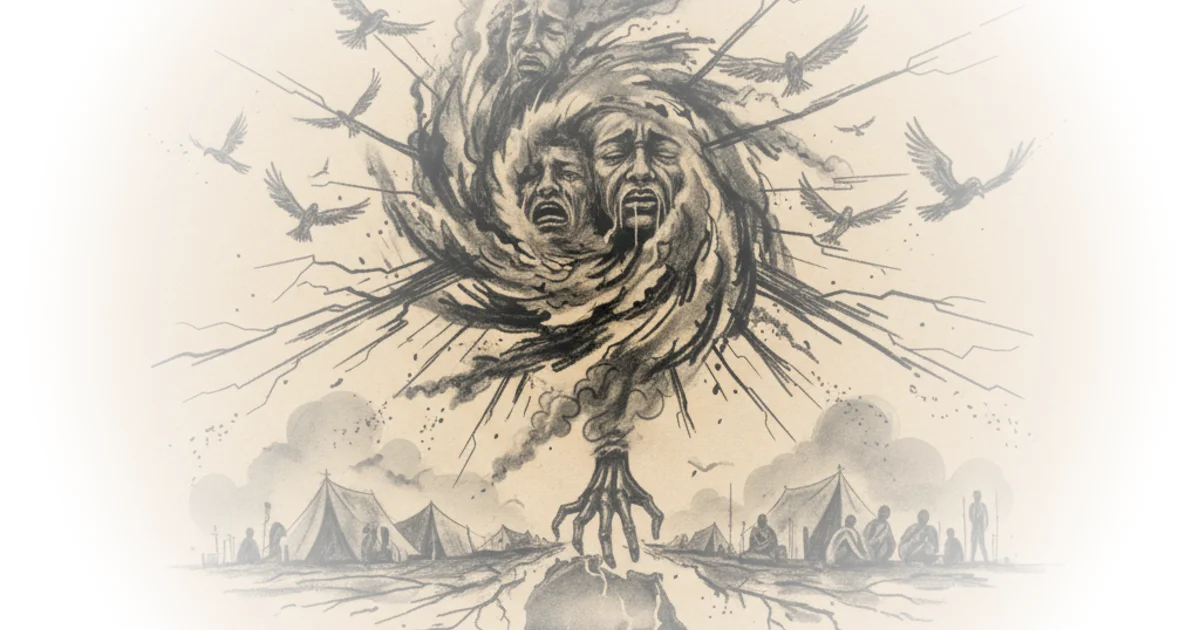
She underscores the sheer scale of the humanitarian disaster with chilling precision. "Right now, about 45% of those people, 21.2 million of them, 'are facing the highest levels of acute food insecurity,'" Gordon notes, citing the UN's World Food Program. The numbers are staggering, yet they remain abstract to many outside the region. Gordon drives the point home by contextualizing the displacement: "compared to the ongoing genocide two countries to the north, the number of starving people in Sudan is 10 times the entire population of Gaza, while the number of displaced Sudanese is almost six times that number." This comparison is the article's most potent rhetorical device, forcing a reckoning with the hierarchy of human value in global media.
Critics might argue that comparing two distinct conflicts risks diluting the specific historical and political nuances of each. However, Gordon's intent is not to equate the causes but to highlight the disparity in the global response to mass suffering, a distinction that holds up under scrutiny.
The situation in Sudan holds an important warning for the movement opposing the current administration in this country.
The Machinery of War
The piece shifts to the roots of the conflict, tracing the current violence back to the 2019 uprising that ousted long-time autocrat Omar al-Bashir. Gordon explains how the military, initially a partner in the transition, eventually seized power, leading to the current civil war between the Sudanese Armed Forces (SAF) and the Rapid Support Forces (RSF). She provides crucial historical context by linking the RSF to the Janjaweed militias responsible for the genocide in Darfur between 2003 and 2005, reminding readers that this is not a new conflict but a continuation of old, unresolved violence exacerbated by climate change and resource scarcity.
Gordon describes the current siege of el-Fasher with unflinching detail. "In October 2025, they finally made their way into the city, massacring civilians (including '500 patients and their companions' in the Saudi Maternity Hospital), while committing mass rape," she writes. The specificity of the hospital attack serves as a grim testament to the collapse of all norms of war. She amplifies the human toll through the words of a refugee: "The RSF fighters stripped us of everything we had—money, phones, even our nice clothes... At each stop they would make you call your relatives to transfer money to your mobile phone account before they let you move on to the next checkpoint." This anecdote transforms abstract statistics into a visceral narrative of extortion and terror.
The author argues that the conflict is sustained by international actors who supply weapons and resources, turning Sudan into a proxy battlefield. "A key US ally in the Middle East, the United Arab Emirates (UAE), appears to be the main supplier of arms to the RSF," Gordon states, noting that the motive is strategic access to the Red Sea and Sudan's gold reserves. This framing shifts the blame from local warlords to the geopolitical interests of powerful nations, a necessary corrective to the narrative of African chaos.
The Cost of US Policy
Gordon does not let the United States off the hook, detailing how recent policy decisions have directly exacerbated the crisis. She points to the dismantling of USAID as a critical factor in the deepening famine. "When President Trump's erstwhile First Buddy Elon Musk spent a February 2025 weekend 'feeding USAID into the wood chipper,' he condemned thousands of people in poor countries to death," she writes. The metaphor is sharp and memorable, illustrating the human cost of bureaucratic cuts.
She further details the impact on health services: "the World Health Organization says an estimated 5 million Sudanese people may lose access to lifesaving health services as a result of the US cuts." This section is particularly damning as it connects domestic political maneuvering to foreign deaths. Gordon also highlights the immigration policy, noting that Sudan is among the countries where applications have been halted, leaving refugees with nowhere to go. "Sudanese immigrants retain Temporary Protected Status in this country, which prohibits their being sent back to Sudan, until it expires in October 2026," she notes, adding a layer of uncertainty to the lives of those already displaced.
A Warning for Democratic Movements
In the final section, Gordon pivots to a broader political argument, using Sudan as a cautionary tale for democratic movements in the United States. She reflects on the 2019 Sudanese uprising, where a nonviolent movement successfully ousted a dictator, only to see the military seize power shortly after. "The answer to that 'key question' turned out to be: 'Probably not,'" she writes regarding the movement's ability to hold out against the military. This historical parallel serves as a sobering reminder that ousting a leader is not the same as securing democracy.
She draws a direct line to the current political climate in the US, questioning the goals of the opposition movement. "Is Trump's resignation our goal?" she asks, warning that a change in leadership without a broader structural shift could lead to similar outcomes. "Success would, unfortunately, bring JD Vance to the presidency, while leaving in place Trump's anti-democratic handlers," she argues. This is a provocative claim that challenges the reader to think beyond electoral politics to the deeper institutional dynamics at play.
Critics might suggest that equating the US political landscape with Sudan's military coup is an exaggeration. However, Gordon's point is not to equate the severity of the regimes but to warn against the complacency that can follow a political victory if the underlying power structures remain intact.
The goal was to replace a dictator with a civilian government. Is Trump's resignation our goal?
Bottom Line
Gordon's most powerful contribution is her refusal to let the world look away from Sudan, using stark comparisons and human stories to expose the moral bankruptcy of the global response. Her argument is strongest when she connects US policy decisions directly to the deepening famine, forcing a reckoning with American complicity. The piece's greatest vulnerability lies in its reliance on a specific political narrative of the US administration, which may limit its appeal to readers who view the crisis through a purely humanitarian lens, yet this political framing is essential to her warning about the fragility of democratic gains. Readers should watch for how the international community responds to the siege of el-Fasher and whether the US will face pressure to reverse its aid cuts before the situation becomes irreversible.