The Forgetting Filter
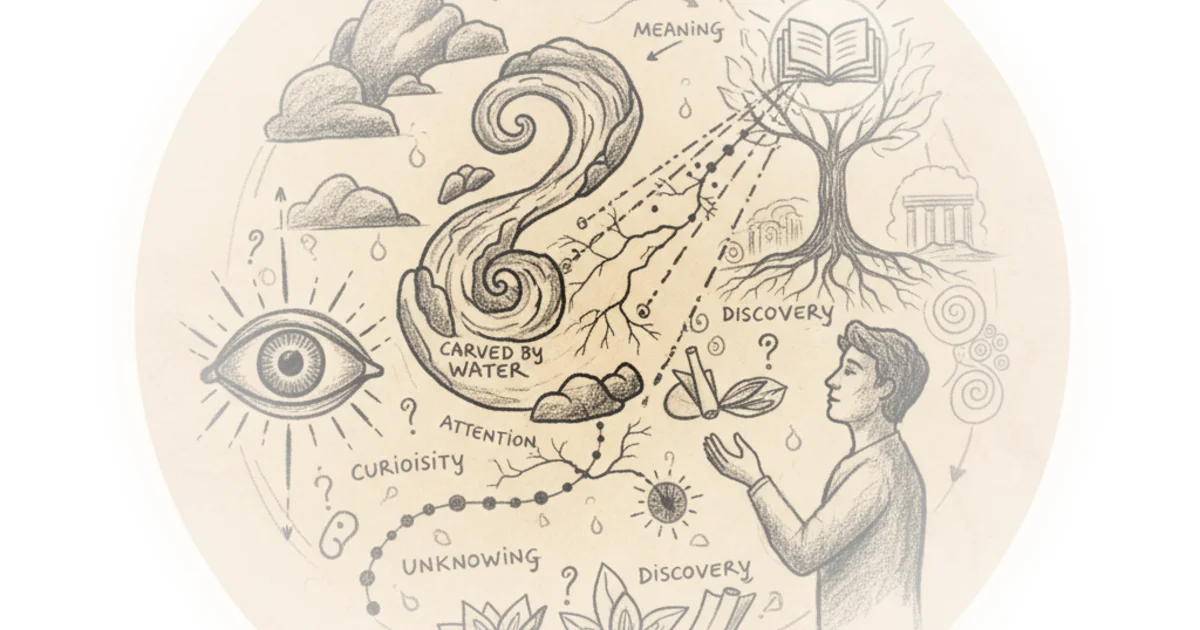
Jeannine Ouellette, writing instructor and author of the Substack newsletter "Writing in the Dark," opens her latest post with a four-word formula: curiosity, attention, discovery, meaning. It is a sequence she positions as the engine of creative writing, and she spends the bulk of this essay arguing that writers must cultivate a deliberate state of "unknowing" to let that engine run. The piece doubles as a craft lesson and a case study, tracing how one of her students, Billie, turned loose retreat scribblings into a lyric essay nominated for a Pushcart Prize in 2022.
The argument is essentially this: writers who impose structure and expectation too early suffocate their best material. The antidote is looseness, patience, and trust that memory will do the sorting for you.
Lauren Groff and the Bankers Box Method
Ouellette anchors her case in a New York Times profile of novelist Lauren Groff, whose drafting process is almost aggressively physical. Groff writes entire first drafts in longhand, then locks them in a bankers box and never reads them again. She starts the book over from memory. As Ouellette quotes from the profile:
It's not even the words on the page that accumulate, because I never look at them again, really, but the ideas and the characters start to take on gravity and density.
Groff takes this further, insisting that only sensory fragments matter between drafts:
Nothing matters except for these lightning bolts that I've discovered, the images that are happening, the sounds that are happening, that feel alive. Those are the only things that really matter from draft to draft.
Ouellette clearly admires this process. She frames it as evidence that creative writing benefits from a kind of natural selection applied through memory. What survives the forgetting is, by definition, the most vital material. It is an elegant idea, and Ouellette presents it with genuine enthusiasm.
Critics might note, however, that Groff is a novelist with five-year timelines and the luxury of working on multiple projects simultaneously. The bankers box method may be less practical for writers who produce on shorter deadlines or who lack the established career that permits such extended gestation.
Handwriting and the Brain
Ouellette supplements her argument with research from Johns Hopkins University on the cognitive advantages of handwriting over typing. She cites a 2020 study showing that handwriting practice:
refines fine-tuned motor skills and creates a perceptual-motor experience that appears to help adults learn generalized literacy-related skills "surprisingly faster and significantly better" than if they tried to learn the same material by typing on a keyboard or watching videos.
The leap from literacy acquisition research to creative writing craft is one Ouellette makes quickly, claiming that handwriting allows writers to drop into what she calls "System II thinking" more easily than typing. She references Daniel Kahneman's framework here, though a counterargument is that Kahneman's System 2 describes slow, deliberate, analytical thought, which is arguably the opposite of the loose, intuitive flow state Ouellette seems to be describing. The neuroscience of handwriting and creativity is real, but the theoretical framing could be tighter.
Billie's Path to a Pushcart Nomination
The heart of the essay is the story of Billie, whom Ouellette identifies as "Z's mom and author of Dumpster Yoga." At a 2018 writing retreat Ouellette hosted at Naniboujou on the North Shore of Lake Superior, Billie struggled to stitch together a coherent piece from weekend workshop fragments. Overwhelmed by reverse culture shock after returning from China, Billie spent most of the allotted revision time staring at frozen ground.
Then, with thirty minutes left, Billie turned to a blank page and wrote from memory rather than revisiting notebook pages. As Billie recalls:
Bits and pieces of everything I had been working on came flowing onto my page. I don't remember exactly what I wrote that day--and that notebook is long gone, or long buried in a pile of other notebooks someplace somewhere--but I do remember that the writing was alive. The words that survived the forgetting and re-remembering process were electric and urgent.
That draft never became a finished piece on its own. But its language and rhythm migrated into later work. Billie describes the long afterlife of that retreat session:
The piece I wrote at Naniboujou never became anything more complete in itself, but it did evolve into more than the sum of its parts over time. For one thing, I stole some of the language and transplanted it into later essays and poems. But more than any specific verbiage I lifted, the thing that resonated the longest from that draft was its rhythm, the drumbeat of its lines, and white space between disjointed fragments.
Those fragments eventually fed into "Beneath The Break," a lyric essay published by So to Speak Journal and nominated for a Pushcart Prize in 2022. The trajectory is genuinely compelling: workshop scraps, filtered through memory, becoming the rhythmic backbone of a prize-nominated essay four years later.
Water, Stone, and Metaphysical Claims
Ouellette tracks a specific image through Billie's writing life. A line written at Naniboujou, "channels of stone carved by water long gone," eventually found its way into an essay about a wedding anniversary that had not even occurred when the line was first drafted. Ouellette finds this deeply meaningful:
This play between stone and water became one of the recurring themes of their essay and echoed in one of the final lines--"I didn't know what love was. I still don't. But I know water, however soft, is capable of cutting stone."
She reinforces this with a passage from Toni Morrison comparing writers to rivers that remember their original courses. Morrison's language is characteristically precise and striking. Ouellette then extends the water metaphor into a broader claim about creative energy, arguing that essays and physical spaces alike reach "tipping points" where accumulated intention pulls everything into alignment.
This is where the essay makes its most ambitious and least defensible move. Ouellette illustrates her tipping point theory with an anecdote about delivery drivers suddenly bringing packages to Billie's front door after days of leaving them on the sidewalk. She attributes this not to the drivers learning the route or Billie's neighbors providing guidance, but to an "energy shift" caused by Billie's unpacking and organizing inside the house. The claim is offered without qualification:
There was an energy shift in the space inside and outside of their new house. They reached a tipping point, a point where things got closer to what, where, and how they wanted to be, and that energy pulled everything else into better alignment.
As craft advice about writing process, the underlying idea is sound: sustained attention to a project generates momentum and coherence. As a literal claim about metaphysical energy directing delivery drivers, it strains credibility.
The Three Contradictory Truths
Early in the piece, Ouellette frames the central tension of creative unknowing as three truths writers must hold simultaneously: that their writing should live free of pressure and premature expectation, that time spent in unknowing is valuable regardless of outcome, and that the work might still become something real and meaningful. She invokes Stephen Jay Gould's observation that the most dangerous stories are the ones we think we know best and therefore never question.
This triple framework is the essay's strongest structural element. It names the psychological paradox of creative work with unusual clarity. The writer must care and not care at the same time. Must invest without attachment. Must be ambitious without being goal-oriented.
Ouellette is at her best when she sits inside this contradiction rather than trying to resolve it.
Bottom Line
Ouellette's essay succeeds as a case study in iterative creative process. The trajectory from Billie's retreat scribblings to a Pushcart-nominated lyric essay is specific, well-documented, and genuinely instructive. The Groff material enriches the argument, and the three-truths framework is a useful articulation of what creative unknowing actually demands of a writer. The writing itself models what it preaches: discursive, associative, willing to follow tangents before circling back.
The vulnerabilities are twofold. First, the metaphysical claims about energy and alignment drift from craft advice into unfalsifiable territory, which may alienate readers who were otherwise persuaded by the concrete examples. Second, the essay is embedded within an ongoing Essay Challenge and Zoom write-in community, which means portions of it read as logistics and promotion rather than argument. Stripped of those scaffolding elements, the core insight, that memory is a ruthless and reliable editor, stands on solid ground.