Forget partisan talking points. Devin Stone’s forensic dissection of the "Doge tapes" exposes how a federal agency was gutted in 22 days by amateurs armed with ChatGPT—and why a Holocaust archive project got labeled "DEI." What makes this urgent isn’t the politics; it’s the terrifying precedent of algorithmic governance without accountability, captured in raw deposition footage most won’t see.
The Algorithmic Guillotine
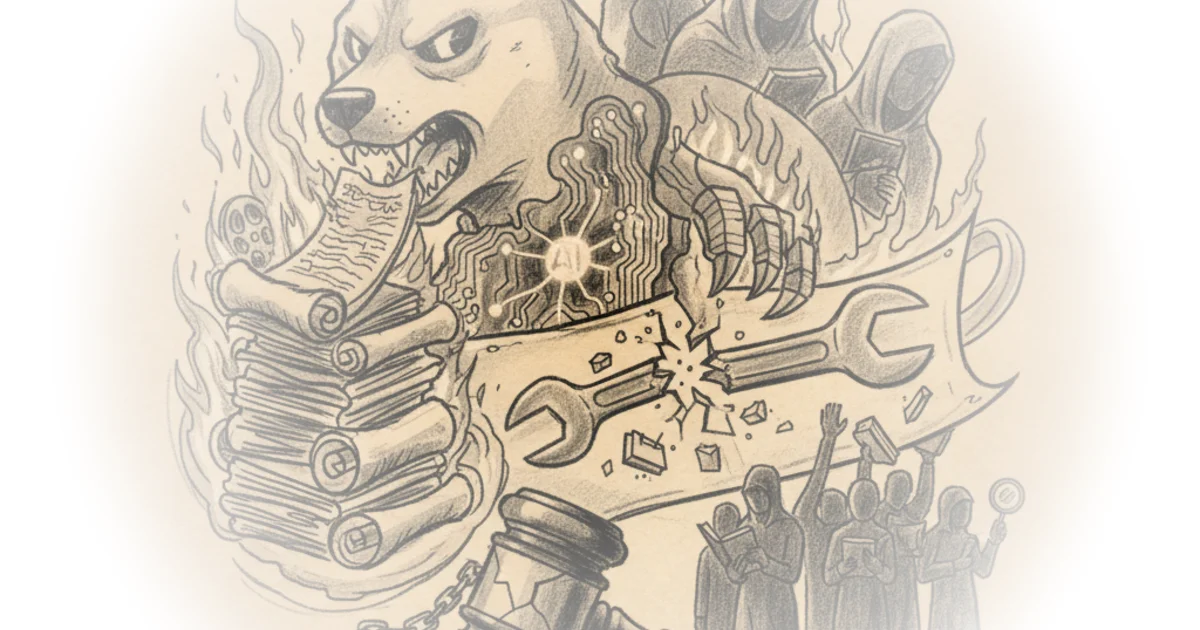
Stone meticulously reconstructs how Doge staffers weaponized AI to cancel $100 million in congressionally approved grants. He reveals that Justin Fox, a Doge operative with no humanities background, fed NEH grant descriptions into ChatGPT-4.5 with a single blunt prompt: "Does the following relate at all to DEI? Respond factually in less than 120 characters." As Stone writes, "The prompts given to Chat GPT did not identify specific criteria of what DEI means. In fact... there was no consistent definition of DEI guiding this process at all." This wasn’t oversight—it was automated arbitrariness. Stone underscores how Fox compiled a "detection list" of forbidden terms like "indigenous," "LGBTQ," and even "equality," turning AI into a blunt instrument for ideological purges. The core argument lands because Stone doesn’t just allege—it shows the machine in action, like when ChatGPT flagged a museum’s HVAC upgrade for "providing greater access to diverse audiences" and slapped it with a "#dei" tag. Critics might argue agencies should cut wasteful spending, but Stone proves the process lacked even minimal legal guardrails—echoing how 1945 liberation records showed Nazi archives deliberately destroyed to erase Jewish history, making today’s preservation efforts not "DEI" but historical necessity.
"It’s inherently discriminatory to focus on... females during the Holocaust. It’s a Jewish specifically focused on Jewish cultures and amplifying the marginalized voices of the females in that culture."
When "Diversity" Erases History
Stone’s most devastating section centers on how Doge’s AI dragnet canceled a documentary about Jewish women’s slave labor during the Holocaust—"a production of a feature-length documentary about Jewish female slave labor during the Holocaust using as a lens one daughter’s journey to uncover her mother’s past." He highlights Fox’s testimony that this was "inherently related to DEI" because it focused on "marginalized female voices." Stone connects this to a deeper legal fracture: Trump’s executive order banning DEI never defined the term, leaving agencies to invent criteria on the fly. As he puts it, "DEI is just a state of mind, man. But the lack of consistent definition matters legally." This reframing is brilliant—it shifts the debate from culture-war rhetoric to administrative law. Stone proves the terminations violated the Administrative Procedure Act by being "arbitrary and capricious," since even Doge’s own staff later admitted the Holocaust project wasn’t DEI. The argument overlooks nothing: he notes how similar keyword-flagging tactics have infected Anti-BDS laws, where vague terms like "boycott" are weaponized to silence academic dissent. Yet Stone’s focus on deposition transcripts—like McDonald’s stunned admission that he "had no basis saying what information [Fox] was feeding into ChatGPT"—makes the legal case feel visceral, not theoretical.
Pressure from the Top
Stone traces how speed and political coercion overrode legality. He cites Fox’s urgent message to NEH’s McDonald: "We’re getting pressure from the top... but let us know if you’re no longer interested." Kavanaaugh later confirmed this was a "time pressure tactic" citing White House demands. Stone argues this proves the cuts weren’t fiscal but ideological—especially since NEH’s entire $27 million budget is "so small you have to write it in scientific notation" compared to private wealth. The commentary here is razor-sharp: Stone notes how Doge conflated "wasteful spending" with undefined political targets, creating a self-licking ice cream cone of bureaucracy. When pressed on whether canceling $140 million in grants reduced the deficit, Kavanaaugh stumbled: "What are you... definitionally saying wasteful spending is here?" Stone’s genius is showing how this linguistic void—where even the destroyers can’t define their terms—makes the process constitutionally fatal. A counterargument worth noting: agencies do need oversight. But Stone demolishes that by highlighting how NEH’s work (like preserving endangered Native American languages) aligns with Congress’s mandate, not partisan whims.
Bottom Line
Stone’s triumph is turning dry deposition footage into a masterclass on how lawless power hides behind tech jargon—proving that when "DEI" becomes a magic word to justify cuts, even Holocaust archives aren’t safe. His vulnerability? Underplaying how common AI screening is across agencies, making this a systemic crisis, not just a Doge scandal. Watch for the judge’s ruling on whether the tapes prove unconstitutional viewpoint discrimination—a test that could redefine federal grantmaking for decades.