This week's roundup from The Pillar does something rare in religious journalism: it treats a centuries-old feast day not as a nostalgic ritual, but as a live wire for the Church's most urgent crisis of public identity. While other outlets might simply list the news, this piece argues that the true power of a Corpus Christi procession lies not in the sacrament itself acting as a talisman, but in its ability to desensitize Catholics to the "strong ick factor" of being publicly religious in secular neighborhoods.
The Public Witness Paradox
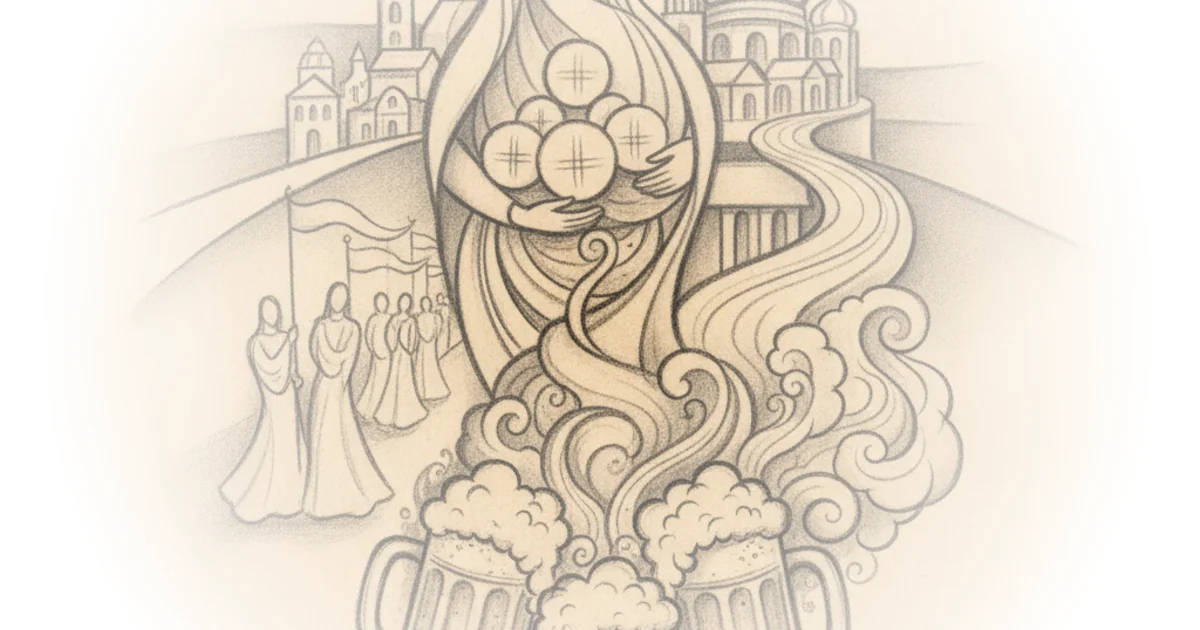
The editors open with Pope Leo's recent encouragement for street processions, calling them a "beautiful manifestation of public witness to the faith." Yet, the piece immediately pivots to a skeptical but necessary critique. It argues that while these events are vital, they risk becoming a form of "talismanic magical thinking" where the Church presumes the ubiquity of the sacrament will automatically announce Christ to passersby.
"The mystery of the sacrament doesn't immediately announce itself to the casual spectator... presuming upon their ubiquity to carry the burden of announcing Christ comes a little close to reification of the sacrament."
This distinction is crucial. It reframes the procession from a display of power into a training ground for courage. The piece suggests that the real evangelization happens not when the crowd watches, but when the participants are "fortified" to carry their faith person-to-person later. This aligns with the concept of reification found in Marxist theory—where a human relationship is turned into a thing-like object—which the editors here apply to the sacrament itself. By treating the Eucharist as a magic wand rather than a call to action, the faithful may miss the actual work of evangelization.
Critics might argue that public displays have historically been the primary engine of conversion in Catholic history, and that dismissing them risks privatizing faith too early. However, the editors maintain that the "bankable power" comes from the people modeling joy, not the object itself.
Institutional Scandals and Canonical Loopholes
The commentary then shifts to a series of legal and political shocks rocking the global Church, moving from Canada to China with startling speed. In Canada, an appeals court rejected a request by the Congregation of St. Basil to dismiss a lawsuit against Father Thomas Rosica regarding sexual assault allegations. The piece highlights the absurdity of the defense argument: that because the accuser was another priest, the matter should be purely canonical.
"Which is not an argument I have ever heard made anywhere else, but there you are."
The editors note that this ruling allows the civil case to proceed against Rosica, a former Vatican communications advisor whose reputation had already suffered from plagiarism scandals. This legal development underscores a growing tension: the Church's internal mechanisms are increasingly being bypassed by civil courts when negligence is alleged.
In a parallel story of high-level displacement, Patriarch Kirill of Moscow transferred Metropolitan Hilarion to Brazil after Czech media reported cocaine was found in his car. The editors describe this as a "bizarre turn of events" for a man once considered a potential successor to the Patriarch. The transfer was officially justified by "objective circumstances," but the timing suggests a desperate attempt to contain a scandal that could fracture the Russian Orthodox Church further.
"It's the latest somewhat bizarre turn of events for the metropolitan, who has been the subject of considerable controversy over his personal conduct since the Russian invasion of Ukraine."
This section serves as a stark reminder that institutional crises are not limited to the West; they are global and often involve the same mix of cover-up attempts and eventual exposure.
The Politics of Faith in Authoritarian Regimes
The piece takes a darker turn when examining the situation in China, where state-sanctioned Church bodies are reportedly promoting a new law aimed at ethnic minorities. The editors report that priests in Inner Mongolia are distributing booklets on the "Law on Promoting Ethnic Unity and Progress," which embeds President Xi Jinping's policies into religious life.
"It requires state organizations, social institutions, schools, and religious groups to foster 'the communal consciousness of the Chinese nation,' in practice moving the country away from a model of ethnic autonomy adopted after the People's Republic of China was established in 1949."
This is not merely a policy shift; it is an attempt to erase distinct cultural identities under the banner of "Sinicization." The editors point out that officially recognized bodies like the Chinese Patriotic Catholic Association are expected to support this, effectively turning religious groups into agents of state assimilation. This raises profound questions about the role of religion in totalitarian states: can faith survive when it is legally mandated to promote the state's agenda over its own doctrines?
In Andorra, a similar tension plays out but with a different dynamic. The country's unique political structure—where one co-prince is the Bishop of Urgell—means that decriminalizing abortion involves direct negotiations between the government and the Holy See. The editors note that while the bill is ready, these "delicate political and ecclesial tensions" could delay its passage.
A Decade of Episcopal Accountability
Finally, the piece reflects on the 10th anniversary of Pope Francis's apostolic letter Come una madre amorevole. This law allowed for the removal of bishops who negligently facilitated harm to others. The editors argue that while couched in parental language, it was a sweeping penal measure that blurred the lines of due process.
"The general consensus was that Francis had acted and communicated a sense of urgency, but opinion was divided between those who saw Come una madre as a bold reform and those who thought it a repetition of the status quo."
The editors suggest this law was the first real evidence of how the Pope viewed his relationship to the Church hierarchy: not as a protector of bishops' rights, but as an active judge willing to remove them for vague "harms." This connects back to the theme of Corpus Christi: just as the procession requires public courage, the governance of the Church now requires public accountability. The piece notes that the law was criticized for its vagueness, potentially allowing any unpopular act of governance to be deemed "harmful."
"For myself... the new law was the first real hard evidence of how Pope Francis conceived of himself in relation to the Church — and what he really thought of the Second Vatican Council."
This is a bold claim, suggesting that the legal framework of the papacy has shifted fundamentally away from the collegiality emphasized after 1965 toward a more centralized, punitive model.
"The real work of evangelization should, I think, come person to person, cor ad cor, and involve each of us being ready to give a witness of our own encounter with Christ in the Church and the actual real effects it has had in our daily lives."
Bottom Line
The strongest element of this piece is its refusal to treat religious news as isolated incidents; instead, it weaves together liturgy, legal battles, and geopolitical strategy into a single narrative about the Church's struggle for public relevance. Its biggest vulnerability lies in its somewhat idealized view of "person-to-person" evangelization, which may underestimate the structural barriers that prevent such interactions in increasingly secular societies. Readers should watch how the Come una madre precedent is applied in future bishop removals, as this could signal a permanent shift in Vatican governance.