Then & Now reframes German history not as a timeline of wars and unification, but as the birthplace of the modern self—a psychological shift born from a fractured nation's reaction against French rationalism and British empiricism. This is a surprising pivot: rather than focusing on political borders, the piece argues that Germany's lack of a unified state forced its thinkers to turn inward, inventing the very concept of individual imagination that now defines Western culture.
The Fractured Crucible
The coverage begins by dismantling the idea of a singular German narrative. Then & Now notes that unlike England or France, "Germany's [story] is much more fragmented as it was a loose collection of Germanic principalities and States until it was unified only in 1871." This fragmentation, the author argues, was not a weakness but a catalyst. Traumatized by the Thirty Years' War and humiliated by Napoleon's occupation, German intellectuals rejected the "overbearing condescending" Enlightenment systems of their neighbors. Instead of looking outward to universal laws, they looked inward.
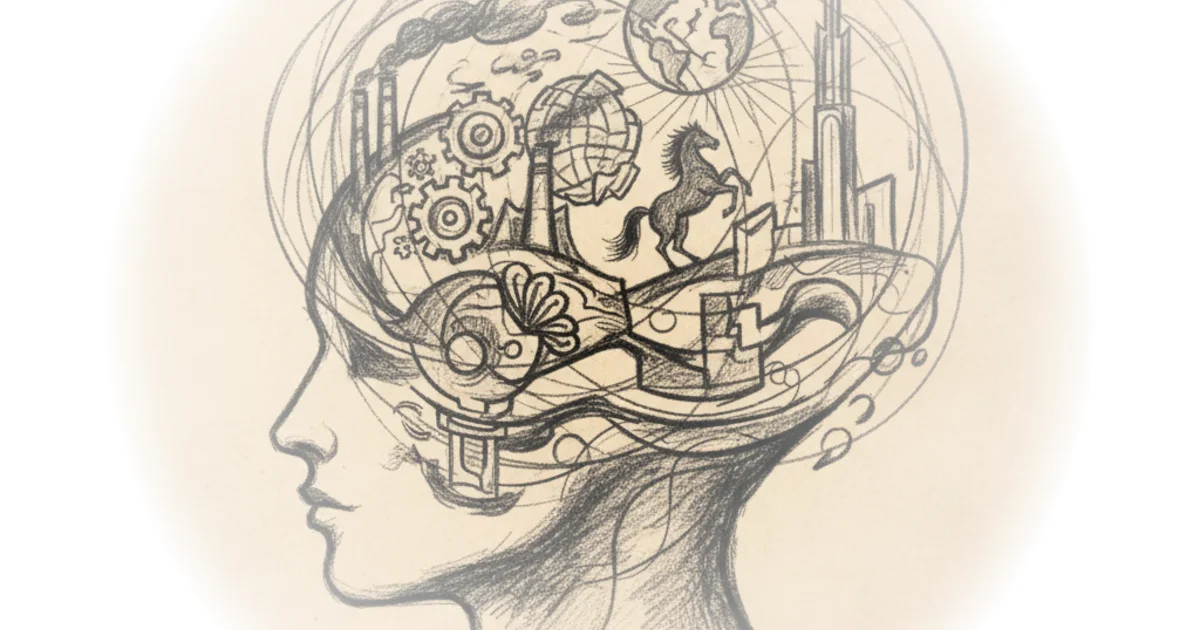
The piece suggests this was a survival mechanism. "Germans took refuge in the imagination more than anywhere else in Europe," Then & Now writes, noting that with no colonies or centralized press, the population turned to books and the domestic sphere. This is a compelling, if slightly romanticized, reading of national psychology. It effectively explains why German philosophy became so obsessed with the subjective experience, but it risks underplaying the material realities of poverty and isolation that also drove this introspection.
"The ideas first took roots in two places: German landscape and German language... things like the everyday in the ordinary, emotion, sentiment, the undecidable mystery, the irrational and spirituality."
The Invention of the Inner World
Then & Now traces this shift through key figures who prioritized "living reason" over static theory. The author highlights Johann Gottfried von Herder, who argued that we do not merely observe the world but construct it. "There's no proof that the world was given to us," Herder posited, suggesting instead that "we construct the world ourselves... in the image of ourselves." This is the core of the piece's thesis: the Germanic turn was the moment humanity realized the mind was not a mirror reflecting reality, but a projector creating it.
The commentary effectively uses the anecdote of Fichte asking students to "think the wall" to illustrate this radical subjectivity. It's a vivid way to explain complex idealist philosophy to a busy reader. However, the piece leans heavily on the idea that this was purely a positive cultural evolution. Critics might note that this same emphasis on the unique, irrational, and national spirit also laid the groundwork for the exclusionary nationalism that would plague the 20th century. The author touches on the "inferiority complex" but doesn't fully explore how that complex curdled into something darker.
"Goethe wrote famously that I turned back into myself and I find a world that within us were forces more powerful, more mysterious, more voluminous than anything we find outside of us."
The Power of the Finite and the Infinite
The final section of the coverage connects these historical ideas to the modern condition. Then & Now argues that the Romantic movement taught us to live in the tension between the mundane and the eternal. "The human story wasn't just about science, logic, reason, industry but had to be holistic," the author asserts. This is where the piece feels most urgent for a contemporary audience living in an age of algorithmic efficiency and data-driven decision-making.
The argument is that the German thinkers gave us permission to value the "ordinary with a mysterious respect." By endowing the commonplace with higher meaning, they created a framework for human resilience. The piece suggests that without this historical turn, we would lack the vocabulary for our own inner lives. While the connection to modern mental health and the search for meaning is strong, the piece occasionally glosses over the fact that this "inward turn" was often an escape from political engagement, a retreat that had real-world consequences.
"By endowing the commonplace with a higher meaning, the ordinary with a mysterious respect, the known with the dignity..."
Bottom Line
Then & Now delivers a sophisticated argument that German history is the origin story of the modern individual's interior life, successfully using the country's political fragmentation to explain its philosophical depth. The strongest element is the reframing of the "inferiority complex" as a creative engine for the imagination, though the piece would be stronger if it acknowledged how this same inward focus could detach from reality with dangerous results. For the busy reader, this is a vital reminder that our current obsession with the self has deep, specific roots in a reaction against cold rationalism.