The CPU Reversal Nobody Expected
For two years, the datacenter narrative was straightforward: GPUs ruled, CPUs receded. Intel watched hyperscalers spend wildly on graphics processors while server CPU revenue stagnated. Then something unexpected happened. Dylan Patel documents a dramatic reversal—CPUs are back in demand, and the industry is scrambling to respond.
From King to Support Role
Patel traces the datacenter CPU's journey from the 1990s Pentium Pro through the cloud computing explosion of the 2010s. The Xeon brand, launched in 1998, became the workhorse of enterprise computing. But after ChatGPT's November 2022 launch, everything shifted.
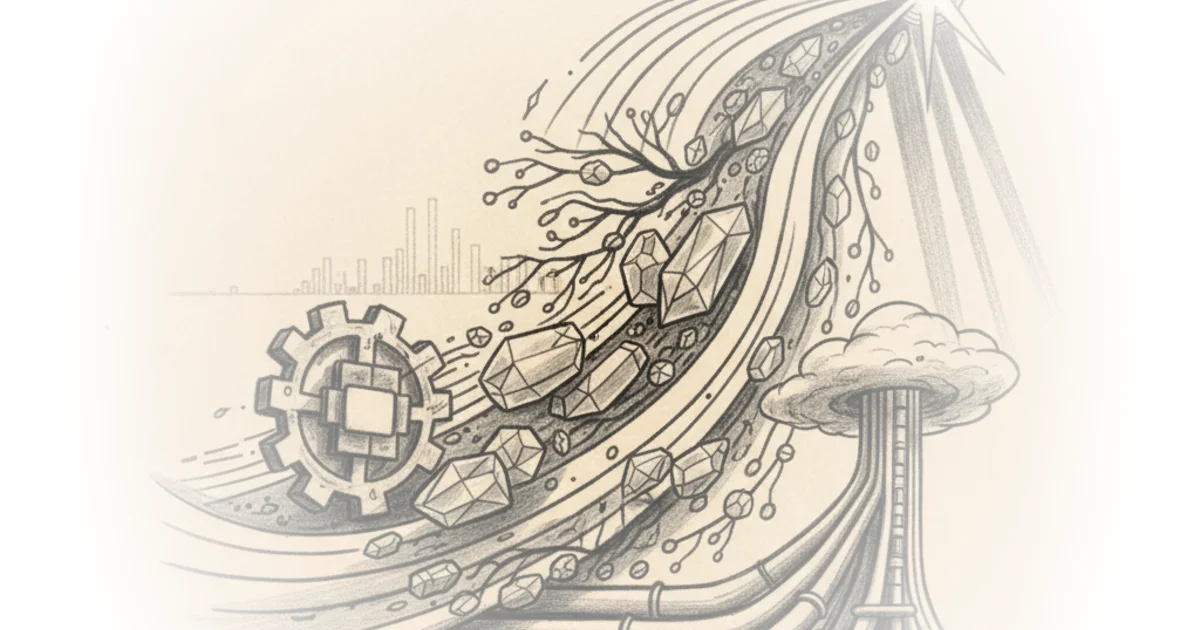
Dylan Patel writes, "Without a competent AI accelerator offering, Intel was left to tread water while the rest of the industry feasted."
The math was simple. AI training requires matrix multiplication—thousands of parallel operations that GPUs handle effortlessly. CPUs, with tens of vector units instead of thousands, were 100 to 1000 times less efficient. Intel added AMX accelerator engines and doubled AVX512 ports, but the CPU became a support actor in the GPU's blockbuster.
Two architectures emerged. Head node CPUs managed attached GPUs, feeding them data with large caches and high bandwidth memory. Cloud-native CPUs pursued maximum throughput per watt, consolidating ten old servers into one power-efficient socket. AMD's Bergamo and Intel's Sierra Forest chased this efficiency race. ARM-based designs like AWS Graviton thrived here—the ARM architecture family's power efficiency finally found its datacenter moment.
"Clouds turned compute into a commodity."
The Inflection Point
Dylan Patel writes, "Over the last 6 months this has changed massively."
Intel's Q4 2025 earnings showed unexpected datacenter CPU demand. The company is increasing 2026 capital expenditure on foundry tools and prioritizing server wafers over PC chips to alleviate supply constraints. Patel marks this as "an inflection point in the role of CPUs in the datacenter, with AI model training and inference using CPUs more intensively."
Three forces drive the reversal. Reinforcement learning training loops require CPUs to execute model-generated actions and calculate rewards—compiling code, verifying outputs, running physics simulations. Retrieval Augmented Generation models search the internet and invoke tools, demanding general-purpose compute. Agentic models query databases and send API calls to multiple sources.
Dylan Patel writes, "With the ability to send out API calls to multiple sources, each agent can essentially use the internet far more intensively than a human can by doing simple Google searches."
Microsoft's "Fairwater" datacenters illustrate the scale. A 48MW CPU and storage building supports a 295MW GPU cluster—tens of thousands of CPUs processing petabytes of GPU-generated data. This infrastructure wouldn't exist without AI.
2026's CPU Landscape
Dylan Patel writes, "2026 is an exciting year for the datacenter CPU, with many new generations launching this year from all vendors amid the boom in demand."
Intel launches Clearwater Forest and Diamond Rapids. AMD releases Venice. NVIDIA develops Grace and Vera. Amazon's Graviton line, Microsoft's Cobalt, Google's Axion—every vendor has new silicon. ARM's Phoenix design and Huawei's Kunpeng round out the competition. The AMD Ryzen processor lineage, familiar to PC builders, now converges with datacenter architectures in unexpected ways.
Patel's team models exactly how many CPUs of what types are being deployed. Their datacenter CPU roadmap extends to 2028, tracking designs from AMD, Intel, ARM, and Qualcomm. The analysis covers DRAM shortage effects and NVIDIA's Bluefield-4 Context Memory Storage platform's implications for general-purpose CPUs.
Critics Might Note
Critics might note that Intel's resurgence depends on fixing execution problems that caused the market share erosion Patel describes. The company's "lackluster execution and uncompetitive performance to rival AMD" remains a vulnerability. ARM-based hyperscaler CPUs still close off significant addressable market. And if GPU performance per watt continues outpacing CPUs, the CPU-to-GPU power ratio could become a bottleneck rather than a partnership.
Patel acknowledges this tension: "a future GPU generation such as Rubin may require an even higher ratio of CPU to GPU power than the 1:6 ratio seen in Fairwater."
Bottom Line
The CPU's datacenter relevance has reversed—not through raw AI performance, but through the infrastructure AI demands. Reinforcement learning, agentic systems, and RAG models require general-purpose compute that GPUs cannot provide. Dylan Patel's analysis shows Intel finally catching demand waves it missed for two years. The verdict: CPUs are no longer kings, but they are indispensable lieutenants in the AI era.