Justin E. H. Smith delivers a startling reimagining of the Voynich Manuscript, not as an unsolvable cipher, but as a first-person confession from a botanist trapped beneath a glass dome in a dystopian city. The piece's most arresting claim is that the manuscript's strange illustrations are actually a literal map of a subterranean escape route, disguised as botanical and astronomical studies to evade the "Glaziers," a ruling class that enforces a manufactured cosmology. Smith bypasses the usual academic deadlock of linguistic decryption to offer a narrative that feels less like a translation and more like a suppressed history of resistance.
The Architecture of Deception
Smith constructs a world where the "City" is physically and intellectually enclosed by a dome that its inhabitants believe to be a natural celestial sphere. He writes, "We live beneath glass here in the City, all the time, but we are reminded of this in practice only when we attempt to walk away from it, or when, as happens several times a day, we hear the sad thunk of an oblivious bird, and then look up to see it sliding down the invisible slope." This vivid imagery immediately grounds the abstract mystery of the manuscript in a tangible, claustrophobic reality. The author's choice to frame the Glaziers as the architects of this false reality is a bold move; it transforms the manuscript from a static puzzle into a dynamic story of power and control.
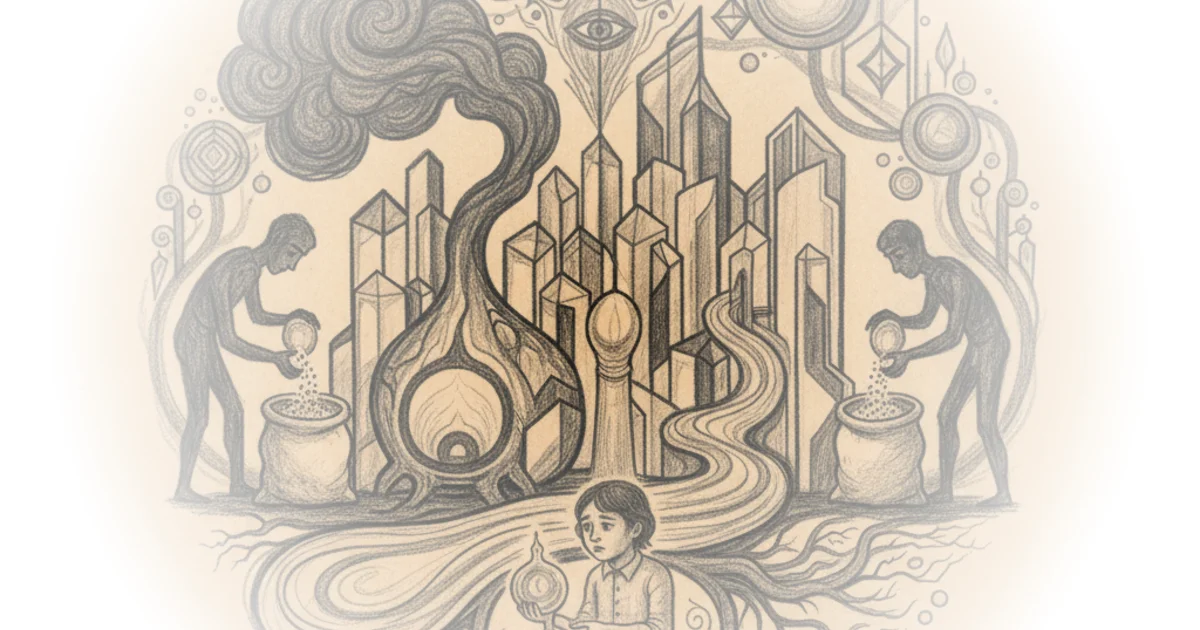
The narrative suggests that the "twenty-seven celestial spheres" mentioned in the text are a deliberate fabrication, with the Glaziers' own dome serving as the twenty-seventh sphere to legitimize their rule. Smith notes that the inhabitants "do not know that it was constructed at all. They believe it is as fixed and eternal as the other twenty-six spheres." This parallels the historical cosmological models discussed in the footnotes, specifically the Eudoxian system of concentric spheres, yet twists it into a tool of oppression. By anchoring the fiction in the real history of Eudoxus and Aristotle, Smith lends a terrifying plausibility to the idea that scientific knowledge can be weaponized to maintain a status quo.
"Glaziers are never to be trusted, given the favor Cocalus extends to them, and least of all when the Citizens' numbers are being thinned on his express orders, in view of some supposed need for what the Glaziers call 'equilibrium'."
The introduction of "Cocalus" as a ruler who orders the "thinning" of the population adds a layer of political urgency. Smith uses this character to explore the tension between the ruling elite and the knowledgeable class, specifically the botanist narrator. The narrator's expertise in plants becomes a double-edged sword: it is the reason he is allowed to live, yet it is also the lens through which he sees the cracks in the dome's foundation. This dynamic mirrors the historical role of scholars under authoritarian regimes, where specialized knowledge is both a shield and a target.
The Geography of Escape
The core of Smith's argument lies in the narrator's revelation of two escape routes: digging beneath the dome's shallow foundation or navigating the thermal baths that lead to a vast network of caverns. Smith writes, "The other way is through the baths, which even the smallest hatchling knows to bubble up from deep thermal springs. But the rites of generation and hatching that occur there are so codified... that no one in these many years has bothered to plunge into them just ten ells or so down, to find the many passages leading to caverns filled with dark pools and dank air."
This section is particularly effective because it recontextualizes the manuscript's famous "bath" illustrations. Instead of being mere diagrams of herbal remedies or alchemical processes, they become blueprints for survival. The narrator's mention of his "blood-brother Cacus," who was "thinned" by the ruler for knowing too much, adds a personal stake to the discovery. Smith writes, "Cocalus having decided on the name of the mythological cow-thief for my friend, he subsequently decided that this name he himself made up must be reflective of a bad character — and now I am the only one left who knows." This detail highlights the arbitrary and cruel nature of the regime's power, where even a name can be a death sentence.
Critics might note that Smith's reliance on a fictional narrative to explain a real historical document risks overshadowing the actual linguistic and material evidence of the Voynich Manuscript. While the story is compelling, it remains a work of fiction rather than a scholarly solution. However, Smith's footnotes, which reference real historical figures like Nicolaus Steno and the thermal baths of Montecatini, serve to blur the line between fact and fiction, inviting the reader to question the boundaries of historical interpretation. The reference to the "Antipodes" and the historical debate over the existence of people on the opposite side of the world further enriches the narrative, suggesting that the narrator's knowledge of the "other side" is not just a physical escape but a philosophical one.
"I told you then that before I came north as a young man I thought all the little flies flew in from torrid Libya... Yet there they were still, in the Tuscan marshes in autumn; we were shivering as we stripped, and they swarmed around us as if preparing to draw blood."
The narrator's recollection of a visit to the baths at Montecatini serves as a poignant reminder of the human cost of the regime's "thinning." The description of the "plague victims" drinking the "earth's hot mineral broth in desperate hope for a cure" evokes a sense of shared suffering and resilience. Smith uses this memory to contrast the narrator's past innocence with his current awareness of the dome's fragility. The mention of the "boot" shape of Italy and the anachronistic nature of the term adds another layer of complexity, as Smith acknowledges the scholarly debate over whether the manuscript is a hoax or a genuine artifact.
The Botany of Truth
Ultimately, Smith's commentary is a meditation on the power of knowledge to liberate. The narrator, a botanist, sees the world through the lens of plants and insects, finding patterns and connections that others miss. He writes, "I know the way well, and someday I will find the courage to take it." This declaration is the emotional climax of the piece, transforming the manuscript from a puzzle into a promise. The author's decision to end with a reference to the "Hinternet Foundation Summer School" and the question "WHITHER THE HUMANITIES?" is a meta-commentary on the role of the humanities in understanding and challenging the structures of power.
Smith's approach is not without its risks. By presenting a fictional narrative as a translation, he challenges the reader to suspend disbelief and engage with the text on a different level. Some might argue that this undermines the scientific rigor required to solve the Voynich Manuscript. Yet, the piece succeeds in highlighting the human element of the mystery, reminding us that behind every cipher is a story of human experience, fear, and hope.
"I assumed the little flies and the bogs and the night themselves could not fail to see the truth of my Love for you."
Bottom Line
Justin E. H. Smith's "translation" is a masterful blend of historical scholarship and speculative fiction that reimagines the Voynich Manuscript as a story of resistance against a manufactured reality. Its greatest strength lies in its ability to humanize the mystery, turning abstract symbols into a narrative of survival and courage. However, its reliance on a fictional framework means it offers a literary solution rather than a linguistic one, leaving the actual code of the manuscript unsolved. Readers should watch for how this narrative approach influences future interpretations of the manuscript, particularly in how it bridges the gap between historical fact and imaginative possibility.