Sabine Hossenfelder delivers a rare, stinging critique from within the German establishment, arguing that the nation's cultural obsession with caution has metastasized into a paralysis that is actively dismantling its economic and technological future. This is not a standard political rant; it is a physicist's autopsy of a country that has forgotten how to execute, where the gap between high-tech aspirations and crumbling reality has become a source of national shame.
The Infrastructure of Decline
Hossenfelder opens by dismantling the global perception of Germany as a model of efficiency. She paints a stark picture of daily life where the systems meant to connect the country are failing at the most basic level. "I never thought I'd say this but I'm embarrassed to be German things are going seriously wrong here in Germany," she writes, setting a tone of urgent disillusionment that resonates far beyond typical policy complaints. She illustrates this with the mundane horror of modern travel: trains cancelled, escalators broken, and Wi-Fi so slow that "by the time the news is streaming it's become a historical documentary."
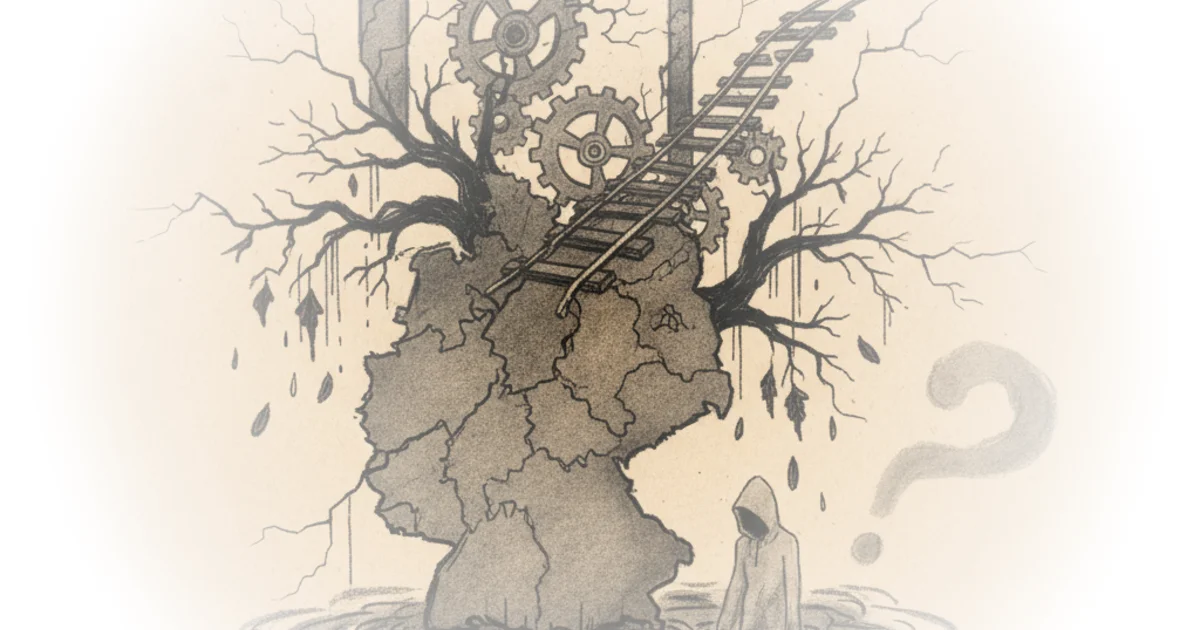
The core of her argument is that this decay is not accidental but the result of a long sequence of bad decisions regarding infrastructure and technology. She contrasts the German experience with a British friend living in a tiny village who has fiber optic access, while Hossenfelder, residing in an industrial heartland, struggles with copper cables. "I still sit on 150 megabits per second copper cables they have faster internet on the International Space Station," she notes, a hyperbolic comparison that underscores the severity of the lag. The state of the internet is described as pathetic, with Germany holding the second-lowest fiber optic coverage in the European Union, trailing only a nation that frequently lacks a functioning government.
This section effectively uses personal anecdote to highlight a systemic failure. The evidence of underinvestment is compelling, yet one might argue that the comparison to the International Space Station, while rhetorically sharp, risks trivializing the complex logistical challenges of terrestrial broadband rollout. However, the point stands: the gap between Germany's reputation and its reality is widening.
The Paralysis of "Thoroughness"
Hossenfelder identifies a cultural root cause for this stagnation: the German stereotype of "thoroughness" has curdled into a dangerous inertia. She argues that the nation's historical strength—its dedication to precision and detail—has become a liability in a world that demands speed. "The Germans are too slow," she asserts, explaining that the strategy of "let's wait and see" is no longer viable. This cultural trait once saved Germany from speculative bubbles, but now it prevents decisive action on climate and technology.
She critiques the government's approach to innovation as "technology openness," a policy she describes as throwing tax money at "any idiotic idea they can find." She uses the example of electric highways, where a test project cost 150 million euros for just 20 kilometers and was rarely used. "It's basically let a thousand flowers bloom except that most of them are psychedelic mushrooms," she quips, capturing the absurdity of funding unproven concepts while neglecting established solutions. The argument here is that the pursuit of a perfect, all-encompassing solution often results in no solution at all.
"The German reputation for being particularly environmentally friendly has been buried in a biodegradable coffin because we like like to pretend at the moment."
This framing is particularly effective because it shifts the blame from a lack of resources to a lack of will and strategic clarity. The author suggests that the country is using humor and sarcasm to cope with problems it cannot solve, a coping mechanism that signals a deeper societal malaise. Critics might note that the transition to green technology is inherently complex and that rushing into unproven methods can also be disastrous, but Hossenfelder's point is that the current pace is not caution—it is stagnation.
The Nuclear and Hydrogen Gamble
The most contentious part of Hossenfelder's commentary is her defense of nuclear power and her skepticism of the hydrogen economy. She argues that the decision to phase out nuclear energy was a strategic error, leaving the country dependent on fossil fuels. "The obvious way to get off fossil fuels is nuclear power," she states, emphasizing that the technology exists and works. Instead, the government has bet on a "non-existing hydrogen economy," a move she views as a delay tactic.
She describes hydrogen as difficult to manage and inefficient for energy storage, predicting that the "hydrogen bubble" will burst within five years. "Hey if pigs could fly maybe they'd be more carbon friendly than airplanes," she writes, mocking the reliance on a technology that does not yet exist at scale. The fear is that if the hydrogen strategy fails, Germany will be stuck with fossil fuels and unappealing to investors. This is a bold stance in a country where anti-nuclear sentiment is deeply entrenched, but it is grounded in the practical reality of decarbonizing heavy industry.
The argument here is that the government is banking on a miracle rather than a plan. "Do you really want to bank the future of an entire country on the possibility that a so far non-existing part of the economy will come into being within 10 years?" she asks. This question cuts to the heart of the risk management failure she identifies. While the hydrogen economy has potential, Hossenfelder's skepticism highlights the danger of treating it as a silver bullet while ignoring proven alternatives.
Bottom Line
Hossenfelder's most powerful insight is that Germany's decline is self-inflicted, driven by a cultural inability to adapt to a rapidly changing world. The strongest part of her argument is the connection between the cultural virtue of "thoroughness" and the vice of paralysis, a nuance often missed in external analyses. However, her dismissal of hydrogen as a near-term solution may overlook the long-term strategic value of diversifying energy portfolios. The reader should watch for whether the administration can break this cycle of delay before the economic gap becomes unbridgeable.