The Hated One challenges the official narrative of a high-profile manhunt, arguing that the FBI's celebrated "advanced intelligence" was a fiction masking gross incompetence. The piece posits that the capture of Tyler Robinson, the alleged shooter of Charlie Kirk, was not the result of a sophisticated surveillance state but rather a fluke of luck and traditional police work. For a busy audience skeptical of government overreach, this dissection of the investigation's failures offers a stark counterpoint to the usual triumphant press releases.
The Illusion of Advanced Surveillance
The author immediately dismantles the FBI's public relations campaign. The Hated One writes, "FBI director Cash Patel is a MAGA podcaster who is telling his audience that a manhunt for the suspect of Charlie Kirk's assassination was a result of some historic investigation with the use of the most advanced intelligence techniques available to any law enforcement anywhere in the world." This framing is crucial because it sets the stage for a direct comparison between the agency's claims and the messy reality on the ground. The commentary suggests that the narrative of a high-tech victory is a cover for a lack of basic competence.
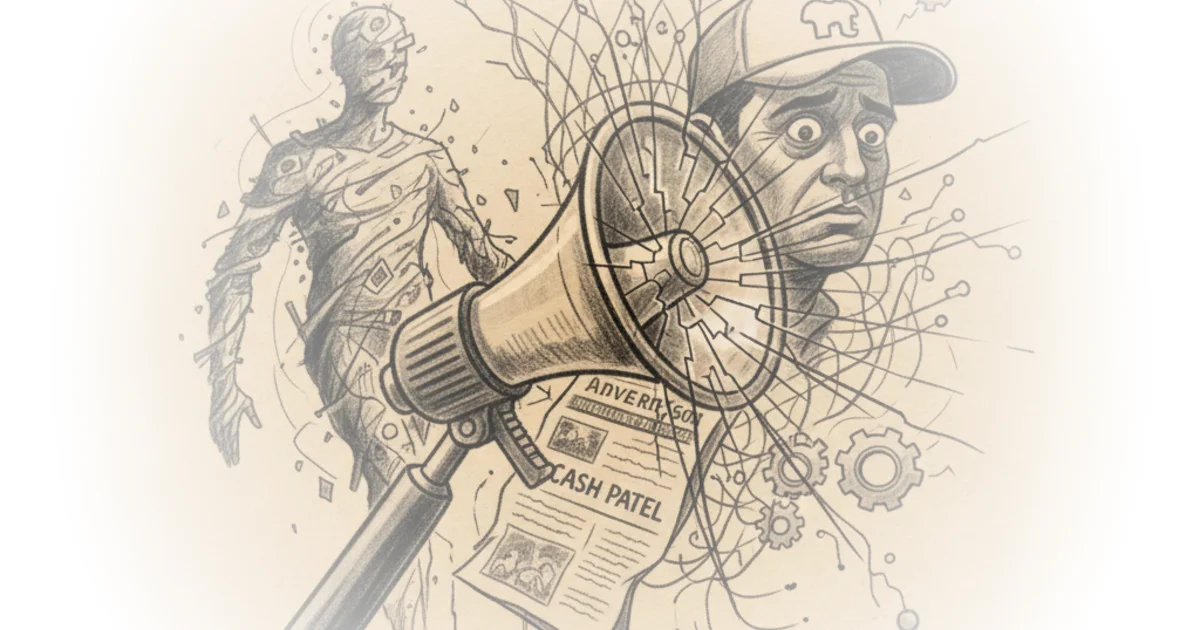
The piece details how, despite claims of thousands of tips and interviews, the FBI remained clueless for over a day. As The Hated One puts it, "after a full day of endless investigation full 24 hours after Charlie Kirk was shot, the FBI, Cash Patel himself and local law enforcement were so confused they had literally no idea where the suspect was and they weren't even sure whether he was still in Utah or not." This admission of confusion is the pivot point of the argument: if the agency didn't know the suspect's location after 24 hours, their subsequent "breakthrough" must be scrutinized. The author argues that the suspect was only caught because he was far from the scene, arrested 33 hours later in his parents' home, 250 miles away. Had he kept running, the author contends, he likely would have escaped.
"The mass surveillance state they have so meticulously built for us since 9/11 is completely useless at preventing horrendous crimes or catching horrendous criminals."
The Failure of Biometric Tools
The commentary then shifts to a technical critique of the specific tools the FBI claimed to use. The Hated One systematically debunks the efficacy of facial recognition, profile recognition, and gait analysis in this specific context. The author notes that the initial images released were of poor quality and obscured by sunglasses and hats, making facial recognition impossible. "Enhancing an image cannot recreate pixels where there are none," The Hated One writes, highlighting a fundamental limitation of current technology that the public often misunderstands. This point is well-taken; it exposes the gap between sci-fi expectations and the grainy reality of surveillance footage.
Furthermore, the author argues that "profile recognition" failed because the suspect wore a "greyman outfit"—generic clothing that blended in with the crowd. The text explains that the suspect even changed clothes on the roof, effectively resetting any tracking based on attire. The Hated One writes, "The biggest problem with profile recognition is that once you change your profile, it's over." This is a compelling observation about the fragility of visual tracking when a subject actively or passively alters their appearance. A counterargument worth considering is that while individual biometric markers can be obscured, the sheer volume of data points from multiple cameras might still yield a probabilistic match, though the author dismisses this as unlikely given the specific conditions.
The piece also addresses gait recognition, noting that the suspect's limp—whether from carrying a rifle or feigned—rendered the technique useless. "There's a much better video from a supposed residential camera where Tyler Robinson is walking across the street... The only problem is the limping throughout this whole video," The Hated One observes. The author concludes that even the most promising emerging technologies, like whole-body biometrics, were not yet ready for prime time in 2025. This technical breakdown serves to strip away the mystique of the "surveillance state," revealing it as a collection of tools that are often ineffective against a determined or simply lucky individual.
The Role of Luck and Traditional Methods
Ultimately, the author attributes the capture to human error and traditional policing rather than technology. The Hated One points out the suspect's "stupidity" in bringing a phone to the scene, which allowed for digital tracking, but emphasizes that the FBI's own tools were secondary. The real breakthrough came from a tip. "The official story says his father confronted him and convinced him to confess," the author notes, contrasting this with the FBI's narrative of a high-tech takedown. The text argues that the rifle was found by luck, and without the confession and the physical evidence, the manhunt would have stalled.
The Hated One writes, "It is simply overloading the law enforcement with too much data they will never be able to sit through properly." This critique of data overload is a powerful conclusion to the technical analysis. It suggests that the surveillance state creates a paradox: more data does not equal better results, but rather confusion and inefficiency. The author concludes that the system is better suited for authoritarian control, such as deporting non-violent immigrants, than for solving complex crimes. "Fundamentally, it is only useful for authoritarians and totalitarianism," The Hated One asserts. This is a strong, provocative claim that reframes the entire debate on surveillance from public safety to civil liberty.
Critics might note that the author's dismissal of the FBI's efforts is perhaps too absolute; while the technology may have failed, the coordination of thousands of agents and the release of images likely contributed to the environment that led to the tip. However, the core argument remains that the decisive factor was not the technology itself.
Bottom Line
The strongest part of this argument is its rigorous deconstruction of the specific biometric failures, which effectively counters the narrative of an omnipotent surveillance state. The piece's biggest vulnerability lies in its absolute dismissal of the FBI's broader investigative coordination, which may have been necessary to generate the tip in the first place. Readers should watch for how this critique of "high-tech" policing influences future debates on privacy and law enforcement funding.