This piece tackles the most elusive frontier in sensory technology: the digitization of smell. While computers have long mastered sight and sound, Asimov Press argues that scent remains stubbornly analog, resisting the binary logic that powers modern AI. The article's most striking claim is that we are finally on the verge of creating an "RGB of odor," a breakthrough that could revolutionize everything from disease detection to the perfume industry. For a reader navigating a world increasingly defined by digital interfaces, understanding how we might finally encode the primal sense of smell offers a rare glimpse into the next great leap in human-computer interaction.
The Analog Barrier
Asimov Press begins by establishing why smell is uniquely difficult to codify. "Unlike vision or hearing, it resists straightforward formalization," the author writes, noting that the molecular diversity of odorants varies in far more ways than photons or frequencies. This framing is effective because it immediately grounds the reader in the biological complexity that makes the problem so hard. The text suggests that while machines have learned to see and hear, they have been blind and deaf to the chemical world until now.
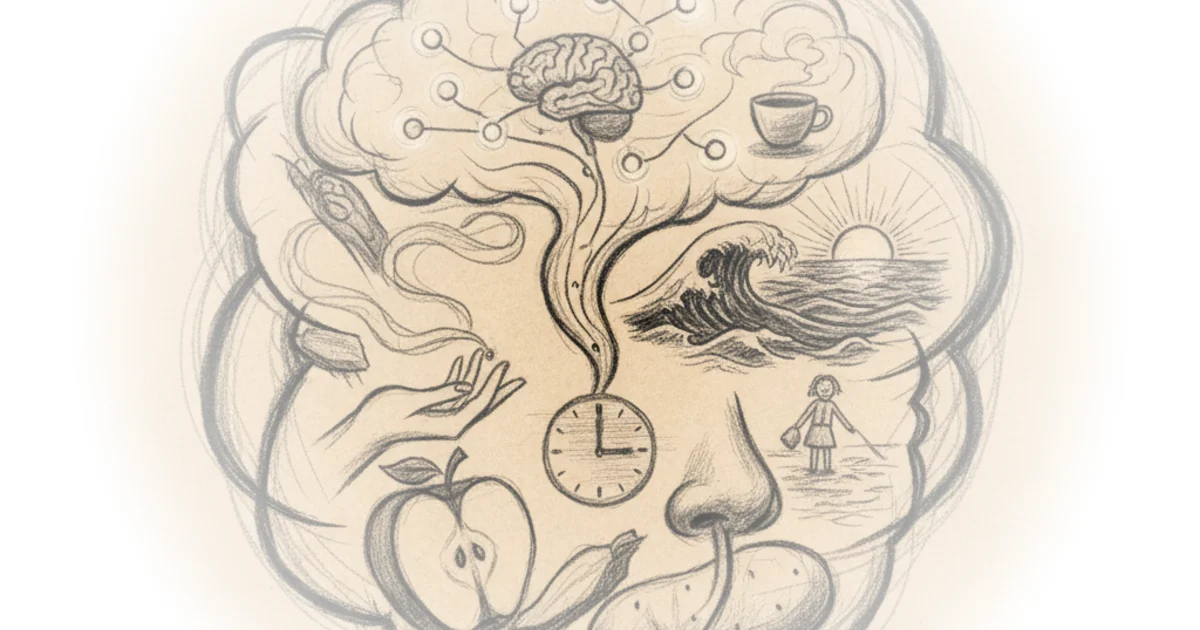
The argument pivots on the idea that we are missing a fundamental translation layer. "There has been no RGB of odor, no Fourier transform for smell," Asimov Press observes, highlighting the lack of a universal language for scent. This is a powerful metaphor that clarifies the technical hurdle for a non-specialist audience. However, the piece could be critiqued for slightly underestimating the sheer scale of the data problem; encoding the subjective experience of smell may require more than just a new algorithm—it may require a complete rethinking of how we map biology to code.
From Bacteria to Brain
To explain the stakes, the author traces the evolutionary history of olfaction, reminding us that "smell, our most ancient interface with the environment, originated over 3 billion years ago, in bacteria adrift in the primordial ocean." This historical context is crucial; it elevates the discussion from a mere tech trend to a fundamental biological imperative. Asimov Press details how early organisms navigated chemical gradients, a process known as chemosensation, which laid the groundwork for all future multicellular life.
The article then moves to the human scale, describing the intricate machinery of the nose. "At any given time, 77 percent of the 356 distinct olfactory receptors are expressed in the lining of the nasal cavity," the author notes, emphasizing the sheer redundancy and complexity of our biological sensors. This detail underscores why predicting a scent is so difficult: it is not a one-to-one mapping, but a combinatorial explosion of signals. Asimov Press illustrates this with the example of a strawberry, explaining that the scent is not a single molecule but a "volatile molecular cocktail" that activates a unique pattern of receptors.
The combinatorial activity of hundreds of receptor genes allows humans to detect and discern more than a trillion distinct odors.
This statistic is staggering, and the author uses it effectively to justify the need for AI. If humans can distinguish a trillion scents through a complex biological network, a machine must have a comparable level of sophistication to replicate or predict them. The piece argues that the key to unlocking this lies in understanding the "Structure-Odor Relationship (SOR) paradox," where molecules with nearly identical structures can smell worlds apart. This paradox has stumped chemists for centuries, making the potential of AI to solve it all the more compelling.
The Industrial and Biological Promise
The commentary shifts to the practical applications of this technology, ranging from defense to consumer goods. "Computational smell could, for example, help detect threats and information invisible to cameras, such as gas leaks, food spoilage, disease markers in breath, and even counterfeit products," Asimov Press writes. This section broadens the scope beyond the laboratory, showing how digitizing smell could have immediate, life-saving applications. The mention of disease markers in breath is particularly poignant, suggesting a future where a simple sniff could diagnose illness before symptoms appear.
However, the article also touches on the commercial motivations driving this research. "Beyond providing further insight into olfactory biology, digital scent could have many practical (and quite profitable) applications," the author admits, noting investments from entities like DARPA and Estée Lauder. While this is a realistic assessment of the market, it raises questions about the ethical implications of synthetic scents. If corporations can engineer molecules to evoke specific brain patterns, could this be used to manipulate consumer behavior in ways that are currently impossible? The piece hints at this but does not fully explore the potential for manipulation.
The historical section on perfumery adds depth, tracing the evolution from ancient distillation to modern chemistry. "In 1820, the French pharmacist Nicolas Jean Baptiste Gaston Guibourt identified and isolated 2H-chromen-2-one, better known as coumarin," Asimov Press recounts, showing how the industry has always been driven by the desire to isolate and replicate nature. This historical continuity reinforces the idea that we are not inventing something new, but rather accelerating a centuries-old quest to understand and control scent.
The Future of Scent
Asimov Press concludes by looking toward a future where we can create entirely novel smells. "And finally, it could lead to the creation of entirely novel smells, revealing a vast, untapped chemical palette that would otherwise be unattainable without the aid of technology," the author writes. This is the most exciting, and perhaps most unsettling, prospect. If we can design smells that have never existed in nature, what does that mean for our relationship with the natural world?
The piece ends on a note of cautious optimism, suggesting that programming smell will illuminate the mysteries of olfaction just as computer vision did for sight. "Just as 'computer vision' has helped us realize that sight is not just passive image capture but an active process of prediction and interpretation, researchers hope that programming smell will illuminate the many mysteries of olfaction," Asimov Press posits. This comparison is apt, but it also serves as a warning: as we decode the language of smell, we may lose some of the mystery that makes it so powerful.
Critics might note that the article relies heavily on the promise of AI to solve problems that are deeply rooted in the subjectivity of human experience. Can a machine truly understand the nostalgia of a childhood memory triggered by a scent, or the visceral reaction to a smell of decay? The piece acknowledges the subjectivity of smell but assumes that technology can eventually bridge that gap. This is a bold assumption that may not hold up as the technology matures.
Smell remains stubbornly analog. There has been no RGB of odor, no Fourier transform for smell. At least, until now.
Bottom Line
Asimov Press delivers a compelling argument that the digitization of smell is not just a technological curiosity, but a necessary evolution in our understanding of the world. The piece's greatest strength is its ability to weave together biology, history, and technology into a coherent narrative about why this problem matters. Its biggest vulnerability lies in the assumption that AI can fully capture the subjective and emotional dimensions of scent, a challenge that may prove far more difficult than the article suggests. Readers should watch for how this technology is deployed in healthcare and consumer markets, as the ability to engineer smell could have profound implications for human behavior and well-being.