Stefan Milo opens by framing one of archaeology's enduring puzzles: perforated batons found across Western and Central Europe, dating between 40,000 and 15,000 years ago. These mysterious objects have baffled researchers for decades. Were they ritual objects? Symbols of power? Or something else entirely?
The piece centers on a new paper from January, co-authored by Professor Nicholas Conard and Vera Røtsch, examining a perforated baton excavated from Hallaufels in southern Germany — one of the most significant Paleolithic sites in Europe.
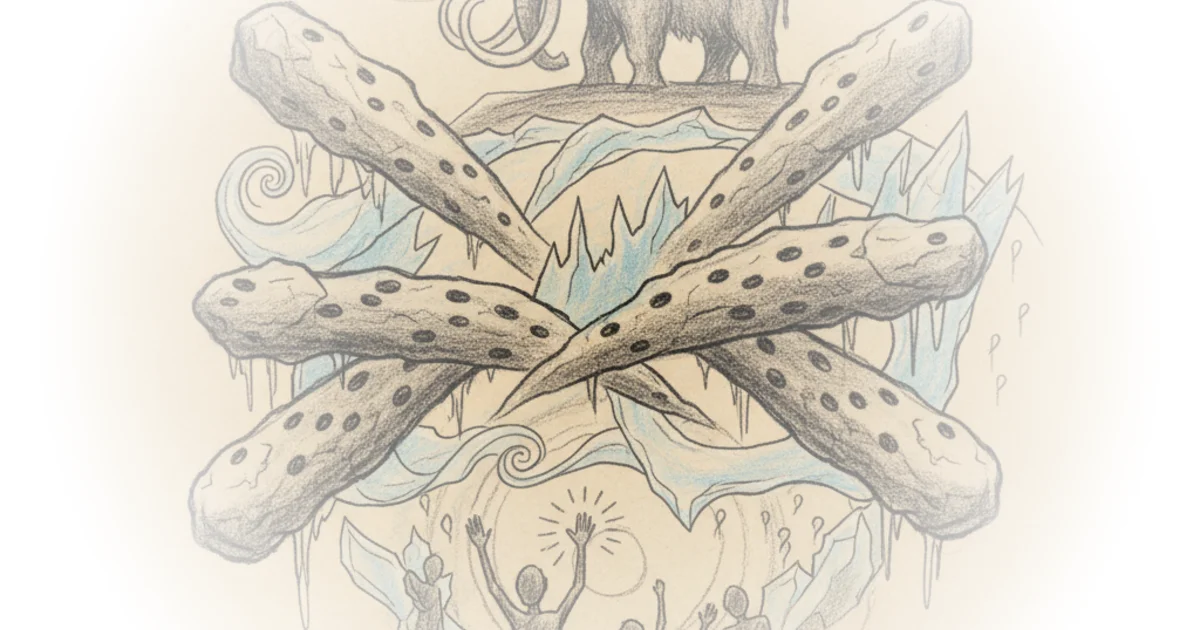
The Ivory Baton
What makes this particular artifact extraordinary is its material. "For the first time we found a really beautifully preserved ivory perforated baton made from mammoth ivory," Milo writes. "and that got my attention." Most perforated batons are made from deer antler; this one was ivory — a rare find.
The baton has four holes with spiraling grooves around them, a feature Milo identifies as "a big clue to their function." Conard and Røtsch hypothesized these spirals were used for orienting whatever passed through the hole and rotating it. They quickly landed on plant fibers.
Testing the Theory
"We thought with the spirals and the holes it had to have something to do with feeding something through the hole and pulling it out the other side," Milo explains, paraphrasing the researchers' reasoning. The team analyzed residue inside the artifact and "found much more plant fibers inside this object than from the sediment just around it" — a positive piece of evidence that plant fibers were connected to this object in some way.
They then made a replica and tested rope-making. The result was striking: "you can make 5 m of very strong rope in about 10 minutes so you can oh wow that's very quick actually quick no you can see in the video it's not it's not that hard and the rope's super strong."
But Milo is careful not to overclaim. "Does this prove definitively that perforated battern are rope making tools? Probably not," he writes, acknowledging this is a hypothesis, not proof.
The Bigger Picture
The piece then expands outward. These aren't rare finds — "we're talking about hundreds," Milo notes. They appear across Europe in various cultural contexts: the Gravettian, Magdalenian. "It's not chance they were definitely good for something."
One particularly evocative example comes from Italy: a burial of a young man buried with an elaborately knapped flint blade, shells either braided into his hair or perhaps worn as some sort of cap, and four perforated batons. The association with burials suggests these objects had practical importance in life — not just death.
Milo then offers a compelling use case: moving food. "How do you get that much food home?" he asks, imagining Paleolithic hunters butchered and dragged mammoth or rhino meat back to their camps using ropes. He cites a photograph from the turn of the last century showing Inuit families dragging a walrus with ropes in a similar cold, dry environment.
These people are living in the Ice Age — there's mammoths around there's woolly rhinos around they are killing hunting eating these huge animals — how do you get that much food home?
Counterpoints
Critics might note that rope-making is an interpretation, not a conclusion. The spirals could serve other functions — feeding plant fibers doesn't necessarily mean rope production. Additionally, the burial evidence is suggestive but not definitive: association with hunting tools could reflect social status or trade goods rather than practical utility.
The piece acknowledges this tension: "I am a little hesitant to go that far with it but I could certainly imagine" is how Milo describes uncertainty about whether perforated batons in burials indicate practical importance. The evidence remains ambiguous.
Bottom Line
Milo's strongest move is reframing what these hundreds of artifacts actually were — shifting them from ritual speculation toward practical utility. His weakest vulnerability is that rope-making, while compelling, remains a hypothesis tested on one artifact. The broader case across Europe is still being built. For readers, the takeaway is clear: our Paleolithic ancestors were innovators, and some of their tools may have been as effective as they appear.