Most legal analyses of superhero fiction treat the genre as a playful thought experiment, but Devin Stone of LegalEagle strips away the cape and cowl to reveal a stark reality: under New York law, the Dark Knight is not a hero, but a dangerous vigilante guilty of hundreds of felonies. Stone's distinctive approach lies in his refusal to accept the "necessary evil" narrative, instead applying the rigid mechanics of the New York Penal Code to every punch thrown and building breached in Gotham City. This isn't just a breakdown of plot holes; it is a rigorous indictment of how the justice system would actually process a man who decides to enforce the law outside of it.
The Conspiracy and the Body Count
Stone begins by dismantling the Joker's defense, treating the chaotic bank robbery not as a scene from a movie, but as a textbook case of criminal conspiracy. He notes that under the Pinkerton doctrine, every member of a gang is liable for the actions of their partners. "Assuming that the Pinkerton doctrine applies all of the members of the conspiracy including the Joker are on the hook for all of the criminal acts of their co-conspirators," Stone writes. This framing is crucial because it shifts the blame from individual acts to a collective enterprise, making the Joker responsible for deaths he didn't physically inflict.
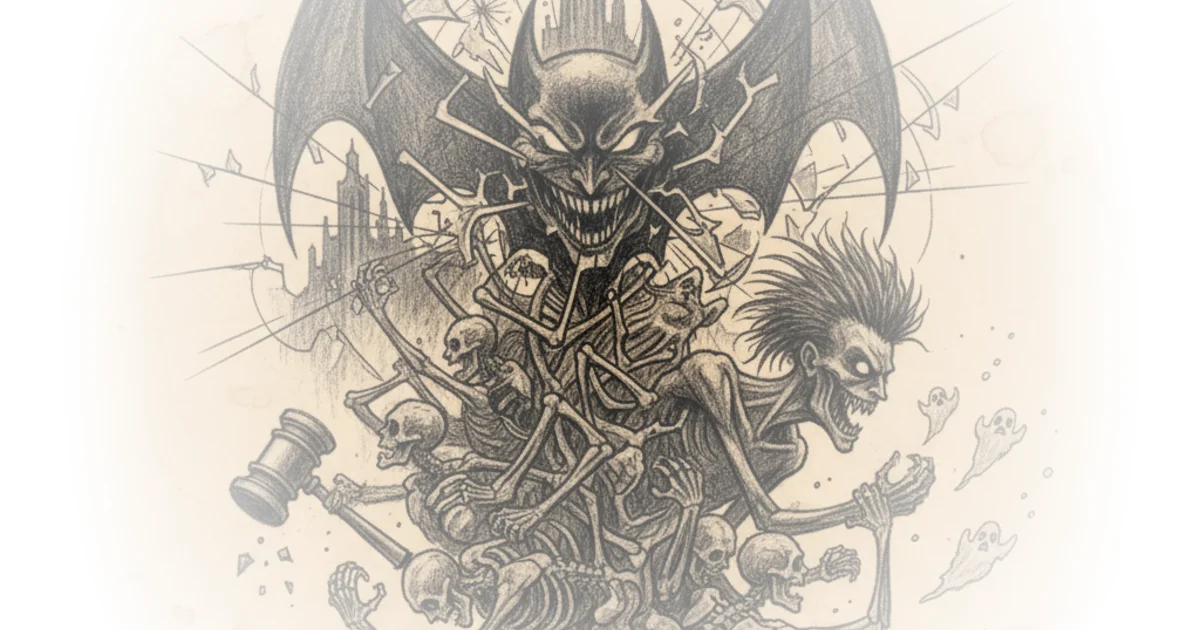
The analysis deepens when Stone addresses the "felony murder rule," which holds that any death occurring during a dangerous felony like armed robbery is murder, regardless of intent. Stone points out that the Joker's manipulation of his own henchmen—forcing a driver into the path of a bus—constitutes murder even without a trigger pull. "Because he knew this was going to happen and moved out of the way and force the guy into the path of the bus that as a mental state we call knowingly which generally carries with it exactly the same kind of penalty that you would have when you intentionally do an act that results in someone's death," Stone explains. This distinction between "intent" and "knowledge" is a sophisticated legal nuance that often gets lost in pop culture discussions, and Stone leverages it to show that the Joker's chaos is legally indistinguishable from cold-blooded premeditation.
Because he knew this was going to happen and moved out of the way and force the guy into the path of the bus that as a mental state we call knowingly which generally carries with it exactly the same kind of penalty that you would have when you intentionally do an act that results in someone's death.
Critics might argue that applying real-world statutes to a fictional villain with supernatural resilience is a category error, but Stone's point is precisely to test the boundaries of the law against the absurdity of the character. The law, he suggests, has no special provision for supervillains.
The Vigilante's Legal Liability
The commentary shifts to the central question: Can Batman claim self-defense? Stone's answer is a resounding no, based on the specific constraints of New York law regarding private citizens. He argues that while the state allows for self-defense, it does not grant a license for proactive violence. "New York law does not look kindly on vigilantes you can't just interject yourself into crime and and pretend to be police it just doesn't work that way," Stone asserts. This is the piece's most provocative claim: the very actions that save lives in the narrative are, in a court of law, assault and battery.
Stone highlights the "duty to retreat" rule, which requires a person to avoid conflict if safe to do so before using deadly force. Since Batman actively seeks out criminals, he cannot claim he was forced into a corner. "He would likely be on the hook as guilty for all of the hundreds of acts of physical assault that he has committed against the criminals of Gotham," Stone concludes. The analysis exposes a paradox: the more effective Batman is at stopping crime, the more evidence he accumulates against himself. He is not a law enforcement officer with immunity; he is a private citizen with a martial arts degree and a grudge.
Furthermore, Stone addresses the "fruit of the poisonous tree" doctrine, which usually excludes evidence obtained illegally by the police. He clarifies that this protection does not extend to Batman because he is a private actor. "The thing is Batman is not a police officer Batman is a private party so while Batman may be liable and almost certainly is liable for the use of deadly force and for illegal kidnapping the fruit of the poisonous tree doctrine doesn't apply," Stone writes. This is a vital distinction for readers to understand: the police can use the evidence Batman finds, but Batman himself faces criminal charges for how he found it.
Terrorism and the Erosion of Order
As the narrative escalates, Stone identifies the Joker's actions as a clear case of domestic terrorism under New York Penal Code section 490. The Joker isn't just killing people; he is attempting to coerce the government and intimidate the civilian population. "Here the Joker is engaging in all of that he's trying to get the police to stop working he's trying to get Batman to stop chasing him and he is trying to terrorize the entire civilian population into disclosing the identity of and to turn against Batman," Stone observes. By framing the Joker's chaos as a political act rather than random madness, Stone elevates the legal stakes to a federal level of severity.
The commentary also touches on the collateral damage of Batman's methods, such as the destruction of property and the use of unlicensed aircraft. Stone notes that gliding through the city violates airspace laws, and the destruction of cars constitutes reckless endangerment. "Someone is guilty of reckless endangerment of property when they engage in reckless conduct which creates a substantial risk to damaging the property of other people here Batman is driving a motorcycle which is not licensed which's in no way street legal and is just destroying cars left and right," Stone points out. The sheer volume of infractions paints a picture of a city in legal freefall, where the hero is arguably as disruptive to public order as the villain.
New York law does not look kindly on vigilantes you can't just interject yourself into crime and and pretend to be police it just doesn't work that way.
A counterargument worth considering is whether the "necessity defense" could apply in a city where the police force is corrupt and the villain is unstoppable. Stone acknowledges the moral weight of Batman's mission but insists that the legal system does not recognize "the ends justify the means" as a valid defense for assault and kidnapping. The law, he argues, is a blunt instrument that cannot distinguish between a good vigilante and a bad one.
Bottom Line
Devin Stone's analysis succeeds by refusing to romanticize the superhero genre, instead applying the cold, hard logic of the New York Penal Code to reveal a legal nightmare. The strongest part of the argument is the dismantling of the "self-defense" claim, proving that proactive violence is never legally justified for a private citizen. However, the piece's biggest vulnerability is its strict adherence to a single jurisdiction's laws, which may not fully capture the unique, extra-legal nature of Gotham's crisis. Readers should watch for how real-world legal systems grapple with private security and vigilante justice as technology and threats evolve beyond the courtroom's traditional scope.