This piece forces a confrontation with a grim reality that official narratives try to sanitize: the Caribbean has become a graveyard for an undeclared war where bodies wash ashore, unclaimed and unidentified. Kahlil Greene does not merely report on military strikes; he exposes the deliberate erasure of human identity that allows the executive branch to kill without trial, without evidence, and without accountability. For the busy reader seeking to understand the mechanics of modern conflict, this is essential listening because it strips away the jargon of "counter-terrorism" to reveal the raw, unverified violence at sea.
The Human Cost of "Narco-Terrorism"
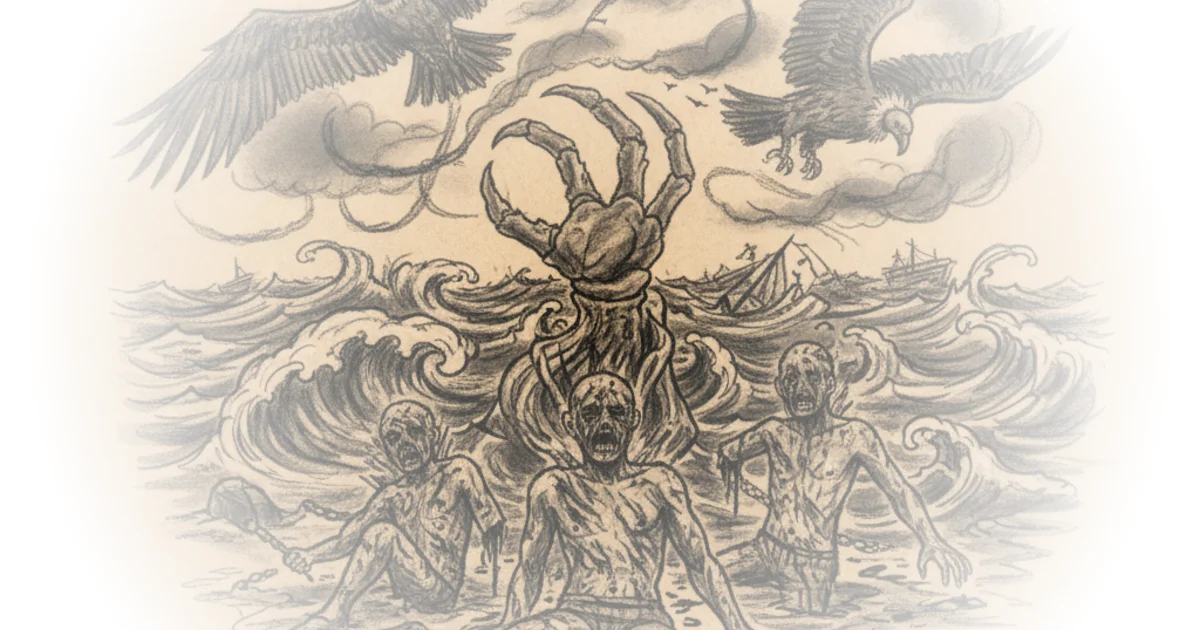
Greene opens with visceral, unflinching imagery that sets a tone of horror rather than triumph. He describes the first body found in Trinidad, noting that it had "burn marks across its face and limbs torn off by an explosion." This is not abstract data; it is the physical reality of drone warfare. The author argues that the administration's refusal to investigate these deaths is not an oversight but a feature of the operation. "No one knows who these men were, and no government has claimed them," Greene writes, highlighting the total lack of due process. The core of his argument is that the labeling of victims as "narco-terrorists" serves as a legal shield for extrajudicial killing. He points out that Defense Secretary Pete Hegseth posts "grainy drone footage of boats exploding into flames on social media like highlight reels, which they claim counts as proof." This framing is effective because it exposes the absurdity of using unverified video clips as judicial evidence. Critics might argue that the speed of these operations requires immediate action without the luxury of a courtroom, but Greene counters that speed does not negate the requirement for evidence, especially when the Pentagon itself admitted it could not definitively prove the victims belonged to the gang it targeted.
"Trinidad's beaches have become dumping grounds for America's undeclared war."
A Pattern of Geopolitical Precedent
Greene situates the current strikes within a forty-year history of using drug enforcement as a cover for regime change and military projection. He draws a sharp line from the present to the 1989 invasion of Panama, noting that President George H.W. Bush launched Operation Just Cause to arrest Manuel Noriega on drug charges, even though Noriega had "spent years on the CIA payroll before Bush decided he needed to be removed." This historical context is crucial; it suggests that the current campaign is not a unique response to a new threat, but a recurring strategy. The author parallels this with the Reagan administration's support for the Contras in Nicaragua, where the CIA allegedly helped smuggle cocaine to fund operations, a fact Greene notes was documented by journalist Gary Webb before his career was destroyed. The argument here is that the "War on Drugs" has always functioned as a weapon to pressure governments the U.S. wishes to remove. "The drugs provide cover for regime change," Greene asserts, pointing out that Venezuela holds the world's largest oil reserves but is not a major cocaine producer. This reframing challenges the official narrative that the strikes are purely about public safety, suggesting instead that they are about securing geopolitical dominance. A counterargument worth considering is that the U.S. has a legitimate interest in disrupting transnational criminal networks regardless of oil reserves, yet Greene's evidence of the lack of narcotics found on the struck vessels weakens the purely law-enforcement justification.
The Grenada Model and the Erosion of Law
The piece then pivots to the legal implications, comparing the current strikes to the 1983 invasion of Grenada. Greene notes that Reagan justified the invasion as a rescue mission for medical students, but the reality was an attempt to overthrow a leftist government and prevent a "Soviet-Cuban colony." The author argues that Grenada proved that "Congressional approval becomes unnecessary if we frame military action as a rescue operation or counterterrorism measure." This is a terrifying precedent for international law. Greene warns that if the U.S. can kill based on "classified intelligence," other nations will follow suit. He illustrates this by asking, "China could bomb fishing boats in the South China Sea while claiming they smuggle fentanyl precursors." This hypothetical is not fear-mongering; it is a logical extrapolation of the precedent being set today. The author emphasizes that the international community's response is often too slow, noting that in Grenada, the United Nations condemned the invasion only after U.S. troops had already secured the objective. "The U.S. is counting on the same outcome as Grenada: that by the time the international community organizes a response, the mission will already be accomplished," Greene writes. This analysis of institutional dynamics is the piece's strongest contribution, showing how power operates by exhausting the mechanisms of accountability before they can be invoked.
Bottom Line
Kahlil Greene's most compelling argument is that the current military campaign is not an anomaly but a calculated erosion of international law, using the War on Drugs as a convenient pretext to bypass judicial review and target specific governments. While the administration claims these are precision strikes against criminals, the lack of evidence, the refusal to identify victims, and the historical pattern of using drug charges for regime change suggest a much darker reality. The reader must watch for how this precedent is codified: if the U.S. successfully normalizes killing on the high seas without trial, the rules of the global order will have fundamentally shifted, leaving the world more vulnerable to the arbitrary use of force by any nation with a navy and a grievance.