The Renaissance Was a Propaganda Project That Almost Worked## The Birth of Italy's City Republics
When the Roman Empire dissolved in the West, individual cities across Europe suddenly needed to govern themselves. They could no longer rely on centralized infrastructure—roads, supply routes, or protection from bandits. Larger, wealthier towns surrounded by fertile agricultural land could support themselves through local resources and their attached farms. These communities converted successfully to Senate-style governance, with prominent families forming councils and ruling as republics.
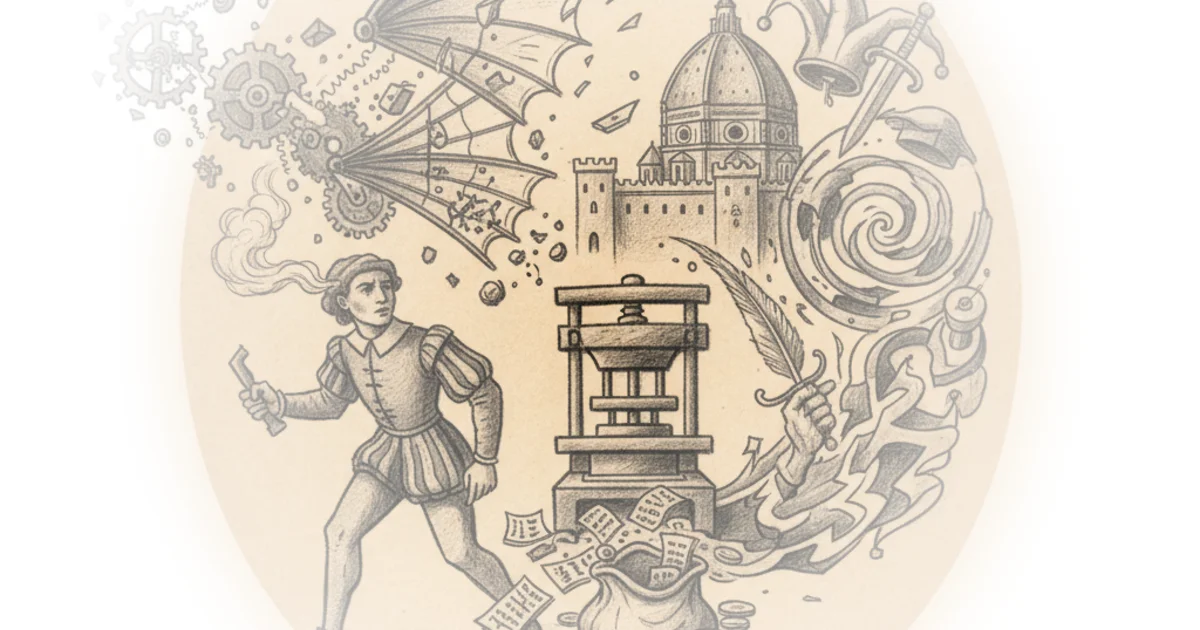
Weaker towns that couldn't self-sustain were more vulnerable to takeover by wealthy families who could gather goons, seize power, and declare themselves monarchs. Italy's exceptional agricultural wealth meant its cities could sustain independence—and that's why the Italian city republics clustered together in this region rather than elsewhere in Europe.
The Petrarchan Dream: Rescuing Roman Virtues
The central thesis of Ada Palmer's work centers on how Renaissance thinkers tried to resuscitate Roman virtues—specifically the qualities that allowed Roman emperors to maintain safety and good government. The connection between studying classical texts and contemplating ancient leadership seems indirect, but the historical answer is complicated.
Petrarch lived through the Black Death, surviving an era when Italy was ravaged by civil war, foreign mercenary troops raiding and pillaging the countryside, and bandits attacking travelers on mountain roads. After losing so many friends to the plague, he received word that two younger scholar friends had survived—only to learn one was killed by bandits while the other wandered lost in the mountains, wounded.
Looking around at this "age of ash and shadow," Petrarch decided Italy needed to imitate the arts of the ancients. The problem was clear: Italian leaders were selfish, caring more about family honor and wealth than the good of the people. Romeo and Juliet illustrates this perfectly—Lord Montague and Lord Capulet's goons knife each other in the streets while their feud damages Verona. They would never execute their own sons for treason against the state.
Petrarch read about ancient Roman figures like Brutus—not the assassin of Caesar, but an ancestor who executed his own plotting sons for treason once he discovered their coup plans. The contrast was stark: modern leaders couldn't match classical virtue.
Building Libraries to Raise Better Princes
The Renaissance project asked: How were these ancient leaders raised? Can we recreate that educational environment? Young princes and princesses needed to read what Cicero and Brutus read—Plato and Homer—and surround themselves with tutors who knew Greek and Latin. Petrarch's students and successors poured resources into traveling across the Alps to find manuscripts, journeying to Constantinople to purchase books from the wealthier East where texts remained abundant.
The assumption was simple: education works through osmosis. Expose young rulers to classical virtue and they'll imitate it. The uptake was strong because Italy was full of upstart rulers who had just seized power through coups and lacked legitimacy or right to rule. They could dress up like Roman emperors, parade with allegorical virtues beside them, invest in impressive palaces modeled on Roman architecture, and people would respect them.
The Medici family of Florence exemplified this. They were merchant scum—three ranks down from important families in Florence's hierarchy—and had no political legitimacy until they adopted Latin, Greek, and quoted Cicero to seem like ancients.
The Ambassador's Transformation
One telling anecdote captures how this worked: imagine a French ambassador traveling through Italy toward Rome for a new Pope's election. He passes through Florence—described in period sources as Europe's "sodomy capital," with Florentine becoming a verb for anal sex in several languages and visiting the city considered evidence enough for French sodomy laws.
The ambassador approaches this city of filth and depravity, but then sees lifelike statues unlike anything in France—statues so realistic they seem about to breathe. He rides through a large impressive city with a cathedral featuring a dome bigger than any Roman ruins except ancient ruins themselves. He reaches the banker's house, steps inside to a space cleaner than outdoors—cool, fresh air, something impossible in France where such knowledge was lost.
In the middle of the square stands another bronze statue, shining and new. Around the courtyard are busts of all Roman emperors in order, with portraits of this family above them. Men wearing robes like ancients speak ancient Greek—and the ambassador protests that Greek is lost. The banker responds: "We have lots of ancient Greek here." The ambassador counters: "We don't have Plato either—those works are lost." The banker produces Plato.
Then the banker's ten-year-old grandson recites a poem in ancient Greek about the three parts of the soul.
Where am I? This isn't possible—this hasn't existed for a thousand years.
When Power Flips Upside Down
Kosko and Debuchi turn to the ambassador and ask if he'll make an alliance with Florence. He could report back to his king: this city has no friends, no nobility, can't marry into other royal families, all its neighbors hate it because of feuds—so let's sack it, take gold from its basements, and burn it.
Or he can choose differently: give me a bronzesmith, an architect, Greek teacher, Platonist—and we'll bring this to the French court. Then when Portugal sends ambassadors, they'll feel like uncultured fools.
The power dynamic flips. The condescending nobleman now respects merchant scum because of art and culture as propaganda.
Machiavelli's Disillusionment
Raised on Petrarchan ideals—philosophers princes educated in Cicero and Plato—the Renaissance produced instead Cesare Borgia and Lucrezia Borgia, who set fire to half the world. Niccolò Machiavelli watched this play out: he observed virtuous rulers like Vidabaldo de Monteltra doing everything correctly, possessing all the libraries and art, only to be betrayed and lose everything.
He watched terrible leaders like Cesar Orsini and Julius II make terrible choices and succeed. Petrarch was wrong—simply reading ancient texts doesn't automatically produce virtue. The project assumed education equals moral formation, but rulers simply used classical aesthetics for legitimacy without internalizing classical values.
"The assumption that education works through osmosis—if you're exposed to something you'll imitate it—was strong because Italy was also full of upstart rulers who had just seized power five minutes ago by having a coup in their state and have no legitimacy."
Counterpoints
Critics might argue that reducing Renaissance philosophy to propaganda oversimplifies its genuine intellectual achievements—the rediscovery of classical texts genuinely advanced human knowledge beyond political theater. Additionally, the text treats Florence's reputation for sodomy as historical fact rather than anti-Italian propaganda from rival cities.
Bottom Line
The strongest argument in Palmer's analysis is how Renaissance ideals got co-opted by those who needed legitimacy most—rulers with no right to rule used classical aesthetics to seem like Caesar when they were just tyrants. The vulnerability is that this framing makes the period feel purely cynical, minimizing genuine intellectual contributions beyond political theater.
The real story isn't whether Renaissance art was propaganda—the fascinating part is how ideals meant to reform leadership became tools for tyranny while simultaneously producing some of humanity's greatest achievements.