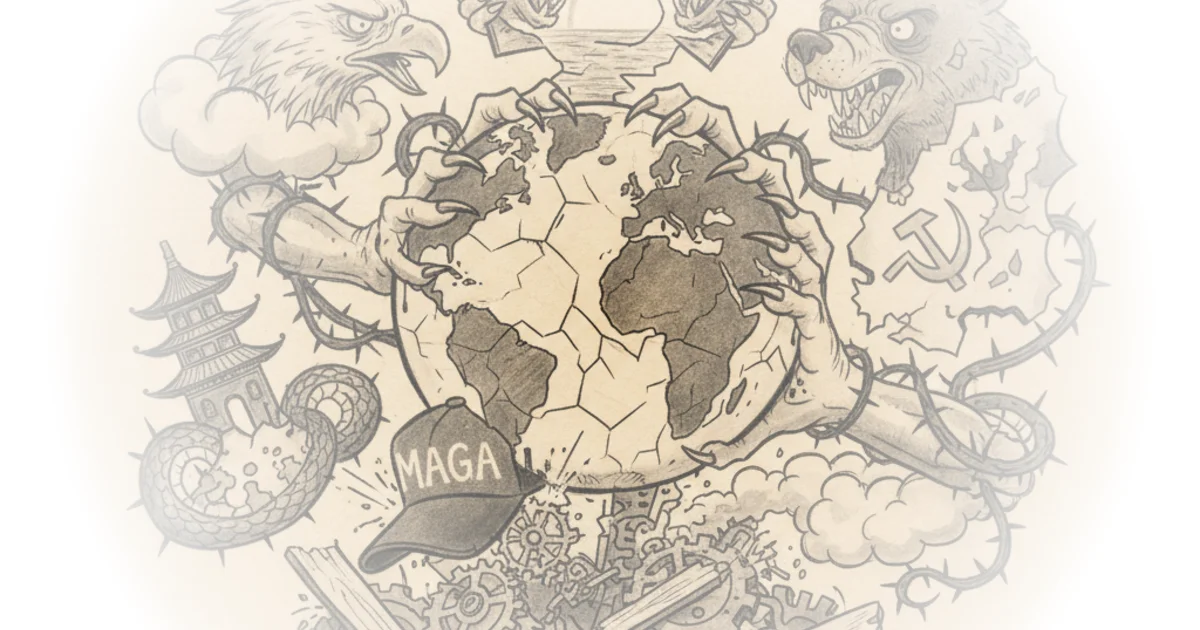
Noah Smith delivers a stark diagnosis of global decline, arguing that the world's dominant powers are not being outmaneuvered by rivals, but are actively dismantling their own futures through ideological rigidity and institutional decay. While Europe shows signs of strategic reawakening, the United States, China, and Russia are each trapped in self-inflicted crises that threaten their long-term stability and the lives of their citizens. This is not a story of external competition, but of internal rot, where the cost of political posturing is measured in human lives, scientific regression, and the erosion of state capacity.
The Human Cost of Ideological Rigidity
Smith opens with a harrowing account of violence in the United States, framing recent killings by Immigration and Customs Enforcement (ICE) agents not as isolated incidents, but as the logical endpoint of a movement that has rejected the rule of law. He writes, "The fundamental problem remains the same: The MAGA movement has convinced themselves that they're in an existential race war, that mass deportations are the only way to win that race war, and that anyone who opposes those deportations is their existential enemy." This framing is crucial because it moves the discussion from individual misconduct to systemic indoctrination. The author details the execution-style killing of Alex Pretti, a protester who was legally carrying a firearm, to illustrate how the administration's rhetoric has emboldened agents to act with impunity.
The commentary notes that the administration's immediate response—denying the reality of the Second Amendment while simultaneously claiming the victim was a terrorist—reveals a tactical disconnect from public reality. As Smith observes, "Americans are not fooled, and the administration may have made a tactical error by denying the existence of Second Amendment rights." This suggests that the executive branch is operating in a bubble of its own making, where facts are secondary to narrative. The sheer scale of the issue is underscored by the statistic that courts have found ICE to have illegally detained over 2,300 individuals, a figure that points to "systematic and flagrant" lawbreaking. Critics might argue that focusing on individual cases obscures the broader complexities of immigration enforcement, but Smith's data on the volume of illegal detentions suggests the problem is structural, not anecdotal. The human toll is immediate and severe, with a majority of respondents in some polls now favoring the abolition of the agency entirely.
The MAGA movement has convinced themselves that they're in an existential race war, and that anyone who opposes those deportations is their existential enemy.
The Hollowing Out of State Power
The analysis then shifts to China, where Smith argues that the centralization of power under Xi Jinping has led to a dangerous purge of the military establishment. The author describes the investigation of General Zhang Youxia, a veteran of the 1979 war with Vietnam and a personal friend of the leader, as part of a "purge unmatched since the death of Mao Zedong in 1976." Smith questions the strategic logic of such a move, noting that if the goal were to prepare for a war with Taiwan, "would you really fire every single general who had combat experience?" The implication is that the leadership is more concerned with internal loyalty than operational competence, a dynamic that echoes historical precedents where purges weakened a nation's ability to defend itself.
Smith posits that the most likely explanation is not a prelude to war, but a reaction to internal instability, perhaps even a coup plot. He writes, "Whoever replaces the purged military leaders will still have power over the same military, and will presumably be just as much of a threat." This suggests that the purge is a symptom of a deeper crisis of legitimacy rather than a calculated strategic maneuver. The argument is compelling because it challenges the assumption that autocratic leaders are always rational actors; instead, it portrays them as increasingly paranoid and isolated. A counterargument worth considering is that such purges are a standard tool for consolidating power in authoritarian regimes, but Smith's point about the loss of combat experience highlights a specific vulnerability that could be exploited in a real conflict.
The Demographic Suicide of War
In Russia, the narrative turns to the catastrophic human cost of the war in Ukraine. Smith presents a grim calculation: if Ukraine's defense minister's goal of killing 50,000 Russian soldiers per month is achieved, it would "wipe out an entire generation of Russian men — simply delete it from existence." The author describes the current Russian tactics as "meat assaults," a return to World War I strategies where armored vehicles are useless against modern defenses. This is not a story of military brilliance, but of attrition that is consuming the country's future. "Russia is really expending a vast number of its citizens' lives for not much territorial gain," Smith writes, emphasizing the futility of the current strategy.
The human cost is the central focus here. The author notes that even if Ukraine's figures are modest overestimates, the trend is undeniable: Russia is losing men at a rate that its birth rate cannot sustain. "In 2024, Russia recorded 1.22 million births... That's almost exactly equal to the number of Russian men Ukraine believes it can kill over the next year." This stark comparison underscores the demographic suicide of the war. While the administration may view these losses as a necessary price for expansion, the reality is a hollowing out of the nation's human capital. The argument is reinforced by the observation that Russia is resorting to foreign mercenaries and North Korean allies, whose numbers are insufficient to change the outcome. The long-term consequence, as Smith points out, is that even if Russia were to win, it would be a pyrrhic victory, leaving a nation depleted and unable to recover.
The Retreat from Science and Reason
The commentary then turns to the United States' internal decay, specifically the assault on scientific consensus and public health. Smith highlights the resurgence of measles, a disease that was previously eliminated, as a direct result of the antivax movement spreading from the fringe to the mainstream. The author notes that the administration has sent "mixed messages" on the topic, with Health Secretary Robert F. Kennedy Jr. downplaying the risks of the virus and spreading misleading claims about vaccines. "The Trump administration could fight against this trend by reassuring everyone that measles vaccines are safe and effective," Smith writes, "but... has sent mixed messages on the topic."
This section is particularly alarming because it connects political ideology to tangible public health outcomes. The author cites Moderna's CEO, who stated that the company does not plan to invest in new late-stage vaccine trials due to the hostile environment in the US. "You cannot make a return on investment if you don't have access to the US market," Bancel said, a statement that signals a retreat of American leadership in biotechnology. Smith argues that this is not just about measles, but about the broader "assault on science" that threatens to slow down progress in mRNA cancer treatments and other critical fields. The author warns that this "medievalism" could "condemn lots of Americans to unnecessary death from cancer." Critics might argue that vaccine hesitancy is a global phenomenon not unique to the US, but Smith's point about the specific role of government officials in amplifying misinformation is a distinct and dangerous development.
America continues its slow deterioration into anti-science, anti-technology medievalism.
The Rise of a Pragmatic Power
In contrast to the self-destruction of the great powers, Smith identifies India as a rising power that is focusing on growth and technological advancement. The author points to India's rapid increase in the publication of well-cited scientific papers, noting that the country is "overtaking the UK, Japan, and Germany in just a few years." While acknowledging that this growth may contain some fraud, Smith argues that "ultimately, China's research turned out to be mostly real, and India's will too." The piece highlights India's aggressive push into electrification and electronics manufacturing, with domestic mobile phone production rising from 2 million units in 2014 to 300 million a decade later.
This section serves as a counterpoint to the rest of the article, suggesting that there is a viable path forward for nations that prioritize economic development over ideological purity. Smith writes, "If any country has the scale, capital and economic dynamism to become a major electrotech manufacturer alongside China, it is India." The argument is that while the US and China are distracted by internal conflicts and geopolitical posturing, India is quietly building the infrastructure of the future. This is a hopeful note in an otherwise grim assessment, but it also raises questions about whether India can sustain this momentum without falling into the same traps of corruption and authoritarianism that have plagued other rising powers.
Bottom Line
Noah Smith's argument is strongest in its unflinching focus on the human cost of political ideology, whether it is the loss of life in Russia's war, the execution of a protester in the US, or the potential death toll from a measles outbreak. The piece's greatest vulnerability lies in its reliance on the assumption that these trends are irreversible; it offers little on how these nations might course-correct or what the global community can do to mitigate the damage. Readers should watch for whether the US administration's stance on science and immigration hardens further, and whether India can maintain its growth trajectory amidst global instability. The ultimate verdict is that the world's great powers are in a race to the bottom, and the only winner so far is the one that refuses to play the game.