Sabine Hossenfelder delivers a blistering critique of a field that has spent fifty years chasing ghosts, arguing that particle physics has confused aesthetic preference with scientific necessity. While the public is told that the absence of new particles is merely a matter of time and better equipment, Hossenfelder contends that the discipline is suffering from a systemic failure of method: the relentless overfitting of theories to data that already fits perfectly. This is not a story of bad luck; it is a story of a scientific community that has lost its way by inventing problems to solve, rather than solving the problems that actually exist.
The Long Shadow of Prediction Failure
Hossenfelder opens by dismantling the comforting narrative that physics is simply on the verge of a breakthrough. She points out that the field is defined by a repetitive cycle of failure: "if you follow news about particle physics then you know that it comes in three types it's either that they haven't found that thing they were looking for or they've come up with something new to look for which they later report not having found or it's something so boring you don't even finish reading the headline." The evidence she marshals is stark and cumulative. From the non-existence of supersymmetric particles to the elusive nature of dark matter candidates like WIMPs (Weakly Interacting Massive Particles) and axions, the track record is dismal. She notes that the list of predicted-but-undiscovered entities is "very long," including proton decay and sterile neutrinos, concluding that there is "about as much evidence for any of those as for bigfoot."
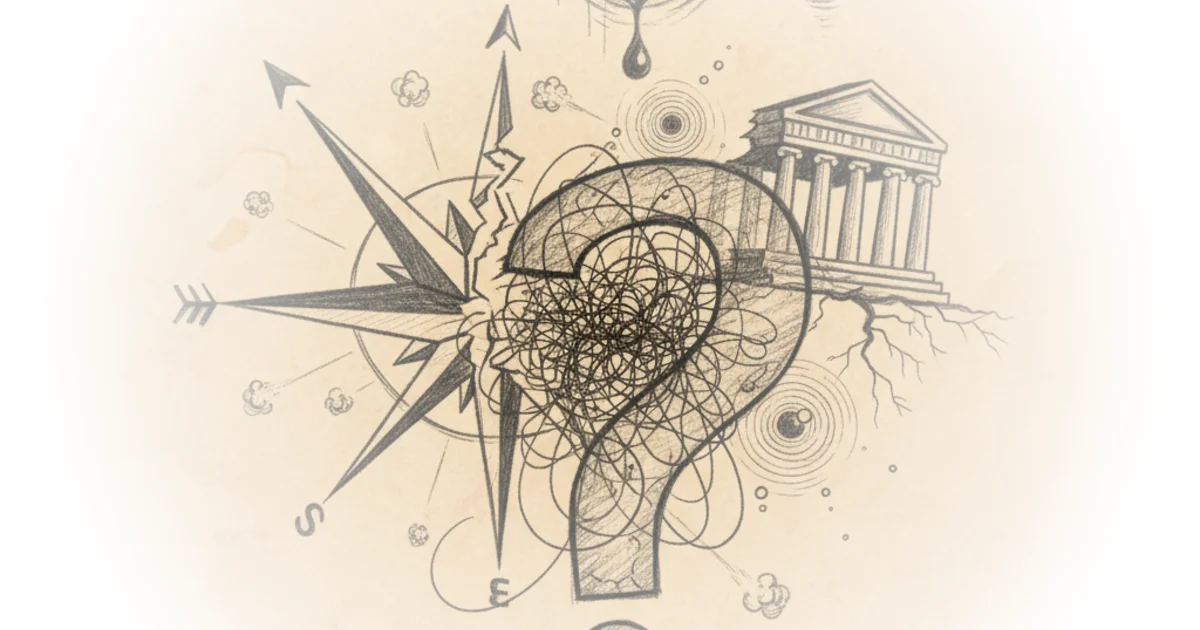
This framing is effective because it strips away the technical jargon to reveal a simple, uncomfortable truth: the standard model, completed in 2012 with the discovery of the Higgs boson, works perfectly. Yet, the community refuses to accept it as a final answer. Hossenfelder argues that the drive to go beyond the standard model is not driven by data, but by a desire for theoretical elegance. "Particle physicists wanted those to be unified to one force why because that'd be nicer," she writes, highlighting that the motivation is often aesthetic rather than empirical. The problem arises when these "nicer" theories make specific predictions that are repeatedly falsified. Instead of abandoning the theories, the community simply amends them. As Hossenfelder observes regarding Grand Unified Theories, "you can make those models more complicated so that they remain compatible with observations. That's what particle physicists did and that's where the problems began."
"Just because the hypothesis is falsifiable doesn't mean it's good science... a hypothesis which is scientific is also falsifiable."
The Trap of Overfitting and Pseudo-Problems
The core of Hossenfelder's argument rests on a statistical concept applied to theoretical physics: overfitting. She uses a simple analogy of fitting a curve to data points. A model that is too simple misses the pattern; a model that is too complex fits every noise and becomes useless. She posits that particle physicists have crossed the line into the latter. "If you make a model more complicated by adding more assumptions you can fit the data better but the more complicated the model becomes the less useful it'll be," she explains. The current practice, she argues, is to take the standard model, which already fits all existing data, and arbitrarily add complexity to predict deviations in untested energy ranges. When those predictions fail, the models are tweaked again. "The problem is that those models with all their different predictions are unnecessarily complicated," she asserts. "They are not scientific hypotheses they are made up stories."
Hossenfelder identifies the root cause as the invention of "pseudo problems." Issues like the "strong CP problem" or the "hierarchy problem" (why the Higgs mass is so light) are framed as crises requiring new particles. However, she argues these are merely "aesthetic misgivings." The standard model works fine with the parameters as they are; setting the theta parameter to zero is not a scientific failure, but a feature of the current model. "These aren't real problems because they don't prevent them from making predictions with the standard model," she writes. The field is stuck because it refuses to tackle the few real, difficult foundational problems, preferring instead to chase "invisible friends" like the axion, which she notes was introduced to solve a problem that wasn't really a problem, only to be ruled out by neutron star cooling data and then resurrected as the "invisible axion."
Critics might argue that Hossenfelder underestimates the value of theoretical exploration. The history of science shows that sometimes the most abstract ideas, like the neutrino or gravitational waves, take decades to confirm. Hossenfelder addresses this, noting that while long timelines are acceptable, the issue is the direction of the field. "The issue isn't that it's taking a long time the issue is that particle physicists make all these wrong predictions and that they think that's business as usual." She emphasizes that resources are finite and that "we must decide which tests are the most promising ones and the ones most likely to lead to progress." Without reliable predictions, the billions spent on massive colliders are being guided by guesswork rather than science.
The Cost of Stagnation
The stakes of this methodological drift are high. Hossenfelder points out that the community's defense of its current trajectory often relies on the sheer volume of output rather than its quality. "The first is to just deny that anything is wrong because hey they are writing so many papers and holding so many conferences," she notes. This is a dangerous feedback loop where the inability to find new physics is met with a call for even bigger machines, based on theories that have already failed multiple times. She illustrates this with a hypothetical physicist named "Bob," who predicts deviations simply because he can, not because the data demands it. When the experiment confirms the standard model again, Bob and his colleagues simply move the goalposts to a new, untested energy range.
The conclusion is a call for intellectual honesty. Hossenfelder suggests that the field needs to admit that its current path is not working. "Good scientists should learn from their failures but particle physicists have been making the same mistake for 50 years." The path forward requires a shift away from "beauty" and toward the difficult, unglamorous work of solving the actual foundational issues, rather than inventing new particles to fix imaginary cracks in the theory. As she bluntly puts it, "if you change a good model then that change should be an improvement not a complication."
Bottom Line
Hossenfelder's strongest argument is her diagnosis of "overfitting" as the central pathology of modern particle physics, effectively explaining why the field produces endless theories but no new discoveries. Her biggest vulnerability is the risk of appearing dismissive of the genuine theoretical challenges that drive the field, though she carefully distinguishes between real inconsistencies and aesthetic preferences. The reader should watch for whether the next generation of experiments, driven by these very theories, will finally break the cycle or if the community will continue to demand larger colliders to chase the same invisible particles.