Sam Denby doesn't just explain why trucking is broken; he exposes the specific economic machinery that turned a regulated, stable profession into a high-stress, low-reward gamble for the driver. By dissecting the daily grind of a Walmart fleet driver against the chaotic reality of the independent contractor, Denby reveals a sector where efficiency for the corporation has come at the direct expense of human dignity and financial security.
The Illusion of the Good Job
Denby begins by constructing a detailed, almost cinematic portrait of a "good" trucking job to show just how rare it has become. He walks the reader through a day in the life of a driver for Walmart's private fleet, noting that while the pay is competitive and the schedule predictable, the job is increasingly difficult to secure. "The job is also flexible as drivers set the end of their own work days," Denby writes, highlighting the work-life balance that is the exception rather than the rule. This framing is crucial because it establishes a baseline of what a decent job looks like in this industry, making the contrast with the rest of the sector even starker.
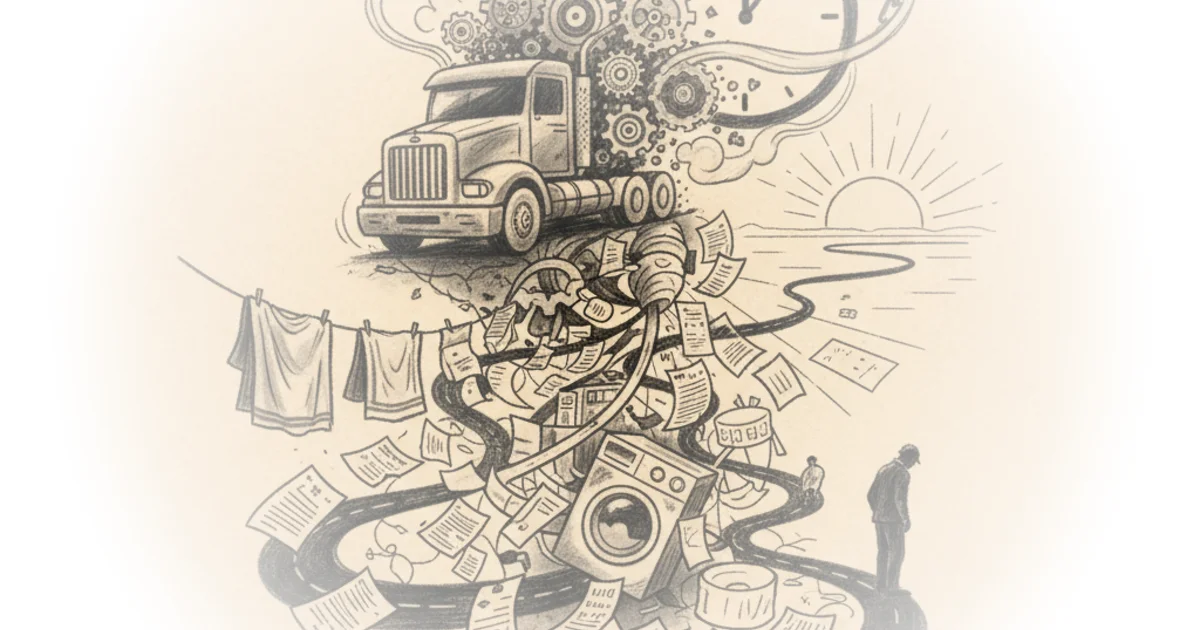
However, even this "good" job is not without its own brand of surveillance. Denby notes that while the company claims tracking tablets and dash cams are for safety, "drivers feel it allows the company means to monitor speed." The argument here is nuanced; Denby acknowledges the tension between corporate logistics and driver autonomy, suggesting that the price of a steady paycheck is a loss of privacy. This lands effectively because it avoids painting the corporation as a cartoon villain, instead presenting a cold, calculated trade-off that defines modern logistics.
Trucking has never been so in demand in the US, and yet it has never been such a bad job.
The Deregulation Trap
The piece then pivots to history, tracing the collapse of the industry's standards back to the Motor Carrier Act of 1980. Denby explains how the pre-1980 era, though restrictive, ensured stable rates and protected drivers from a race to the bottom. He describes the old system where "truckers were told what they could carry, where they could carry it, and how much they could charge for that service." While this sounds oppressive, Denby argues it was a necessary check on market forces that prevented the exploitation of labor.
The deregulation era, he argues, unleashed a flood of competition that destroyed wages and union power. "The floodgates opened on the industry, and while it was a wash in labor and employment options, the sharp increase in competition led to lower wages and a loss in union power." This is the core of Denby's thesis: the very freedom that promised to liberate truckers actually trapped them in a hyper-competitive environment where the only way to survive was to accept worse terms. Critics might note that deregulation did lower consumer prices and increased the volume of goods moved, a benefit the author acknowledges but frames as a cost paid entirely by the workforce.
The Myth of the Owner-Operator
Perhaps the most damning section of Denby's analysis is his deconstruction of the "owner-operator" myth. In a sector where nearly half of the 3.5 million truckers are classified as owner-operators, Denby reveals that this status is often a trap. He points out that "only 44% actually drive under their own direct authority, while 45% lease their time to a motor carrier company." This distinction is vital for understanding the modern crisis, as it shows how companies like XPO Logistics have shifted all the risk onto the driver while retaining the profits.
Denby illustrates this with the example of port driving, where an independent contractor might wait for hours in traffic without pay. "During the co-fueled consumer boom where docks and ports were making daily news because of stacking delays, drivers were waiting up to 6 hours to pick up their freight, at which point they'd get turned around at the docks because they wouldn't be able to deliver within the 11-hour driving window." The irony is palpable: the driver bears the cost of the delay, the fuel, and the lost time, while the logistics company remains insulated. This evidence holds up because it moves beyond abstract economic theory to the visceral reality of a driver burning money while sitting in traffic.
In many ways, this represents the opposite of the Walmart approach. One invests in employees and provides benefits to maintain a steady, well-trained driver base. The other keeps their commitments to drivers minimal under the assumption that there will always be a strong supply of independent individual operators.
Bottom Line
Denby's strongest contribution is his ability to connect the macro-economic shift of deregulation to the micro-reality of a driver's paycheck, proving that the industry's "freedom" is largely a fiction for those on the road. The argument's vulnerability lies in its reliance on the dichotomy between the private fleet model and the independent contractor model, which may overlook the growing number of hybrid arrangements that don't fit neatly into either category. Ultimately, the piece serves as a stark warning: without structural changes to how the industry is regulated and compensated, the demand for goods will continue to outpace the ability of drivers to live decent lives.