This piece delivers a jarring but essential truth: the modern Ku Klux Klan is not an ancient institution, but a modern invention born from fiction and amplified by cinema. Kahlil Greene exposes how a 1915 film did not merely reflect racism but actively manufactured the rituals, uniforms, and organizational structure of the hate group that terrorized the nation for decades. For a reader navigating a landscape of historical revisionism, this is a critical correction to the record, proving that the symbols of white supremacy were often borrowed from Scottish poetry and Hollywood special effects rather than historical reality.
The Fictional Birth of a Real Terror
Greene anchors his argument in a specific, startling timeline: the Klan that Americans recognize today emerged directly from the screen. He writes, "The Klan that Americans recognize today came out of fiction, and the men who joined it learned the part from a film." This is a profound distinction. The original Klan of the 1860s was a decentralized, ragtag insurgency that had largely dissolved by the 1870s, wearing mismatched clothes and never burning crosses. Greene points out that "Dixon invented the burning cross," tracing the imagery not to Reconstruction-era terror, but to Sir Walter Scott's 1810 poem The Lady of the Lake.
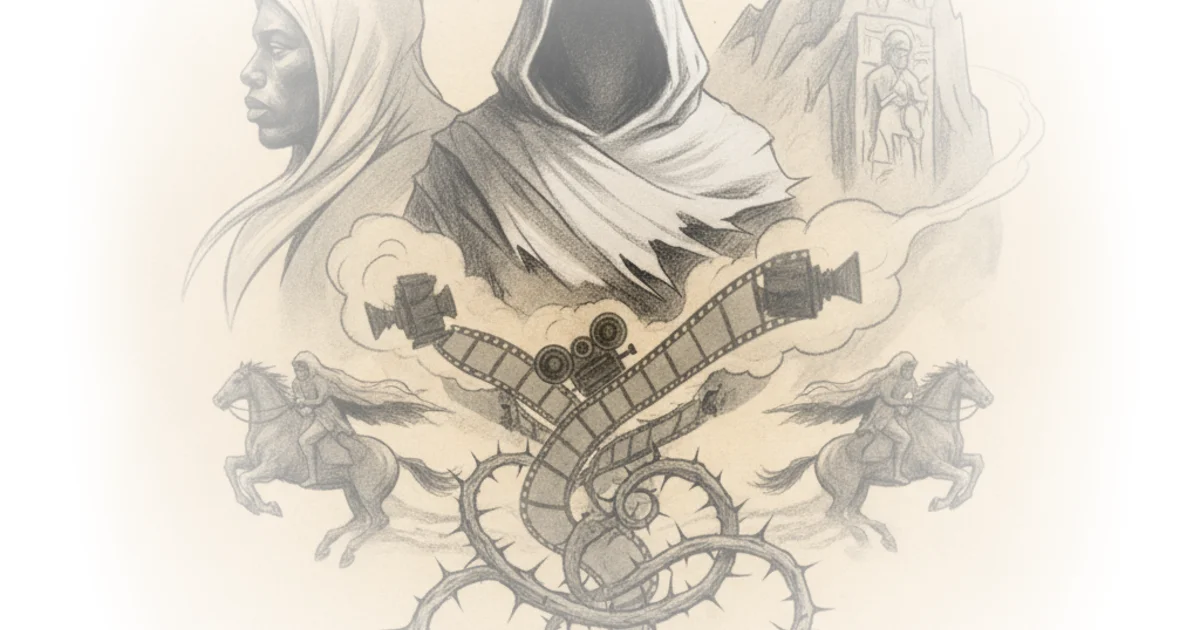
The article details how Thomas Dixon Jr., a novelist who studied alongside Woodrow Wilson, crafted a narrative that framed Reconstruction as a period of Black terror, only to be "saved" by hooded riders. When D.W. Griffith adapted this into The Birth of a Nation, he utilized unprecedented cinematic techniques—close-ups, cross-cutting, and orchestral scores—to make the fiction feel like history. Greene notes that the film became "the most profitable American film made to that point," creating a cultural vacuum that the revived Klan rushed to fill. This framing is effective because it shifts the blame from an inevitable historical resurgence to a specific act of cultural engineering. Critics might argue that the Klan's roots in white supremacy predate the film, which is true, but Greene's point stands: the organization and its iconography were industrialized by the movie.
The men on the mountain copied what they saw on the screen, down to the robes and the flaming cross.
The Hollywood Marketing Machine
The most chilling aspect of Greene's coverage is the revelation that the Klan's revival was a coordinated marketing campaign. William Joseph Simmons, a former preacher, did not stumble upon the idea of a new Klan; he orchestrated it. Greene explains that Simmons "followed the film's success from Atlanta" and timed his first cross-burning on Stone Mountain to coincide with the film's local premiere. The connection was deliberate: "Simmons bought newspaper advertisements announcing his organization and placed them beside the theater's advertisements for the film."
This section of the piece highlights how hate groups can leverage pop culture for recruitment. The article notes that recruitment initially moved slowly, but once professional marketers Edward Young Clarke and Elizabeth Tyler were hired, "Membership then climbed into the millions." Greene cites historian Linda Gordon's estimate of "four to six million members at the peak," emphasizing that the organization grew fastest outside the South, in places like Indiana. This data underscores that the Klan was not a regional anomaly but a national phenomenon fueled by a sophisticated publicity apparatus. The comparison to modern political marketing is unavoidable; the machinery of hate has always been adaptable to the media of the day.
The Battle for Historical Memory
The narrative takes a sharp turn to the present, connecting the 1915 revival to a 2025 legal battle over the Stone Mountain Park museum exhibit. Greene writes that "state officials spent $11 million on a museum exhibit that explains how the Ku Klux Klan came back to life on that mountain in 1915," only to face a lawsuit from the Sons of Confederate Veterans. The plaintiffs argued the exhibit violated state laws requiring the park to function as a Confederate memorial. Greene frames this not as a bureaucratic dispute, but as a continuation of the original erasure: "Griffith and Dixon built the Klan that millions of Americans joined, and the people who defend the site where those men gathered are still working to keep that account out of public view."
The article also honors the early resistance to the film, specifically the work of William Monroe Trotter. Greene details how Trotter, a Harvard graduate and editor of the Boston Guardian, organized protests and legal challenges, even being arrested for attempting to buy tickets to the film. "The campaign brought the young NAACP national attention and put Black protest on the front pages of seven daily newspapers in a single city." This historical context is vital; it reminds the reader that the fight against this narrative began the moment the film premiered, and that Black Americans were never passive recipients of this propaganda.
Bottom Line
Kahlil Greene's most powerful contribution is dismantling the myth of the Klan as an unbroken, ancient lineage, replacing it with the reality of a media-driven revival. The piece's greatest strength lies in its meticulous tracing of specific symbols—the white hood, the burning cross—to their fictional origins, proving that hate can be manufactured and sold. The biggest vulnerability is the sheer scale of the conspiracy, which requires the reader to accept that a movie could single-handedly reshape American social history, a claim that, while well-documented here, feels almost too cinematic to be true. As the legal battles over Stone Mountain continue, the core lesson remains: history is not just what happened, but what we choose to remember, and the tools of memory are often in the hands of those with the loudest megaphones.