Tom van der Linden challenges a near-universal assumption: that the Coen brothers' No Country for Old Men is a flawless translation of Cormac McCarthy's novel. His most surprising claim isn't just that the film omitted plot points, but that these "major emissions" actually sharpen the story's fatalistic core rather than dilute it. For the busy listener, this offers a rare reframing of a classic text, suggesting that fidelity to the source material is sometimes the enemy of the adaptation's soul.
The Cost of a Hitchhiker
Van der Linden begins by dissecting a subplot entirely absent from the screen: Llewellyn Moss's encounter with a teenage runaway. In the novel, Moss picks up a girl he suspects is no older than fifteen, a decision that leads to her death alongside his own. Van der Linden notes that this addition does more than extend the runtime; it fundamentally alters Moss's moral standing. "Every step you take is forever. You can't make it go away," the author quotes Moss telling the girl, a line that underscores the inescapable weight of consequence.
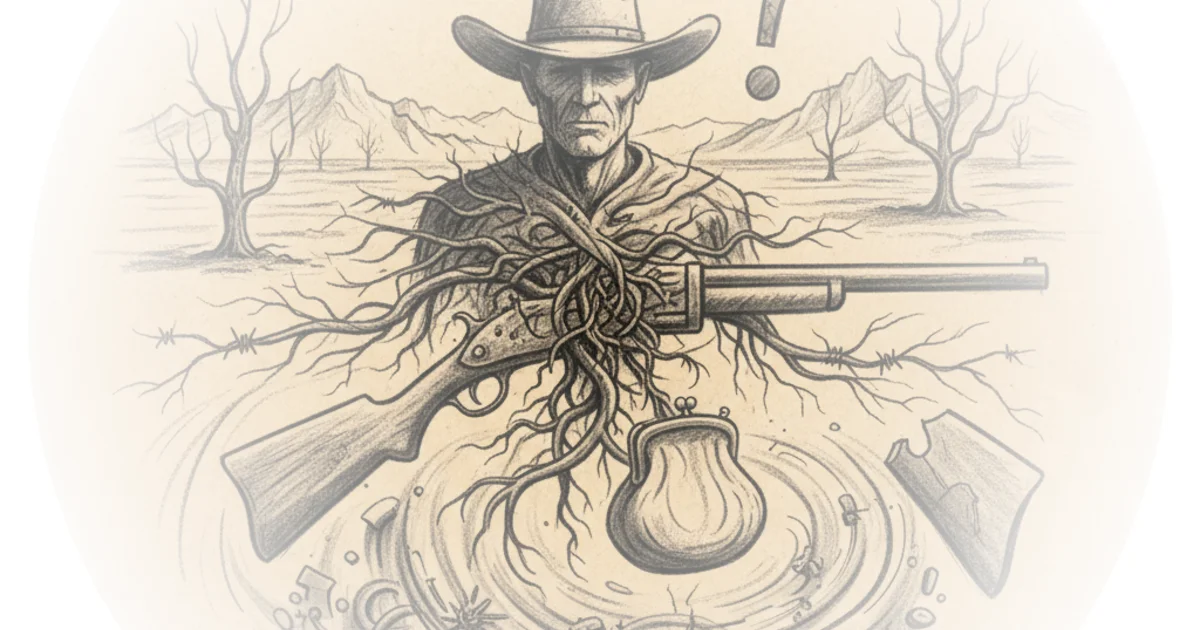
The commentary highlights a tragic irony: in the book, Moss is not just killed, but his reputation is destroyed posthumously. Because the girl is found dead with him, the world assumes he was cheating on his wife, Carla Jean. Van der Linden argues that this detail deepens the tragedy, stripping Moss of his "good name in the memory of everyone he's left behind." While the film hints at this with the poolside murder of a different woman, the book makes the accusation explicit.
"It's not just that he's robbed of his life, but also of his reputation and of his good name in the memory of everyone he's left behind."
Critics might argue that removing this subplot saves the film from unnecessary melodrama, but Van der Linden suggests the omission serves a different purpose. By cutting the hitchhiker, the Coens force the audience to focus on the inevitability of Moss's fate rather than the specific collateral damage of his choices. The film's version is cleaner, but the book's version is more cruelly human.
The Coin Flip and the Illusion of Choice
The analysis shifts to the confrontation between Carla Jean and the antagonist, Anton Chigurh. Here, the divergence is subtle but philosophically significant. In the movie, Carla Jean refuses to call the coin toss, directly challenging Chigurh's philosophy of fate. In the book, she calls the coin, loses, and then attacks his reasoning. Van der Linden writes, "In the movie, Carla Jean refuses to call Shigur's coin flip and instead confronts his philosophy by arguing that his insistence on leaving his decisions to fate is but a pretense to avoid culpability."
This distinction, the author argues, changes the nature of the conflict. The film version empowers Carla Jean, allowing her to deny Chigurh's power. The book version, however, doubles down on the theme of fatalism. "Somewhere you made a choice all followed to this," Chigurh tells her in the text, reinforcing the idea that the future is already written. Van der Linden appreciates this darker tone, noting that it "doubles down on that feeling of fatalism and on how our agency in the present is curtailed by our past selves."
"The accounting is scrupulous. The shape is drawn. No line can be erased."
This is a compelling observation. The film's Carla Jean is a defiant hero; the book's Carla Jean is a victim of a closed system. Van der Linden suggests that while the movie's choice is more cinematically satisfying, the book's choice is more thematically consistent with McCarthy's worldview. The "scrupulous accounting" of the past is a burden the film chooses to lighten, perhaps to make the ending more palatable for a general audience.
Bell's Ghost and the Burden of the Past
The most substantial section of Van der Linden's commentary focuses on Sheriff Ed Tom Bell. In the film, Bell is a weary man nostalgic for a simpler past, a view challenged by his uncle Ellis. In the book, however, Bell's nostalgia is rooted in a specific, hidden trauma: he is a decorated World War II veteran who fled a battlefield, leaving his men to die. Van der Linden writes, "He still got a medal for it. Mostly because, as Belle believes, they had to make it look good."
This backstory recontextualizes Bell's entire arc. His lamentation about the state of the world is not just generational grumbling; it is a projection of his own guilt. "I didn't know you could steal your own life," Bell confesses to Ellis, admitting he feels he has no right to the life he survived. Van der Linden argues that this makes Bell's character "a projection of the way he's actually feeling about himself." The "loss of value" he sees in the world is actually his own internal sense of failure.
"I should have done it and I didn't. And some part of me has never quit wishing I could go back and I can't."
The author also points out a subtle genealogical shift: in the book, Bell's father was a horse trader, not a sheriff. This detail is crucial. Bell's father represented a quiet, ordinary integrity that Bell initially dismissed. "My daddy always told me to just do the best you knew how and tell the truth," Van der Linden quotes, contrasting this simple wisdom with the complex, violent legacy of the lawmen Bell idolizes.
Critics might suggest that adding a war backstory to Bell risks making him a cliché of the "traumatized veteran," but Van der Linden counters that McCarthy uses it to dismantle Bell's romanticism. The "fire" Bell sees in his father's dream is not the fire of a lawman, but the fire of a common man who lived with truth. This reframes the ending not as a loss of the old order, but as a rediscovery of a quieter, more enduring kind of goodness.
Bottom Line
Tom van der Linden's analysis succeeds because it refuses to treat the film and book as competitors; instead, he positions them as complementary explorations of the same fatalistic themes. The strongest part of his argument is the revelation that Bell's war trauma is the hidden engine of his despair, a detail that transforms a generic "old man" trope into a profound character study. The only vulnerability lies in the assumption that the film's omissions were purely artistic choices rather than practical constraints, but even that distinction serves his larger point: that the movie's power lies in what it leaves unsaid.