Jesse Damiani delivers a stark warning that the U.S. economic recovery of the last two years is not a sign of broad-based health, but a fragile illusion propped up by a single, overheated sector. While mainstream narratives celebrate GDP growth, Damiani argues we are witnessing a capital expenditure boom so concentrated in artificial intelligence that a correction in this one industry could trigger a systemic collapse far worse than the dot-com crash. This is not a story about stock prices; it is an analysis of how the entire American economy has become hostage to a speculative narrative that may not yet have real-world earnings to back it up.
The Concentration Risk
Damiani's central thesis rests on the sheer scale of investment pouring into AI infrastructure, which has effectively replaced traditional consumer spending as the primary engine of growth. He cites data showing that "Capex spending for AI contributed more to growth in the U.S. economy in the past two quarters than all of consumer spending." This statistic is jarring because it reveals a fundamental shift in how the economy functions: the boom is not driven by people buying goods, but by tech giants building data centers.
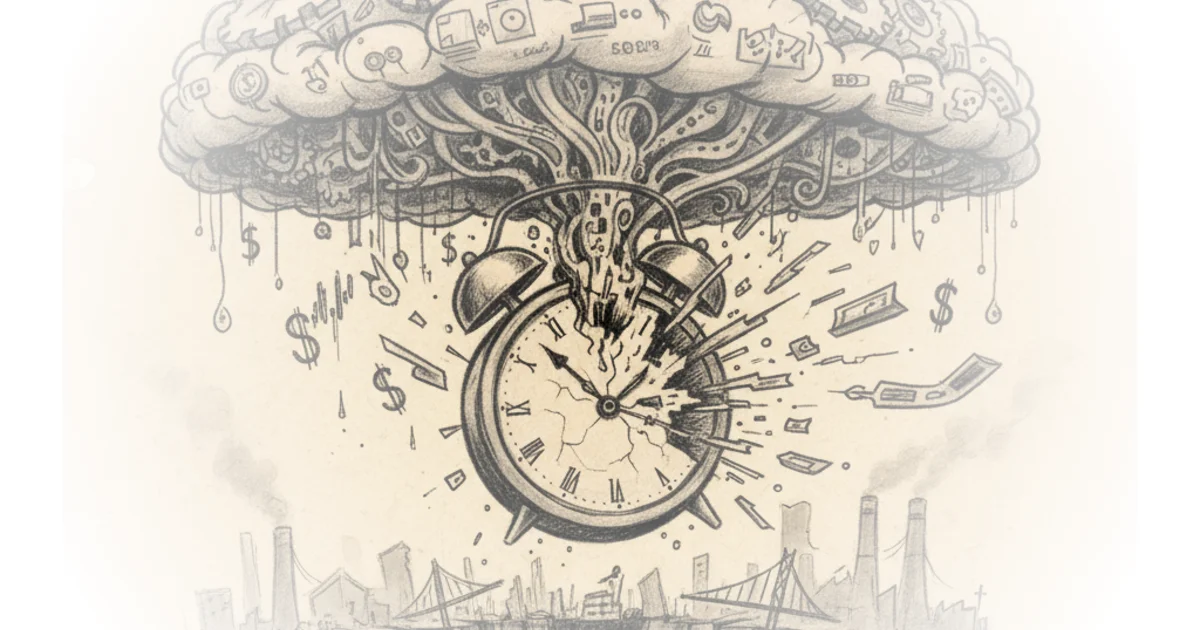
The author draws a parallel to historical financial crises to illustrate the danger of such concentration. He notes that if the current AI bubble bursts, "the blast radius will not be contained to Silicon Valley. It will ripple through the U.S. economy, creating the kind of cascading slowdown that I believe will feel a whole lot more like a full-on crash than a small 'contraction.'" This framing is effective because it moves the conversation from abstract market volatility to tangible economic pain for the average worker. The argument suggests that the recent economic resilience is actually a sign of extreme vulnerability.
Critics might argue that the productivity gains from AI are simply taking longer to materialize and that the current spending is a necessary investment in the future, much like the railroad boom of the 19th century. However, Damiani counters this by pointing out that "evidence is piling up that AI is failing to deliver in the real world," with major tech companies struggling to recoup their massive investments.
If that bubble bursts, it could put the dot-com crash to shame—and the tech giants and their Silicon Valley backers won't be the only ones who suffer.
The Fragile Foundation
The piece meticulously details how this bubble has infected every layer of the economy, from the stock market to the electrical grid. Damiani highlights that the stock market has become "hostage to this concentration," with the "Magnificent Seven" dominating indices and Nvidia alone accounting for nearly 8% of the S&P 500's weight. This lack of diversification means that a downturn in AI stocks would immediately erode household net worth and dampen consumer spending, creating a negative feedback loop.
Furthermore, the physical infrastructure built to support this boom is predicated on demand that may never arrive. Damiani points out that "Data-center construction has surged to annualized highs of around $40 billion, a figure unmatched in U.S. history." If the expected demand for computing power does not materialize, these massive projects will become stranded assets. The energy sector is particularly exposed, with forecasts suggesting data centers could consume 10% of U.S. electricity within a few years. If that demand falls short, "capital-intensive grid and generation projects may no longer pencil out," leaving utilities with debt they cannot service.
The author also identifies a dangerous circularity in the financing of this boom. He notes the risk of "circular seller-investing-in-customer entanglement," citing the announcement that Nvidia would be investing $100 billion in OpenAI. This structure amplifies risk because it ties the financial health of the chip maker directly to the success of the software developer, creating a chain reaction if either side falters.
Triggers and Consequences
Damiani outlines specific, non-hypothetical triggers that could pop the bubble. These include enterprises failing to see productivity gains, the normalization of the global GPU supply, or regulatory delays in grid expansion. The consequence of any of these triggers would be a rapid unraveling of the current economic setup. He warns that "if enterprises fail to realize near-term productivity or revenue gains from AI adoption, investment will slow," which would immediately hit semiconductor makers, cloud providers, and construction firms.
The political context adds another layer of complexity to this economic fragility. Damiani suggests that a crash would occur "at an already perilous moment in geopolitics," compounding the damage from existing trade policies and economic turbulence. The author argues that the current trajectory leaves the U.S. economy "balanced on a knife's edge," where the bet on AI has supported GDP and employment but has also starved other sectors of necessary capital and attention.
America's recent economic resilience has not been the product of broad dynamism but of a singular bet on AI.
Pathways to Resilience
In the final section, Damiani shifts from diagnosis to prescription, arguing that the solution lies in diversification. He posits that "diversity is the answer," urging policymakers to redirect fiscal incentives toward neglected areas like housing, public infrastructure, and clean energy. The goal is to build an economy where future damages in any one sector remain localized rather than systemic.
He also calls for better data transparency and scenario planning. "Regulators and utilities should adopt scenario planning that includes lower-than-expected demand trajectories," he writes, to avoid the creation of stranded assets. This approach would not only mitigate economic risk but also reduce environmental harm from unnecessary construction and energy consumption. The author emphasizes that building countercyclical buffers now is far less costly than cleaning up the mess after a crash.
Critics might note that forcing a diversification of capital away from the most profitable sector could slow overall growth in the short term. Yet, Damiani's argument is that the current path is a high-wire act with no safety net, making the short-term pain of diversification a necessary insurance policy.
Bottom Line
Damiani's most compelling contribution is his ability to connect the abstract world of venture capital valuations to the concrete realities of construction jobs, utility bills, and retirement accounts. His argument is strongest in its demonstration of how deeply the AI boom has penetrated the real economy, making a correction potentially catastrophic. The biggest vulnerability in his analysis is the difficulty of timing a bubble; markets can remain irrational longer than any investor can remain solvent. However, the warning is clear: the U.S. economy is currently running on a single cylinder, and if that engine stalls, the entire vehicle stops. Readers should watch closely for capital expenditure guidance from major tech firms in 2026, as that will be the first true signal of whether the boom is sustainable or merely a final, frantic sprint.