The shadow docket — the Supreme Court's emergency orders issued without full briefing or oral argument — has become one of the most contested features of modern judicial power. But Reason's piece makes a claim that cuts against the conventional wisdom: the shadow docket may not have begun with the flashpoint conservative victories everyone remembers. It may have started on New Year's Eve 2013, with Justice Sonia Sotomayor granting emergency relief to a small order of nuns.
The Origin Story Nobody Tells
Reason opens with a question that reveals how murky this terrain really is. "When exactly did the shadow docket begin? People are now arguing about what was the first relevant shadow docket case, but those disagreements turn on stated and unstated assumptions." The piece then cites a specific moment: "My colleague Stephanie Barclay suggests that the shadow docket actually began on New Year's Eve 2013 when Circuit Justice Sotomayor granted emergency relief to the Little Sisters of the Poor."
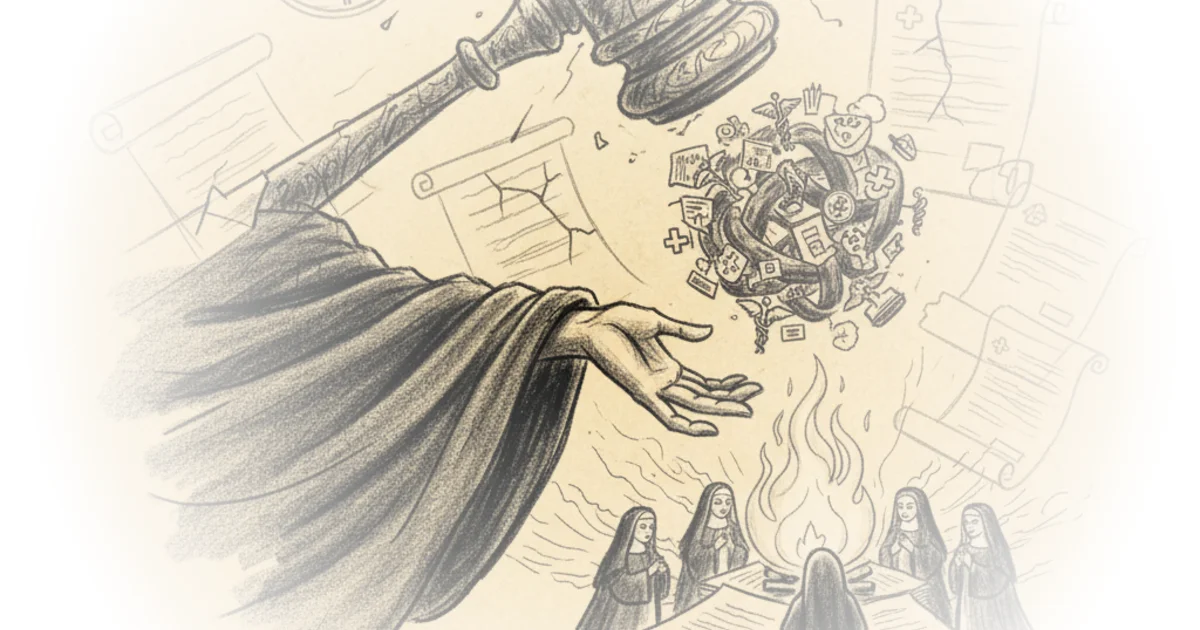
This is effective framing. Most discussions of the shadow docket focus on its weaponization in recent years — nationwide stays of federal policy, emergency rulings on voting rights, pandemic restrictions. But Reason traces the lineage back to a case that doesn't fit the partisan script. The Little Sisters sought only an exemption for themselves, not universal relief. "Outside death penalty cases, it is rare for the Supreme Court to grant emergency one-off relief," the piece notes. That specificity matters.
The order itself was narrow. "Justice Sotomayor's order in no way short-circuited the appellate process. Moreover, Sotomayor did what virtually every court had done at that point." Seventeen of nineteen lower courts had already granted similar relief to religious non-profits. The piece argues this distinguishes the case from later shadow docket entries that bypassed lower courts entirely.
The shadow docket may have been born not in controversy, but in consensus.
Administrative Stays and Institutional Restraint
Here's where the Wikipedia background becomes relevant. What Sotomayor issued was technically an administrative stay — a temporary pause pending further review, not a final ruling on the merits. The Supreme Court has used administrative stays since at least the 1970s, but they've surged in frequency over the past decade. The Court itself cautioned that its order "should not be construed as an expression of the Court's views on the merits."
Reason contrasts this with the Clean Power Plan case two years later, where the Court stayed an Obama administration climate rule before the D.C. Circuit had even ruled. That 5-4 split signaled genuine disagreement about whether emergency relief was warranted. "Such a sharp disagreement is almost certain proof that the basis for legal relief is not clearly established," the piece argues.
The Little Sisters case had no dissents. "The Justices all likely agreed that the District Court in Colorado committed a clear error, and the ex ante status quo had to be preserved." That unanimity — rare in anything touching the Affordable Care Act — suggests the emergency mechanism worked as designed: preserving the status quo when lower courts clearly erred, not rewriting policy from the shadows.
The Human Stakes Behind the Procedure
Procedural history can feel abstract. Reason grounds it in a specific deadline and a specific choice. On December 31, 2013, Mother Provincial Loraine Marie Maguire faced a decision: sign a form her religious order believed made them complicit in providing contraception, or face crushing fines. The Becket Fund — the law firm representing the Little Sisters, which has litigated numerous religious liberty cases before the Supreme Court since its founding in 1994 — filed an emergency appeal with less than twelve hours until the mandate took effect.
"Mother Loraine must make that decision by midnight tonight, unless relief is granted by this Court." The urgency wasn't manufactured. Justice Sotomayor received the petition while riding Amtrak to New York City, where she was scheduled to push the button for the Times Square ball drop. The piece notes she had wireless access on the train. Relief was granted before midnight.
The human detail that lingers: after lower courts denied relief, Mother Loraine joked to her attorney, "Well, really, how many nuns can they put in jail?" That gallows humor captures something the procedural analysis can't — the genuine bewilderment of a religious order that never wanted to litigate, forced into a last-minute appeal to the highest court in the land.
What This Means for the Shadow Docket Debate
Reason's core argument is that not all shadow docket entries are created equal. The Little Sisters order was narrow, unanimous, and consistent with what lower courts had already done. Later cases — particularly the Clean Power Plan stay — were broader, divided, and preemptive. Conflating them obscures more than it reveals.
Critics might note that this distinction, while accurate, doesn't address the structural problem: emergency orders have become a routine way to decide major policy questions without the transparency of full briefing and oral argument. Even if the Little Sisters case was justified, the precedent it set — that the Court can grant emergency relief on compressed timelines — opened the door to more aggressive uses. The Supreme Court of the United States, established in 1789, was designed around deliberation. The shadow docket operates in the margins of that design.
The piece also doesn't fully reckon with how the shadow docket's expansion correlates with increasing court polarization. Unanimous emergency relief in 2013 is easier to defend than 5-4 emergency stays on hot-button issues today. The mechanism hasn't changed. The context has.
Bottom Line
Reason's strongest move is recovering an origin story that complicates the shadow docket's partisan framing. The Sotomayor order to the Little Sisters was procedurally distinct from later emergency rulings — narrower, unanimous, and consistent with lower court consensus. The piece's vulnerability is that it doesn't fully address whether that distinction matters to critics concerned about the shadow docket's growth as an institution. The real question isn't whether this specific order was justified. It's whether the precedent it set has been stretched beyond what its original logic can bear.