The Hated One delivers a chilling thesis that reframes the mundane act of scrolling through social media as an unwitting contribution to the next generation of autonomous warfare. The piece argues that our digital footprints are not merely commodities for advertisers but the primary training data for algorithms that will soon identify and strike targets without human intervention. This is not a speculative fiction piece; it grounds its alarm in the rapid evolution of drone technology in Ukraine and the aggressive intelligence gathering already underway in the Arctic.
The Data Fuel of Autonomous Weapons
The core of the argument rests on the idea that the scale of modern conflict has shifted from raw firepower to information dominance. The Hated One writes, "What will transform the future of warfare will be something that's cheap to make, easy to scale, and has an unlimited capacity to destroy. That's autonomous weapons." This distinction is crucial because it suggests that the barrier to entry for devastating warfare is collapsing, moving away from expensive nuclear arsenals to software trained on public data.
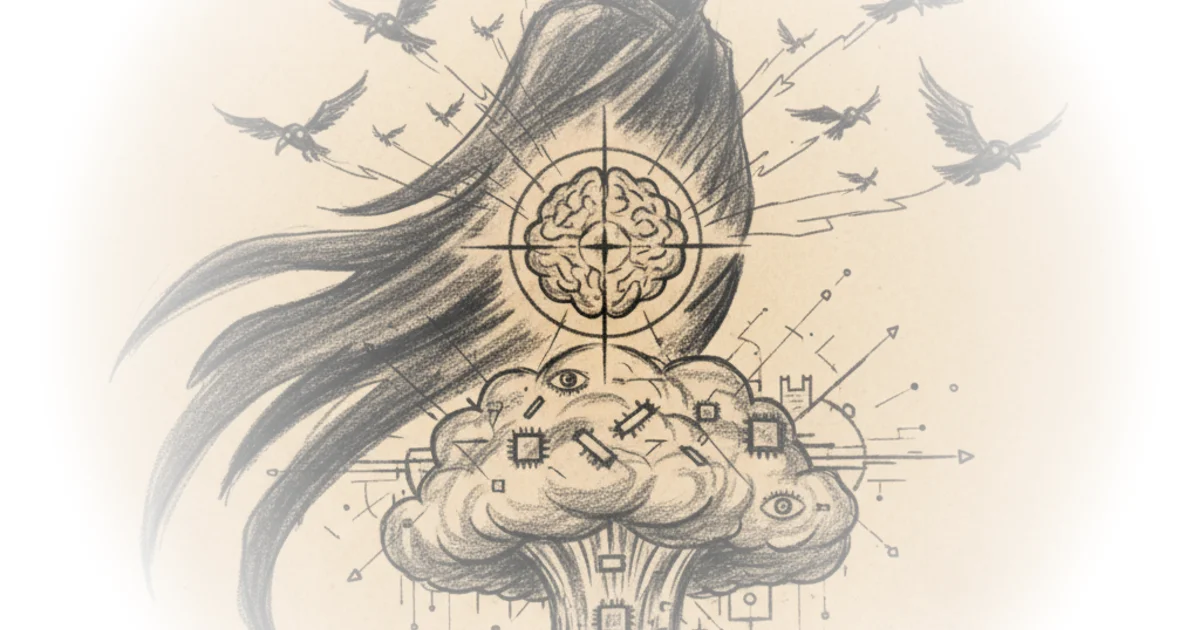
The author posits that the average user is unknowingly participating in this arms race. "All of us unwillingly training algorithms called machine learning with our data and our behavior, helping AI become better at recognizing images, identifying patterns, analyzing human behaviors, finding targets." This framing is effective because it personalizes a geopolitical threat, turning the abstract concept of "big data" into a tangible military asset. However, critics might note that the leap from commercial image recognition to lethal autonomous decision-making involves significant technical and ethical hurdles that the article glosses over, particularly regarding the reliability of AI in chaotic combat environments.
You didn't just give the big tech an ability to monetize your data for ads. You gave them an unlimited right to build weapons of war.
From Greenland to the Front Lines
The commentary then pivots to a specific, tangible example of this surveillance architecture in action: the strategic competition for Greenland. The Hated One notes that "surveillance warfare has already begun" in the Arctic, driven by the melting ice and the opening of new trade routes like the Northwest Passage. This connects to the historical context of the GIUK gap, where NATO once established surveillance dominance over the North Atlantic, but now the focus has shifted to the digital domain.
The author describes how the executive branch has directed intelligence agencies to map the social graphs of Greenlandic and Danish citizens. "The US intelligence seeks to identify people in Greenland and Denmark they could work with, amplify or diminish to tilt the scales in their favor before even sending any boots on the ground." This suggests a new form of hybrid warfare where the battlefield is the population's digital footprint. The piece argues that mass data collection via satellite, intercepts, and ground agents is designed to manipulate public opinion and identify potential targets simultaneously.
This section effectively illustrates the "dual-use" nature of modern technology. The same tools used for commercial social media analysis are repurposed for statecraft. "Manipulation of an ordinary mind is the goal here. And in case that doesn't work, all that personal data and location tracking will serve very well in identifying potential targets should the conflict turn hot." The urgency here is palpable, as the author warns that the line between peacetime surveillance and wartime targeting is dissolving.
The Ukraine Case Study and Corporate Complicity
To prove that this is not theoretical, the article points to the war in Ukraine, specifically the deployment of AI-driven drones that can operate in GPS-denied environments. The Hated One highlights the Shields AI V-Bat drone, which uses onboard AI to navigate and identify targets without external signals. "The drone not only kept flying, it found Russia's surface-to-air missile system and alerted Ukrainians who hit it with a rocket." This real-world example validates the claim that autonomous systems are no longer science fiction but active combatants.
The author then traces the lineage of this technology back to major tech corporations. "The same kind of AI that organizes your Apple photos is an AI that can recognize military targets. Your private data has been the primary fuel for this." The commentary scrutinizes the role of companies like Meta, Google, and Palantir. It notes that while Google claimed to exit military contracts like Project Maven, the technology was never truly abandoned but rather repurposed or allowed to expire and be replaced by new initiatives like Project Nimbus, which supports the Israeli military.
The piece goes further to suggest a deep, structural link between intelligence agencies and the tech industry, citing early grants from the CIA and NSA to the founders of Google. "Google had not yet been incorporated, but the grants allowed Brin and Page to create their two biggest breakthroughs that would later form Google." This historical deep dive adds significant weight to the argument that the current surveillance state was engineered from the ground up, rather than emerging accidentally. While the claim that Google was "created under a careful management of CIA" is a strong assertion that historians might debate regarding the extent of direct control, the evidence of early funding and shared technological goals is well-documented.
Everything that isn't encrypted is collected, stored, and given to the government for surveillance. Everything that is encrypted is also collected in case the government will be able to decrypt it with quantum computing in the future.
Bottom Line
The Hated One's most compelling contribution is the synthesis of commercial data practices with military strategy, revealing that the privacy policies we click through are effectively enlistment papers for the autonomous battlefield. The argument's greatest vulnerability lies in its deterministic view of AI capabilities, potentially underestimating the current limitations of machine learning in complex, unstructured combat scenarios. However, the trajectory is clear: as the executive branch and defense contractors increasingly rely on consumer data to build targeting systems, the distinction between a civilian and a combatant is becoming dangerously blurred.
Bottom Line
This piece succeeds in reframing privacy not as a personal inconvenience but as a critical national security vulnerability. The strongest part of the argument is the concrete linkage between everyday tech usage and the development of autonomous weapons in active theaters like Ukraine. The biggest vulnerability is the assumption that all encrypted data will eventually be decrypted, a technological certainty that remains debated. Readers should watch for the expansion of "dual-use" contracts between big tech and the defense sector, as this is where the theoretical threat becomes operational reality.