Dylan Patel argues that we are witnessing an economic miracle that our statistical tools are blind to: a massive surge in value creation by artificial intelligence that is vanishing from official records before it can even be counted. While headlines fixate on the cost of chips and electricity, this piece reveals a deeper paradox where the very efficiency of AI causes national accounts to register economic decline instead of growth. For leaders trying to navigate the next decade, understanding this "dark" data gap is not just academic—it is essential for distinguishing between a bubble and a genuine revolution.
The Measurement Trap
Patel opens by drawing a sharp parallel to the 1980s, when Robert Solow famously quipped, "You can see the computer age everywhere, but in the productivity statistics." He suggests we are repeating this error on a much larger scale. The core of his argument is that current government accounting methods are fundamentally broken for the AI era because they rely on tracking prices and labor receipts rather than actual output.
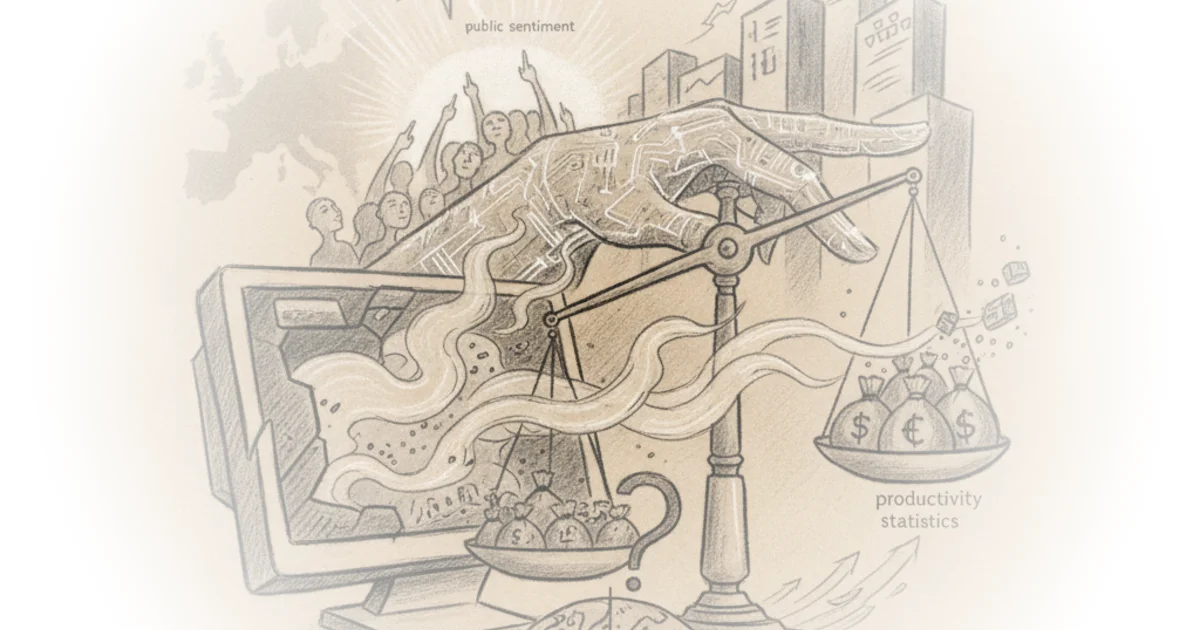
"The magnitude of the measurement problem from AI dwarfs prior measurement issues, we call the work AI does that national accounts can't currently see Dark Output," Patel writes. This framing is crucial because it shifts the narrative from "AI isn't working" to "our rulers are blind." Just as the Boskin Commission later realized in the 1990s that failing to account for new product quality and R&D investment had severely understated growth, we now face a similar distortion where AI-driven deflation looks like economic contraction.
The article highlights a specific danger: when AI makes a service cheaper or faster, GDP often records it as a loss. "Normally when the price of something collapses, we can see this deflation and call the results productivity," Patel explains. "Due to well-known difficulties in the service sector... GDP will record those as declines, and prices may even show inflation." This is a profound insight. In manufacturing, if a machine makes screws cheaper, we count more screws. But in services, where there is no physical unit like a screw, statisticians often just see lower spending and assume less work was done.
Like the dark energy that makes up our universe, Dark Output will likely only be visible in its effects on other elements of the economy and not through direct observation.
Substitution vs. New Value
Patel breaks this invisible value down into two distinct categories: substitution and new output. The first is work previously done by humans that AI now handles for pennies. "Substitution dark output is work that was previously done by humans and is now done by AI," he notes, estimating roughly $1.5 trillion in tasks currently exposed to this shift. When a legal document drafted by a lawyer for thousands of dollars is replaced by an AI draft costing a few tokens, the transaction vanishes from the ledger.
However, the more transformative category is "New dark output." This refers to work that was previously too expensive to do at all. "When literature reviews fall from $2,000 to $2, we do not do the same number and pocket the savings, we do them before every project!" Patel illustrates. We are suddenly running comprehensive background checks on every potential hire or summarizing months of emails instantly. This creates massive real-world value, but because no one was paying for it before, there is no baseline to measure the gain against.
Critics might argue that assuming all these new AI tasks generate genuine economic value is optimistic; much of this "new work" could be low-quality noise or redundant busywork that inflates activity without creating wealth. Patel anticipates this by introducing an "Evidence Ladder," prioritizing market signals like insurance underwriting and court rulings over abstract benchmark tests, which he rightly dismisses as "backward-looking."
The Fingerprint of Displacement
Perhaps the most striking empirical claim in the piece is the mismatch between employment numbers and wage data. As AI displaces junior workers—the lowest-paid tier in many professions—the average wage for that occupation paradoxically rises because only the higher earners remain.
"The cheapest workers disappear from the data," Patel observes, noting that "no one got a raise, and yet wages rose." This statistical artifact serves as a hidden fingerprint of the transition. While employment in AI-exposed sectors falls relative to the broader economy, those same segments show rising average wages. It is a counter-intuitive signal that should alert policymakers to structural shifts even when headline job numbers look stable.
The author also points to the limitations of current metrics, stating, "We lack a functional vocabulary for units of services, and mental work." Without a metric like horsepower to quantify cognitive labor, we are flying blind. The administration or Federal Reserve may see stagnant growth data and tighten policy, only to find that the economy is actually expanding invisibly.
Incoming Fed Chairman Kevin Warsh acknowledged as much in December 2025: "If you're looking at the data, my view is you're backward looking. You're going to be late... So you're going to have to make a bet."
Bottom Line
Patel's strongest contribution is reframing the silence of economic data not as evidence that AI is failing, but as proof that our measurement tools are obsolete. The argument's greatest vulnerability lies in its reliance on the assumption that "new dark output" will eventually manifest in tangible productivity gains rather than just digital busywork. Readers should watch for whether market signals—specifically insurance pricing and corporate adoption rates—continue to climb even if GDP reports remain flat, as this divergence will be the true test of the AI revolution's success.