Noah Smith delivers a necessary reality check to the fever dream of artificial superintelligence, arguing that the much-anticipated economic explosion has been replaced by a quiet, incremental shift. While popular culture expects a sudden "singularity" where machines outpace human cognition by orders of magnitude, Smith presents evidence that intelligence itself may face hard physical and informational limits, forcing us to rethink how we measure progress. This is not a story about robots taking over the world; it is a story about why the world is changing slower than the hype cycle predicted, and where the real value actually lies.
The Myth of the Explosion
Smith opens by dismantling the expectation that AI would first dominate physical labor before conquering abstract thought. The reality has been the opposite. He notes, "Not a lot of people expected that AI would come for the mathematicians before it came for the truck drivers, but it did." The evidence is stark: AI models have recently disproved the Jacobian Conjecture, an 87-year-old open problem in mathematics that had stumped human experts, and solved critical questions in quantum cryptography. Yet, despite these intellectual leaps, the broader economy feels unchanged. Smith observes, "We still live basically the same lives — driving to work or taking the train, sitting in front of a computer, scrolling on our phones, collecting a paycheck."
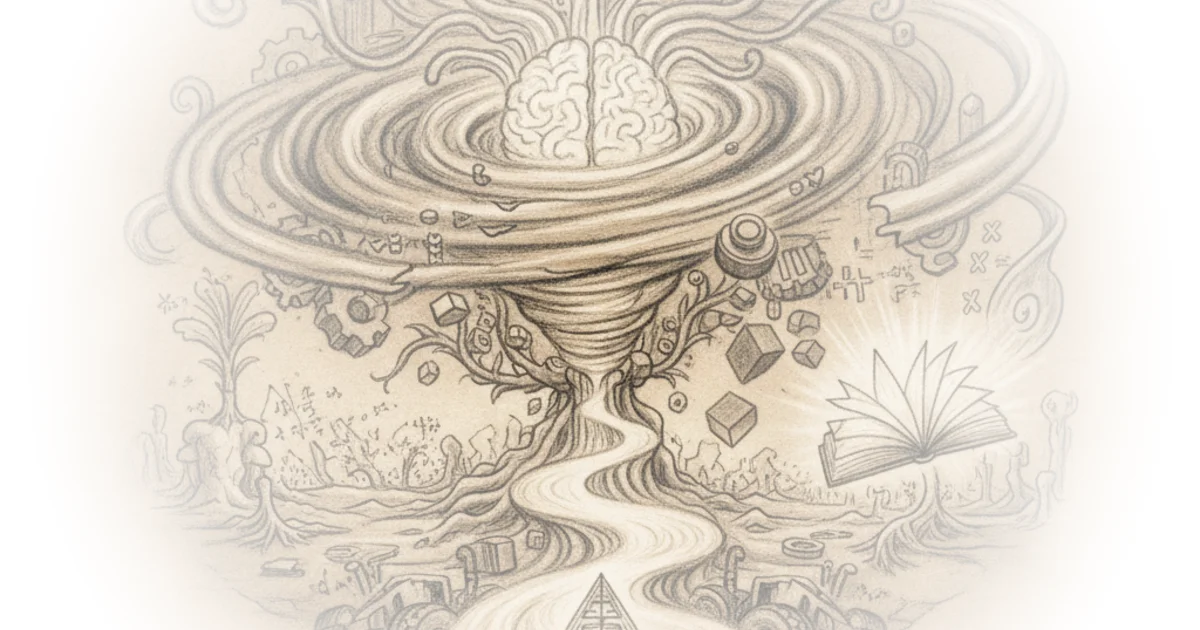
This disconnect between technological capability and economic transformation is the core puzzle Smith addresses. He references the concept of the "technological singularity," a theoretical point where AI bootstraps itself into godlike intelligence, noting that "lots of people, especially 'AI safety' and 'effective altruist' types, expected things to play out basically the same way in reality." Instead, the result has been incremental. As Clifford Sosin writes, "Superintelligence arrived. You probably didn't notice, because it turned out to be kind of incremental." This framing is crucial because it shifts the conversation from fear of immediate obsolescence to a more nuanced analysis of where the bottlenecks actually are. The absence of a sudden takeoff suggests that the limits of AI are not just engineering problems, but fundamental constraints of the universe.
The Physics of Diminishing Returns
The most provocative argument in the piece is the hypothesis that intelligence is subject to diminishing returns. Smith cites AI researcher Francois Chollet, who challenges the idea of intelligence as an unbounded stat. "One of the biggest misconceptions people have about intelligence is seeing it as some kind of unbounded scalar stat, like height," Chollet argues. "Increasing intelligence is not so much like 'making the tower taller', it's more like 'making the ball rounder'."
Smith expands on this, suggesting that humans may have already approached the theoretical maximum for certain cognitive tasks, particularly those involving intuition and judgment. The limitation is not the machine's processing power, but the nature of the data itself. "Even an infinitely advanced model endowed with infinite compute will be limited by the fact that there's a limited amount of information that can be extracted from the data," Smith writes. This connects deeply to the principles of chaos theory, where the tiniest error in measuring the present state of a system explodes into massive uncertainty when predicting the future. As Smith notes, "The limit is contact with reality. A smarter reasoner fills the gaps between known facts in simple areas faster and better, but it doesn't produce new facts."
This is a sobering counter-narrative to the idea that we are on the verge of solving all complex problems. It suggests that while AI will dominate in domains with smooth, verifiable solution spaces like coding or math, it may never significantly outperform humans in the messy, stochastic domains of geopolitics or social forecasting. Critics might argue that this view underestimates the ability of AI to find patterns in data that humans are blind to, but the argument regarding the "irreducible error" in complex systems remains a strong, often overlooked constraint.
Intelligence isn't defined for machines the same way it is for humans — AI's capabilities are spiky in different ways than ours — but it's undeniable that the technology is improving rapidly in every domain of cognitive capability.
The Real Engine: Smart Matter and Distributed Knowledge
If raw intelligence has limits, Smith argues that the true economic revolution lies in replicability and the capture of tacit knowledge. Unlike human capital, which is constrained by biology and fertility rates, machine intelligence is "good old physical capital" that can be manufactured. "Imagine if we suddenly discovered a way to manufacture more land in any city on the planet; this is similar," Smith writes. By building more data centers, we can run more agents in parallel, effectively creating an army of intelligent workers.
This shift is most potent when combined with robotics and the "battery revolution," which allows for the creation of "smart matter." But perhaps the most transformative application is in unlocking "distributed tacit knowledge." Smith uses the example of Zeiss, the German company that makes the world's best glass for chipmaking. Their technology is so complex and reliant on individual worker tricks that it cannot be stolen or easily replicated. "If the technology were capable of being written down on a blueprint, China would have hacked Zeiss and stolen it," Smith notes. But it isn't; the knowledge exists only in the collective experience of the workforce.
AI changes this dynamic by synthesizing vast amounts of observational data to codify these tricks. "In the age of AI, distributed tacit knowledge might not be nearly as big of a barrier to technological diffusion," Smith concludes. This could allow lagging firms to catch up to leaders much faster, spreading productivity gains across the economy rather than concentrating them in a few tech giants. This is a more grounded, practical vision of the future than the sci-fi narrative of a single super-intelligence redesigning the universe.
Bottom Line
Smith's strongest contribution is reframing the AI narrative from a race for infinite intelligence to a practical analysis of economic bottlenecks and physical constraints. While the argument that intelligence faces diminishing returns is bold and may be challenged by future breakthroughs in data synthesis, the focus on "smart matter" and the codification of tacit knowledge offers a tangible roadmap for where real productivity gains will come from. Readers should watch not for a sudden singularity, but for the slow, steady integration of AI into the physical world and the supply chains that power it.