Babbage cuts through the polished veneer of Bill Gates's new memoir to reveal a consistent, decades-long drive for dominance that extends far beyond software licensing. While the book offers a nostalgic look at early computing, the real story here is how a specific childhood advantage and a relentless need for control shaped not just a company, but the modern philanthropic landscape. This isn't just a history of code; it is an autopsy of an ego that learned early on that rules are suggestions for everyone else.
The Architecture of Advantage
The piece begins by dismantling the myth of the self-made tech titan, pointing out that Gates's journey was paved with rare, expensive resources. Babbage writes, "Gates attended the prestigious Lakeside private school in Seattle (ranked best private school in Washington State in 2024)." This wasn't just a school; it was a launchpad equipped with a DEC PDP-8 minicomputer, a luxury that allowed Gates to experiment while his peers were locked out of mainframes. As Babbage notes, "The PDP-8 was designed to be used directly by one person and was small enough to sit on the desk next to you. It was probably the closest thing in its day to the personal computers that would be common a decade or so later." The author argues that this access was the critical differentiator, allowing Gates to write a version of BASIC for the machine when others couldn't even touch it.
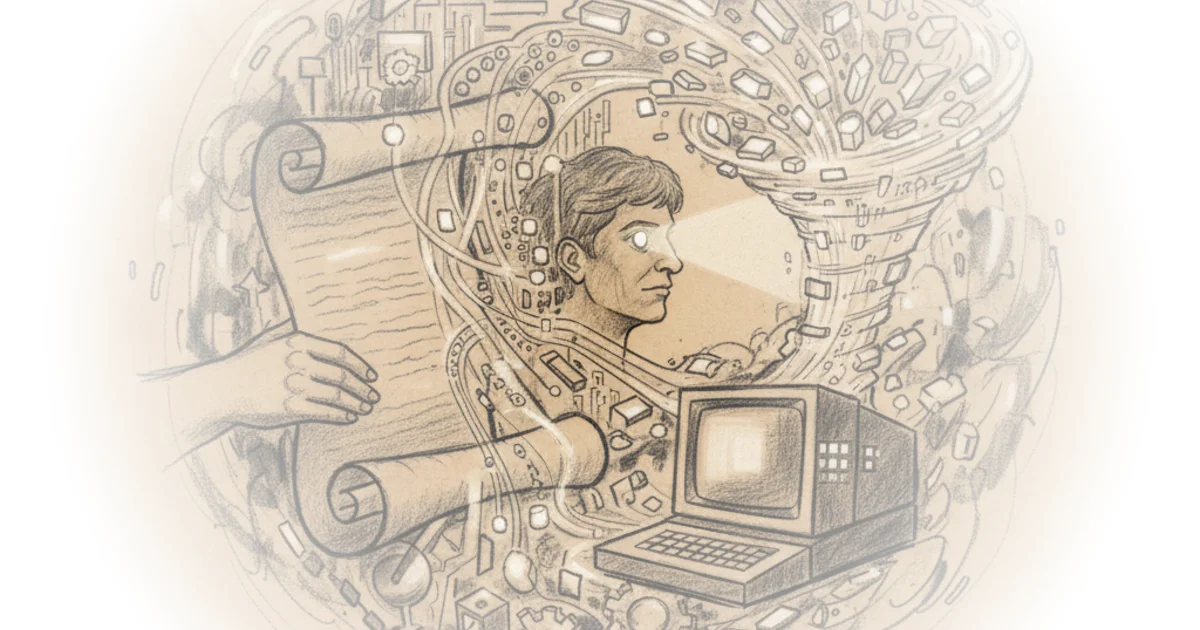
The commentary highlights how this privilege extended to his family, specifically his father's legal acumen. When a dispute arose over unpaid computer time, Gates Sr. didn't argue; he simply said, "I hear you." Babbage observes that "those three words of my father's, and their tone, have stayed with me ever since," capturing a "quiet power" that resolved conflicts by acknowledging them without accepting the counter-arguments. This framing is effective because it shows that the aggressive business tactics Gates later became known for were modeled in the boardroom of his own home. Critics might note that many successful entrepreneurs come from privileged backgrounds, but Babbage's point is that Gates didn't just have the resources; he had a specific, ruthless strategy for leveraging them that was taught to him.
The ISI president seemed to get it too. With little more discussion, he agreed to give us the computer time.
Stretching the Rules
The narrative then shifts to a pattern of behavior that would define Microsoft's early years: pushing boundaries until they broke. Babbage details a significant incident at Harvard where Gates and his friends accumulated thousands of hours of unauthorized computer time, funded by the government research agency DARPA. The author notes that Gates's own records described him as a "wise ass" who "did not understand the ramifications of his activities." This wasn't a moment of youthful rebellion; it was a calculated risk that only worked because his father intervened again to smooth over the fallout.
Babbage argues that this incident was not an anomaly but a precursor to a broader strategy. "The Harvard incident is just one example of a pattern of Gates's early attitude to rules that might have deterred someone else in his place," the author writes. This pattern of stretching rules to the breaking point—whether in negotiations, work schedules, or market control—became the operating system of Microsoft. The commentary suggests that the administration of the company was built on the premise that if a rule could be bent, it should be, provided one had the power to absorb the consequences. This is a crucial distinction: the book frames these actions as justifications for success, but Babbage frames them as the root of a controlling ideology.
The Hunger for Control
Perhaps the most damning section of the commentary focuses on the internal power dynamics between Gates and his co-founder, Paul Allen. Babbage dissects the equity negotiations, noting that Gates initially demanded 60% of the company, arguing that "the monetary, legal, and management decisions involved are very difficult... I feel my contribution towards these tasks entitles me to more than 50 percent." When Allen pushed back, Gates didn't settle; he revised the split to 64-36. Babbage writes, "I feel bad now that I pushed him, but at the time I felt that split accurately reflected the commitment Microsoft needed from each of us." The author points out the irony: Gates claimed fairness, but the math was purely about retaining absolute control.
This desire for control is traced directly to the Gates Foundation's current operations. Babbage references Tim Schwab's book, The Bill Gates Problem, to argue that philanthropy has become another avenue for dominance. "Gates has ruled over these projects with a very clear ideology of how the world should work, devising solutions to social problems through innovation and technology," Babbage writes. The commentary suggests that the same drive to dictate the terms of software licensing now manifests in dictating global health and education policy. While the book attempts to humanize these decisions, Babbage sees a through-line from the 64-36 split to the modern assertion of leadership over "diseases of the poor" and "agricultural standards in sub-Saharan Africa."
Perhaps I was just too aware that this book too - backed by Gates's huge wealth and unrivalled media access - is part of Gates's decades-long programme of control.
Bottom Line
Babbage's review is a necessary corrective to the hagiographic tone of Gates's memoir, successfully reframing the narrative from a story of innovation to one of calculated control. The strongest part of the argument is the linkage between early childhood advantages and the later institutional rigidity of the Gates Foundation. However, the piece may underplay the genuine, albeit paternalistic, desire to solve complex global problems that also drives his work. Readers should watch for how this controlling style plays out in the next two volumes of the memoir, which are expected to cover his later, more controversial years. The verdict is clear: the book is essential reading not for the history of code, but for understanding the psychology of power in the modern age.