Tim Mak delivers a harrowing revelation that reframes a global health crisis not as a random foodborne accident, but as a predictable consequence of modern warfare. While the United States scrambles to contain a parasite outbreak linked to lettuce, Mak exposes how the same pathogen has become a weaponized byproduct of Russia's systematic destruction of Ukraine's energy grid. This is not merely a medical report; it is a chilling indictment of how infrastructure attacks translate directly into pediatric suffering.
The Parallel Outbreaks
Mak opens with a visceral, personal account that anchors the abstract statistics in human reality. "When I looked at the clock, it was 5 a.m. I had spent the last four hours trying unsuccessfully to get my 6-year-old daughter Daria back to sleep after she woke me up from vomiting." This immediate intimacy forces the reader to confront the physical toll of the crisis before any policy analysis begins. The author then draws a sharp comparison to the American experience, noting that while the U.S. outbreak involved nearly 7,000 cases across 34 states, the Ukrainian equivalent is driven by a different, more malicious engine.
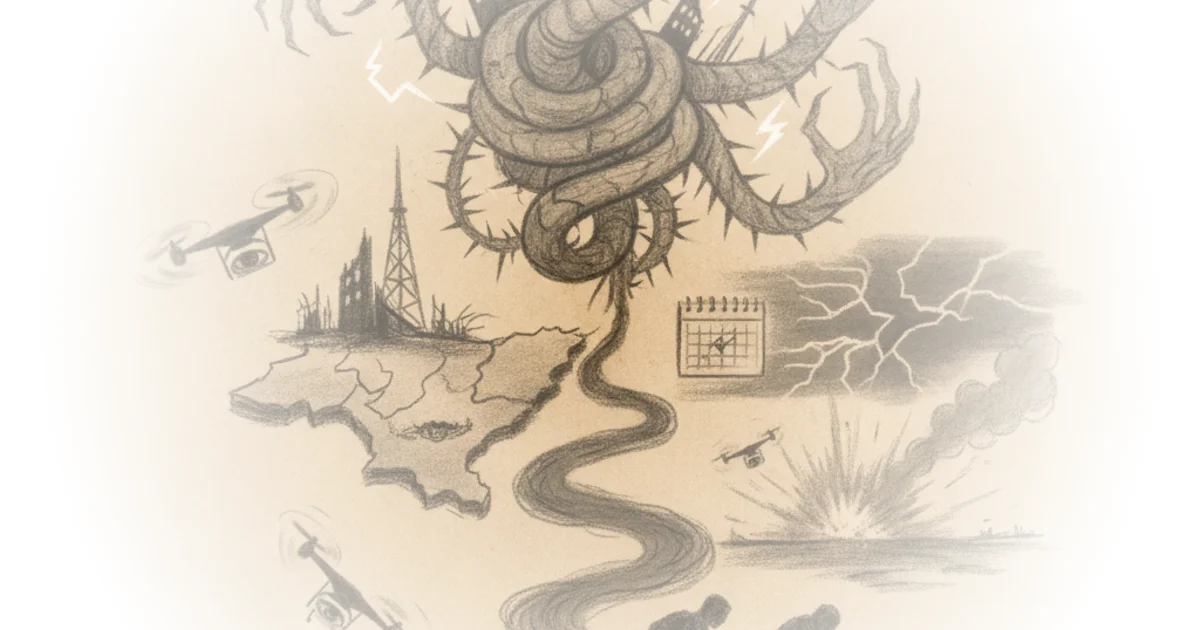
The core of Mak's argument rests on the causal link between power outages and biological contamination. He explains that municipal sewage treatment plants, which rely on electricity to pump oxygen into bacterial systems, simply cease to function when the grid fails. "If the power is cut, the compressors stop. The bacteria that clean the sewage die off and untreated waste may be discharged into the environment." This technical explanation is crucial because it demystifies the spread of disease; it is not bad luck, but a mechanical failure of the sanitation system caused by external aggression. The author notes that in January 2026, intestinal infections accounted for 41.8 percent of all infectious diseases in Ukraine, a statistic explicitly tied by the Ministry of Health to Russian attacks on the power grid.
Critics might argue that drawing a direct line between missile strikes and specific viral outbreaks risks oversimplifying complex epidemiological data. However, Mak supports this by citing the sheer scale of the assault: between 2025 and early 2026 alone, 12,800 missiles and drones targeted the energy sector, knocking out more than half the country's power generation capacity. The evidence suggests that the breakdown of water treatment is an inevitable, not accidental, outcome of such sustained bombardment.
"It's not even sure if I realized that water treatment plants need electricity, or that they don't have backup power sources."
The Human Cost of Infrastructure Collapse
Mak shifts from the systemic to the deeply personal, describing the scene inside a pediatric gastroenterology unit where the walls are too thin to mask the suffering of other children. "The hardest part about children's hospitals is hearing the other children cry. The unit where I was staying had very thin walls and wooden doors leading to the patient and treatment rooms." This description serves as a powerful counter-narrative to the sterile language often used in military reporting. The author details the physical trauma of his daughter, Daria, whose IV needle shifted due to her weakness, causing her arm to swell so severely a nurse had to cut open her sweater to replace it.
The article juxtaposes the American response—where Taco Bell voluntarily removed ingredients and the CDC issued clinical guidance for pediatricians—with the Ukrainian reality where such preventative measures are impossible. In the U.S., the outbreak was traced to shredded iceberg lettuce, and the supply chain was cut off. In Ukraine, the source is the environment itself. Mak writes, "For Ukraine, however, such outbreaks are nothing new. They occur periodically, though the causes are far less peaceful and obvious." This distinction highlights a grim asymmetry: in one nation, the solution is a recall; in the other, the solution requires surviving the winter.
The author also touches on the psychological toll, noting that his daughter has begun to understand the pattern of air raid sirens and power outages. "Last winter, she began to understand for the first time what an air raid siren really was, and to perceive it as more than just a roaring alarm that occurs from time to time." This observation underscores that the war's damage extends beyond physical injuries to the developmental trauma of a generation growing up in a state of perpetual crisis.
The Unseen Consequences of War
The piece concludes by reflecting on the unpredictability of illness in a war zone. Mak admits, "I don't know how to protect my child or myself from the hardships that are all too common during wartime." This admission of vulnerability is a stark reminder that even the most vigilant parents cannot shield their children from the systemic collapse caused by the destruction of essential services. The author's final anecdote about his daughter asking if the cat needs to wash its paws before eating serves as a poignant, heartbreaking symbol of a child trying to impose order on a chaotic world.
While the article focuses heavily on the immediate health crisis, it implicitly raises questions about the long-term recovery of Ukraine's water infrastructure. A counterargument worth considering is whether the current focus on immediate survival obscures the need for long-term, resilient infrastructure investment that can withstand future attacks. Mak's narrative suggests that without a secure energy grid, public health in Ukraine will remain perpetually fragile.
Bottom Line
Tim Mak's reporting succeeds by connecting the dots between a specific biological pathogen and the strategic targeting of civilian infrastructure, proving that in modern warfare, water treatment plants are as much a battlefield as front-line trenches. The piece's greatest strength is its refusal to let the reader look away from the pediatric suffering caused by these policy decisions, while its vulnerability lies in the lack of concrete solutions for a system that has been systematically dismantled. Readers should watch for how international aid efforts address not just medical supplies, but the restoration of the electrical grid that keeps the water clean.