Kings and Generals delivers a stark, granular account of how a crumbling empire was dragged into a global conflagration not by grand strategy, but by financial desperation and a fatal miscalculation of German intentions. While many histories focus on the battlefield tactics of Sarakamish, this piece argues that the true catastrophe was baked in months prior, when the Ottoman Treasury was "near empty" and the state possessed only "one cannon foundry" capable of producing modern war material. The narrative forces a re-evaluation of the Great War's entry in the East, framing it less as a calculated geopolitical pivot and more as a desperate gamble by a leadership that believed they could leverage a foreign alliance to survive their own internal decay.
The Anatomy of Desperation
The authors establish the pre-war context with brutal efficiency, stripping away any romanticism about the "Sublime Porte." Kings and Generals writes, "By 1914, the empire's resources were drained. Its economy was in shambles, and its subjects were demoralized, earning it the moniker of sick man of Europe." This framing is crucial because it explains why the Ottoman leadership, specifically the Young Turk triumvirate, felt they had no choice but to align with Germany. The alternative was not peace, but dismemberment by the great powers who were already circling.
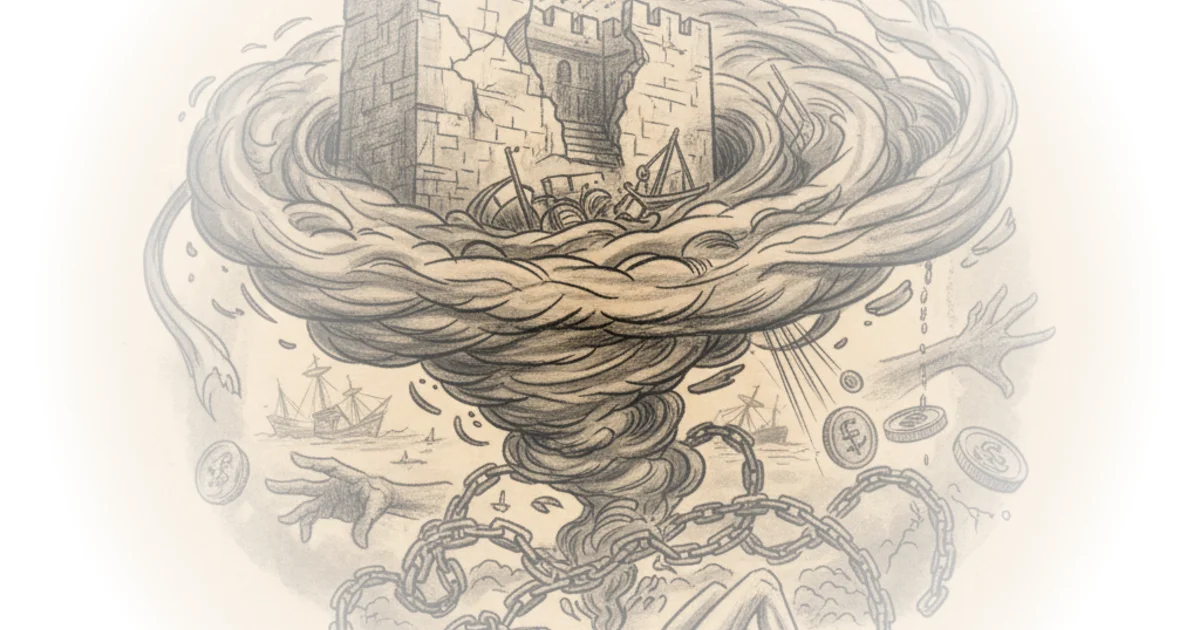
The piece details the diplomatic isolation that forced the hand of the Ottoman government. After Britain requisitioned two Ottoman-purchased dreadnoughts—a move the authors describe as a "national humiliation"—the path to an Anglo-French alliance was closed. As Kings and Generals puts it, "The Ottomans initially sought a British French alliance. But on August 1st, Britain requisitioned two Ottoman purchased dreadnots... poisoning the prospects of an Anglo alliance." This specific incident is often glossed over in broader histories, yet here it is presented as the tipping point that made the German alliance inevitable. The authors effectively argue that the Ottoman entry was a reaction to betrayal by the Entente, rather than an ideological embrace of the Central Powers.
"Money to buy arms was unavailable... The assassination of Archduke Franz Ferdinand drew Europe into two hostile blocks, dooming the Ottoman Empire."
The commentary on the German-Ottoman relationship reveals a transactional dynamic rather than a genuine partnership. Germany, seeking to disrupt British communications and mobilize Muslim sentiment, saw the Ottomans as a useful tool. Kings and Generals notes that "Germany, initially reluctant, soon believed the Ottomans could open a new front against Russia... They also hoped to disrupt British communications by threatening Egypt and the Suez Canal." This reframing shifts the blame from Ottoman aggression to German manipulation. The "jihad bureau" established by Max von Oppenheim in Berlin was not a spontaneous religious uprising but a calculated geopolitical weapon. Critics might argue that the Young Turks had their own imperial ambitions in the Caucasus and Persia that made them willing partners, but the evidence presented here suggests their agency was severely constrained by their lack of resources.
The Naval Gambit and the Spark
The narrative pivots to the specific actions that turned a diplomatic crisis into a shooting war. The transfer of the German ships SMS Goeben and Breslau to the Ottoman Navy is presented as a clever ruse to bypass British naval dominance. Kings and Generals explains, "To get around the difficulty, Germany agreed to gift the ships to the Ottoman Navy." This maneuver allowed the Ottoman fleet to strike Russian ports in the Black Sea, an action that effectively declared war before the official diplomatic notices were even sent.
The description of the raid on Odessa and Sevastopol is visceral. The authors detail how the Ottoman fleet "torpedoed [ships], sinking it as they shelled merchant vessels, shore installations, oil tanks, and a sugar refinery." This was not a defensive posture; it was an offensive strike that guaranteed a Russian response. The authors are clear on the consequence: "This prompted Russia to declare war on November 2nd, followed by Britain and France on the 5th, and then the Ottomans reciprocated against all three on the 11th." The timing is critical here. The Ottoman government, led by Enver Pasha, had hoped to stay neutral until the Central Powers wore down the Entente, but German impatience forced their hand. As Kings and Generals writes, "By mid-September, German patience wore thin. Military aid was delayed until the Ottomans opened a new front against Russia."
The Caucasus Catastrophe
The most harrowing section of the coverage details the Battle of Sarakamish, where Enver Pasha's ambitious plan for a three-corps envelopment collapsed under the weight of winter and logistical failure. The authors highlight the tragic disconnect between the leadership's vision and the reality on the ground. Enver Pasha, refusing to listen to General Hassan Izzet Pasha's warnings about the lack of winter gear, took personal command. Kings and Generals writes, "Hassan Izzet Pasha refused to start a winter campaign without proper winter material and resigned, forcing Enver Pasha to take personal command on December 19th."
The result was a massacre driven not by enemy fire, but by the elements. The text describes the 10th Corps advancing "through snowdrifts towards Sarakamish, lacking tents, winter clothing or firewood." The human cost was staggering. "Thousands died of exposure," the authors note, and for the 10th Corps, "A third of the corps died of exposure, dropping to about 3,200 men." This section serves as a grim reminder of the human cost of political miscalculation. The Russian forces, equipped for a winter campaign with an "organized medical system," held the high ground while the Ottoman troops, who "avoided hospitals believing they had better odds in the field," froze to death in the mountains.
"Thousands died of exposure... The 9th and 10th corps would attack the Russian right flank and rear near Sarakamish, storming Ulukisla, cross the Allahuekber mountains and catch the railway."
The authors do not shy away from the incompetence of the command structure. The plan relied on the 9th and 10th Corps linking up deep behind enemy lines, a maneuver that required speed and endurance the Ottoman soldiers simply did not possess. The failure was total: "The 29th was stalled by terrain and Russian resistance... The 33rd division [was] defeated." By the time the Ottomans realized the encirclement had failed, the blizzard had already done its work. The authors estimate Ottoman casualties at "1,983 dead, 6,170 wounded, 3,070 imprisoned, and 2,800 desertions," a figure that likely undercounts the dead from exposure.
The Mesopotamian and Red Sea Fronts
While the Caucasus front was a disaster of ambition, the Mesopotamian and Red Sea fronts were characterized by a different kind of failure: the inability to defend a vast, fragmented empire against a determined colonial power. The British expedition to secure Basra is described with a focus on the strategic value of the Anglo-Persian oil company. Kings and Generals notes that Britain "eyed Mesopotamia as a postwar prize, even before negotiating with Russia and France." The landing at Basra was swift and decisive. "On the 17th, the British attacked again at Shaiba, routing Turkish trenches and the fort. The British suffered 500 casualties. The Ottomans 1,500."
The rapid collapse of Ottoman defenses in the south contrasts sharply with the stubborn, albeit doomed, resistance in the north. The authors point out that the Ottomans were forced to abandon Basra on November 21st, "triggering looting by the locals." This detail underscores the fragility of Ottoman control in the region; once the military presence was broken, the social order disintegrated. Similarly, in the Red Sea, the British seizure of Sheikh Sa'ad was a minor tactical victory with major strategic implications, securing the route to the Suez Canal. "Casualties were five British Indian deaths and 11 wounded," the authors write, highlighting the ease with which the British Indian forces could project power against the overstretched Ottoman garrisons.
"The Ottomans lacked the productive capability or financial means to defend themselves."
This sentence encapsulates the entire tragedy. The Ottoman Empire was not defeated solely by superior enemy tactics; it was defeated by its own inability to modernize, fund, and supply its armies. The British and Russian forces were able to leverage their industrial bases and logistical networks to overwhelm an opponent that was fighting with one hand tied behind its back.
Bottom Line
Kings and Generals succeeds in reframing the Ottoman entry into the Great War not as a bold strategic move, but as a desperate, fatal error born of economic collapse and diplomatic isolation. The strongest part of this argument is the detailed breakdown of the naval transfer and the subsequent Black Sea raid, which clearly demonstrates how a specific, avoidable decision triggered a chain reaction that the Ottoman leadership could not control. The piece's biggest vulnerability is its heavy reliance on the narrative of German manipulation, which, while supported by the evidence, occasionally downplays the agency of the Young Turk leadership in pursuing their own expansionist dreams in the Caucasus. Readers should watch for how this narrative of structural weakness influences future analyses of the empire's collapse, particularly regarding the role of internal dissent and the Armenian question, which the authors mention only in passing as a factor in Russian policy. The ultimate lesson here is that a state without the economic foundation to support its military ambitions is doomed, regardless of the bravery of its soldiers.