The Quiet Revolution of Mental Illness Fiction
Naomi Kanakia's review signals something unexpected in contemporary literature: the most daring avant-garde move isn't experimental prose or fractured narrative, but a return to the straightforward problem novel. Freddie DeBoer's debut fiction, The Mind Reels, traces a young woman's cyclical descent into mental illness and medication with restraint that feels almost radical in today's literary landscape.
What the Novel Does
Kanakia writes, "Like Vincenzo Latronico's Perfection, this is not a book about a person, it's a book about a type." Alice, the protagonist, is deliberately constructed as ordinary-yet-slightly-above-average in every dimension. Her childhood was happy but not exceptional. She stood outside high school hierarchies, rewarded for kindness rather than status. This careful positioning makes her an everywoman, not an exceptional case.
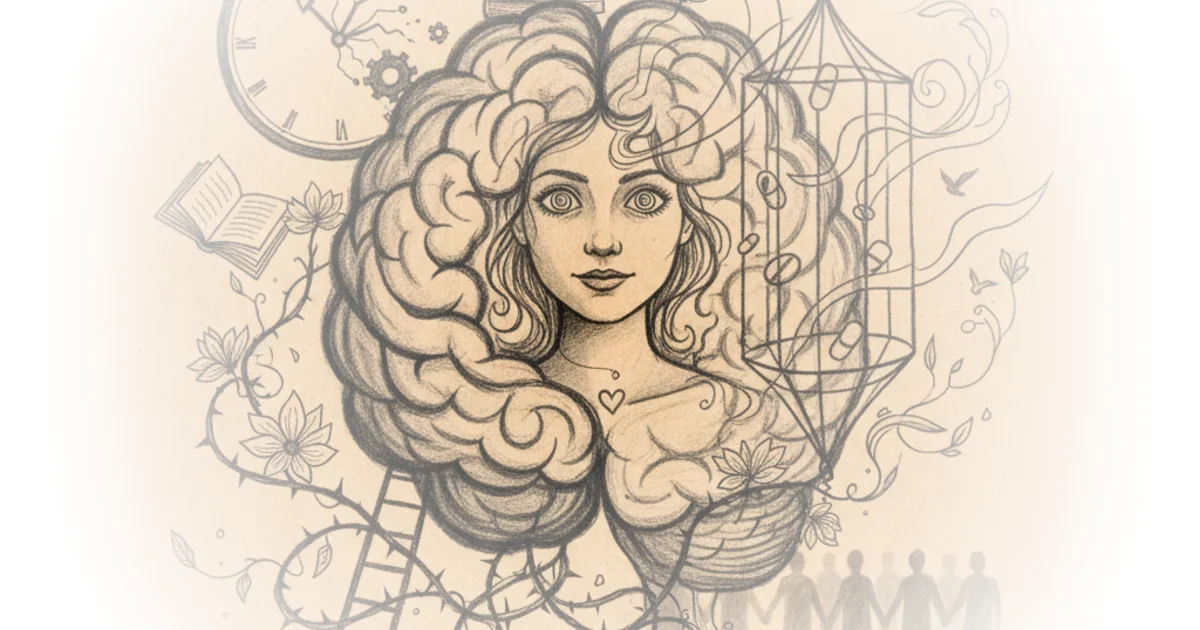
The prose mirrors this restraint. As Kanakia puts it, "No particular sentence calls attention to itself. The aim isn't to impress you, the aim is to tell a story." Readers move through the narrative driven by one question: "Is she going to be okay?"
"The illness is all negative, no positive. She is not more sensitive because she was once psychotic. She does not learn any lessons, does not gain any special grace. She is unambiguously worse off than she would be if she wasn't sick."
This refusal to romanticize madness distinguishes DeBoer's work from earlier bipolar fiction like Elaine Kraf's The Princess of 72nd Street, which Kanakia notes "glamorized insanity, and that's part of why I liked it. There's a beauty that hangs over insanity: a beauty that comes from floating down 72nd street, feeling like everything on this block belongs to you."
The Mind Reels offers little of that floating beauty. Instead, Alice destroys friendships, ruins grades, and must rebuild her life after each episode. Each recovery leaves her worse off—less stability, fewer friends, less money.
The New Problem Novel
Kanakia identifies an emerging pattern she calls "the new problem novel," though she admits the genre currently contains just two books: DeBoer's The Mind Reels and Peter Shull's Why Teach?. These differ from twentieth-century problem novels in their humility and psychological focus.
"Where the 20th-century problem novel was concerned with social relations, the 21st-century problem novel pays more attention to psychology," Kanakia observes. Alice's situation cannot be fixed by altering social structures. The world cannot change in ways that would meaningfully improve her life. The novel dramatizes internal conflict, not social action.
This represents a genuine departure from mainstream literary fiction. Kanakia notes that big-press novels about marginalized people typically feature characters who are "messy, alcoholic, lazy, or otherwise imperfect." Alice, by contrast, is good and purely a victim of misfortune. Her mental disorder is her only real problem.
The Publishing Machine
The review cannot ignore the controversy DeBoer ignited about book coverage inequality. He argued that certain titles receive disproportionate attention from mysterious backers. Kanakia writes, "I am in sympathy with what Freddie is saying, but I don't necessarily have any contribution to make to the discourse."
She acknowledges her own review is downstream of being a fan of DeBoer's blog and preordering to support him. Yet she maintains editorial independence: "I think with a newsletter there's an implicit promise of authenticity. I'm not being paid for my reviews; I only review books that I actually wanted to read, and I only praise a book that I actually enjoyed."
Critics might note that Kanakia's genre classification rests on just two books, making "the new problem novel" more observation than established category. The claim that problem novels are systematically overlooked by mainstream presses also conflicts with her own evidence: The Mind Reels received coverage from The Chicago Tribune, Wall Street Journal, and The New Yorker.
Another tension: if Alice is purely a victim with no agency in her misfortunes, the novel risks reducing mental illness to simple tragedy without exploring how patients navigate institutional healthcare systems that Kanakia describes as "darkly amusing." The ER doctor who concludes psychosis from Adderall abuse, the therapist who blames childhood, the counselor who refuses to remember a patient's chosen name—these interactions suggest systemic failure, not just individual misfortune.
Bottom Line
DeBoer's restrained approach to mental illness fiction offers something genuinely rare: a story that refuses to glamorize madness or extract wisdom from suffering. Kanakia's review identifies an emerging literary pattern worth watching, even if the "new problem novel" remains provisional. For readers exhausted by autofiction and braided narratives, this quiet revival of the problem novel may indeed be the most exciting avant-garde trend.