Dave Borlace delivers a jarring correction to the financial world's favorite excuse: that short-term profit maximization is a legal requirement. He argues that the very concept of fiduciary duty is being weaponized by corporate leaders to ignore the existential threat of climate change, when in fact, the law demands they protect assets against precisely these long-term risks.
The Legal Reckoning
Borlace dismantles the idea that Wall Street's obsession with quarterly earnings is a neutral business strategy. He writes, "In recent years, the mantra of fiduciary duty... has increasingly manifested itself as a short-term scramble to publish quarterly earnings reports that demonstrate revenue and profit growth curves with no real eye towards future implications or consequences." This framing is crucial because it shifts the narrative from moral failure to legal negligence. The author points to a new guidance paper from the NetZero Lawyers Alliance, which asserts that true due diligence now requires protecting companies from climate-related asset collapse.
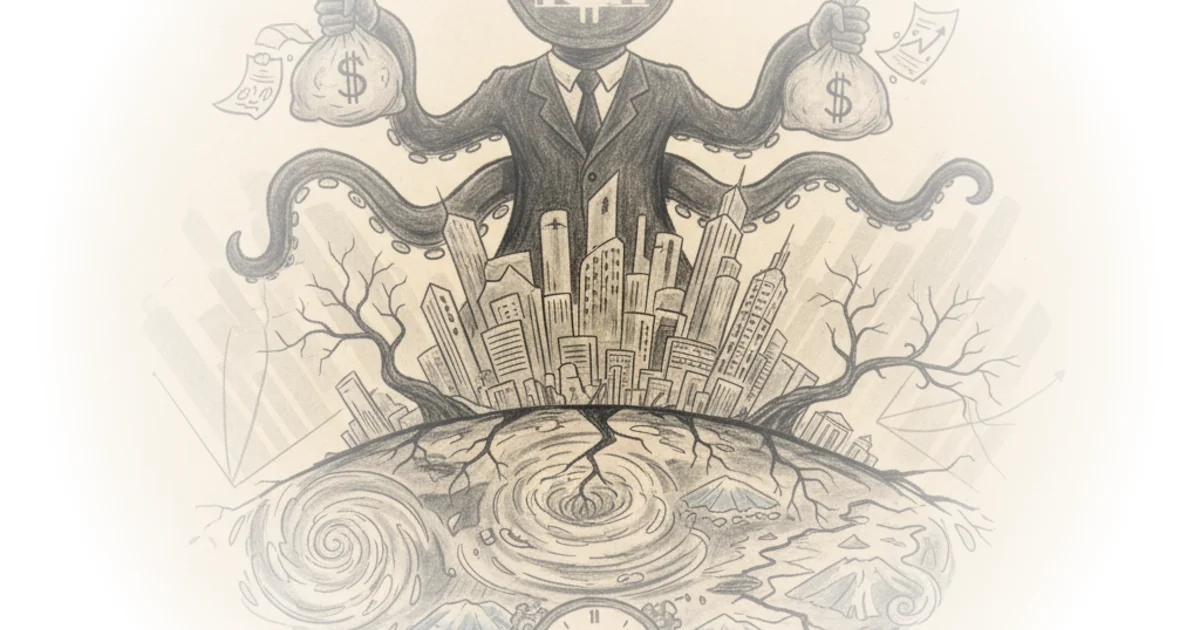
The argument gains weight when Borlace details the specific physical risks that are no longer theoretical. He notes that the Atlantic meridional overturning circulation, a critical ocean current system, is "closer to collapse than previously thought," with a potential tipping point arriving as early as 2037. He quotes Professor Stefan Rahmstorf, who warns that while a single study offers limited evidence, "when multiple approaches have led to similar conclusions, this must be taken very seriously, especially when we're talking about a risk that we really want to rule out with 99.9% certainty." This scientific consensus transforms climate change from an environmental concern into a material financial liability that boards can no longer afford to ignore.
If the subpolar gy goes as well, then we can expect much colder and stormier conditions in Northern Europe with even shorter growing seasons, more extreme heat waves in southern Europe, a sharp rise in sea levels on the US East Coast, and more chaotic weather patterns across the North Atlantic.
Critics might argue that predicting specific decades for ocean collapse introduces too much uncertainty for long-term financial planning. However, Borlace effectively counters this by highlighting that the cost of inaction—measured in lost GDP and stranded assets—far outweighs the risk of over-preparing.
The Prisoner's Dilemma of Capital
The most compelling part of Borlace's analysis is his diagnosis of why the market remains stuck. He describes the current investment landscape as a "prisoner's dilemma," where fund managers are trapped by a fear of being the first to act. He explains, "Each of them worries that if they switch to cleaner, greener projects, the other one will stick with polluting ones that might ostensibly provide better short-term returns for their clients."
This dynamic creates a systemic paralysis where everyone knows the endgame is disaster, yet no one moves first. Borlace illustrates the stakes with stark data from Norway's sovereign wealth fund, comparing historical crises to future climate projections. He notes that while the 2008 financial crash and the 2020 pandemic caused GDP contractions of 5% and 11% respectively, climate inaction could lead to a "27% reduction in global GDP by 2100 according to Nor Bank Investment Management and perhaps as much as 50% according to projections from the IFOA." The sheer scale of this potential loss makes the current hesitation not just shortsighted, but irrational.
A Blueprint for Survival
Borlace transitions from problem to solution by outlining five core principles that the law already supports, arguing that "the law doesn't have to evolve because the principles are already in place." He emphasizes that fiduciaries must "act in the best interest of their beneficiaries to avoid the worst climate damages that those beneficiaries would otherwise suffer." The first principle, "first do no harm," explicitly bans new investments in unabated high-emission projects, which Borlace argues create unavoidable costs that eventually "come back into the portfolio as insurance premiums, taxes, inflated input prices, and the physical cost associated with disasters."
He further supports this with performance data, noting that fossil fuel investments have "barely above break even compared to a three-fold increase for the overall market" over the last decade. This evidence suggests that the transition to green infrastructure is not just an ethical choice but a superior financial strategy. Borlace writes, "There are massive investment opportunities in renewable infrastructure, clean energy, and innovation, much of which is far more futureproof than the crumbling fossil fuel industry."
Unless fiduciaries internalize the collective dimension of climate risk and factor them properly into their financial risk assessments and due diligence, they will face widescale dysfunction and failure of portfolios and financial systems.
A counterargument worth considering is that the transition costs Borlace mentions—such as the 2% GDP hit for new infrastructure—could still be politically unpalatable for developing nations. Yet, the author's point about the 8% GDP growth resulting from these investments offers a powerful economic rebuttal to the idea that decarbonization is a burden.
Bottom Line
Borlace's strongest contribution is reframing climate inaction not as a moral failing of executives, but as a breach of their legal fiduciary duty. His argument is vulnerable only to the inertia of the very financial systems he critiques, which may resist this legal reinterpretation until it is too late. The most critical takeaway for any investor or board member is that the window to avoid liability for "dereliction of duty" is closing faster than the window to avoid physical climate damage.