This piece dares to link the most hyped figure in modern technology with one of history's most controversial explorers, not to equate their moral legacies, but to expose a shared psychology of delusion and dominance. Alberto Romero argues that Sam Altman, like Christopher Columbus, is a frontiersman whose success relies less on technical certainty and more on an almost religious conviction that bends reality to his will. For busy leaders navigating the AI boom, this framing offers a crucial warning: the narrative driving the industry may be less about inevitable progress and more about a charismatic leader's refusal to admit he might be lost.
The Architecture of Delusion
Romero builds his case on the sheer audacity of Altman's vision, drawing a direct line from the skepticism Columbus faced to the doubts surrounding early artificial intelligence. He notes that just as the courts of Europe mocked the Genoese explorer, the tech establishment initially scoffed at the idea of neural networks becoming a consumer product. Romero writes, "The courts of Portugal, Spain, Venice, and Genoa ridiculed his plan and mocked the sailor as a crackpot." This historical parallel effectively reframes the current skepticism about Artificial General Intelligence (AGI) not as a lack of imagination, but as a rational response to a leader who insists the impossible is imminent.
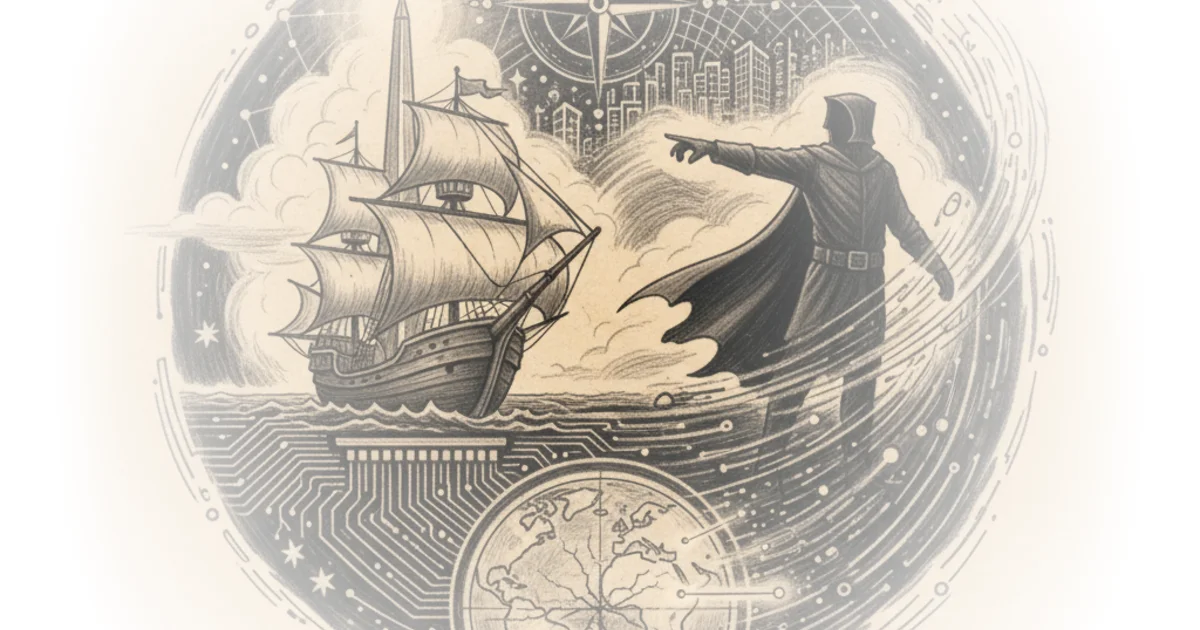
The author suggests that Altman's greatest asset is not his code, but his ability to convince others to fund a dream that defies current economic logic. Romero points out that while Columbus secured the Spanish Crown, Altman has extracted billions from titans like Elon Musk and Microsoft. He quotes Altman directly to illustrate this mindset: "The most successful people I know believe in themselves almost to the point of delusion." This is a sharp observation of the Silicon Valley ethos, where the line between visionary and fraud is often defined by who succeeds in raising the next round of funding. Critics might argue that this comparison ignores the tangible, immediate utility of current AI tools, which Columbus's voyages lacked until they actually returned with gold. However, Romero's point stands that the promise of the future is currently driving the valuation, not the present reality.
"A big secret is that you can bend the world to your will a surprising percentage of the time."
The Messiah Complex and the Cost of Certainty
The commentary deepens as Romero explores the quasi-religious underpinnings of both men's motivations. He argues that neither was driven primarily by wealth, but by a desperate need for status and a belief in a divine or cosmic destiny. Romero writes, "Columbus was always driven by an overwhelming obsession with social status... Altman, meanwhile, has even less need for money." Instead, Altman is portrayed as a modern messiah figure, guided by a "millenarian outlook" where the singularity is either the apocalypse or the rapture. Romero notes that Peter Thiel, a key investor, has explicitly told the Wall Street Journal, "We should treat him as more of a messiah figure."
This framing is particularly potent because it highlights the danger of a leader who cannot admit error. Romero draws a chilling parallel between Columbus's refusal to acknowledge he had found a new continent and Altman's potential inability to recognize if AI progress is merely a normal technological iteration rather than a singularity. He asks, "If, as some have suggested, AI progress is indeed slowing down... will Altman be able to admit he was wrong about an imminent superintelligence?" This question cuts to the heart of the current investment bubble. If the leader is blind to the truth, the entire organization—and the billions backing it—remains on a collision course with reality.
The Human Cost of "By Any Means"
Romero does not shy away from the darker implications of this "by any means" doctrine. While he is careful to state there is "absolutely no moral equivalence" between Columbus's enslavement of indigenous people and Altman's business practices, he draws a parallel in their willingness to bend ethical boundaries for progress. He cites accusations from OpenAI co-founder Ilya Sutskever, who claimed Altman exhibited a "consistent pattern of lying, undermining his execs, and pitting his execs against one another." This behavior mirrors the mutinies Columbus faced, where the leader's deception about the distance traveled nearly cost him his life and crew.
The author suggests that the instability within OpenAI—from the walkout of engineers to form Anthropic to the temporary ousting of Altman by the board—is a direct result of this high-risk, high-control leadership style. Romero writes, "Columbus too had a propensity to lie... He only just staved off rebellion on that first crossing, but he wouldn't be so fortunate on his third." The implication for the AI industry is stark: a culture built on a leader's unshakeable, perhaps delusional, self-belief is inherently fragile. When the data doesn't match the prophecy, the internal fractures become impossible to ignore.
"Columbus couldn't see that he had found a New World; will Altman be able to see we haven't left the old one?"
Bottom Line
Romero's comparison is a powerful lens for understanding the current AI frenzy, shifting the focus from technical specs to the psychology of the man steering the ship. The argument's greatest strength is its ability to humanize the abstract risk of the singularity by grounding it in a historical failure of perception. However, the analogy risks overstating the moral equivalence of their actions, potentially distracting from the very real, non-physical harms of AI deployment. The reader should watch not just for the technology's capabilities, but for the moment Altman is forced to choose between his delusion and the truth.